

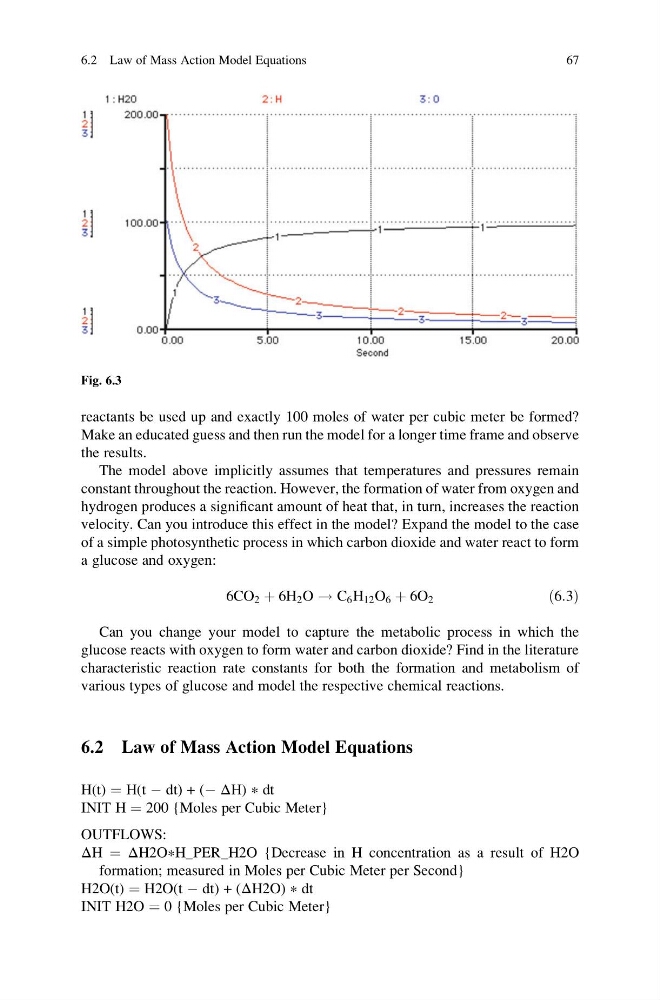
reactants be used up and exactly 100 moles of water per cubic meter be formed?
Make an educated guess and then run the model for a longer time frame and observe
the results.
The model above implicitly assumes that temperatures and pressures remain
constant throughout the reaction. However, the formation of water from oxygen and
hydrogen produces a significant amount of heat that, in turn, increases the reaction
velocity. Can you introduce this effect in the model? Expand the model to the case
of a simple photosynthetic process in which carbon dioxide and water react to form
a glucose and oxygen:
6CO 2 þ 6H 2 O ! C 6 H 12 O 6 þ 6O 2
ð6:3Þ
Can you change your model to capture the metabolic process in which the
glucose reacts with oxygen to form water and carbon dioxide? Find in the literature
characteristic reaction rate constants for both the formation and metabolism of
various types of glucose and model the respective chemical reactions.
6.2 Law of Mass Action Model Equations
H(t) ¼ H(t À dt) + (À ΔH) * dt
INIT H ¼ 200 {Moles per Cubic Meter}
OUTFLOWS:
ΔH ¼ ΔH2O * H_PER_H2O {Decrease in H concentration as a result of H2O
formation; measured in Moles per Cubic Meter per Second}
H2O(t) ¼ H2O(t À dt) + (ΔH2O) * dt
INIT H2O ¼ 0 {Moles per Cubic Meter}
Fig. 6.3
6.2 Law of Mass Action Model Equations
67
Make an educated guess and then run the model for a longer time frame and observe
the results.
The model above implicitly assumes that temperatures and pressures remain
constant throughout the reaction. However, the formation of water from oxygen and
hydrogen produces a significant amount of heat that, in turn, increases the reaction
velocity. Can you introduce this effect in the model? Expand the model to the case
of a simple photosynthetic process in which carbon dioxide and water react to form
a glucose and oxygen:
6CO 2 þ 6H 2 O ! C 6 H 12 O 6 þ 6O 2
ð6:3Þ
Can you change your model to capture the metabolic process in which the
glucose reacts with oxygen to form water and carbon dioxide? Find in the literature
characteristic reaction rate constants for both the formation and metabolism of
various types of glucose and model the respective chemical reactions.
6.2 Law of Mass Action Model Equations
H(t) ¼ H(t À dt) + (À ΔH) * dt
INIT H ¼ 200 {Moles per Cubic Meter}
OUTFLOWS:
ΔH ¼ ΔH2O * H_PER_H2O {Decrease in H concentration as a result of H2O
formation; measured in Moles per Cubic Meter per Second}
H2O(t) ¼ H2O(t À dt) + (ΔH2O) * dt
INIT H2O ¼ 0 {Moles per Cubic Meter}
Fig. 6.3
6.2 Law of Mass Action Model Equations
67