

Obviously, not all of the oxygen molecules will instantaneously find hydrogen
molecules to engage in the reaction. Rather, the reaction will take place over time.
The reaction velocity will be high early on as the concentrations of each of the
reactants are high. With declining concentrations, the reaction velocity declines.
The law of mass action expresses the rate of formation of the product H 2 O from the
reactants O and H:
ΔH 2 O ¼ K Ã H Ã O
ð6:2Þ
with K as the reaction rate constant, measured in 1 per second. This law provides
chemistry with dynamics. It was first used many centuries ago and the theoretical
basis for it was established in the late nineteenth century. If the pressure and/or
temperature vary during the reaction, H and O have exponents to modulate the rate
for such effects.
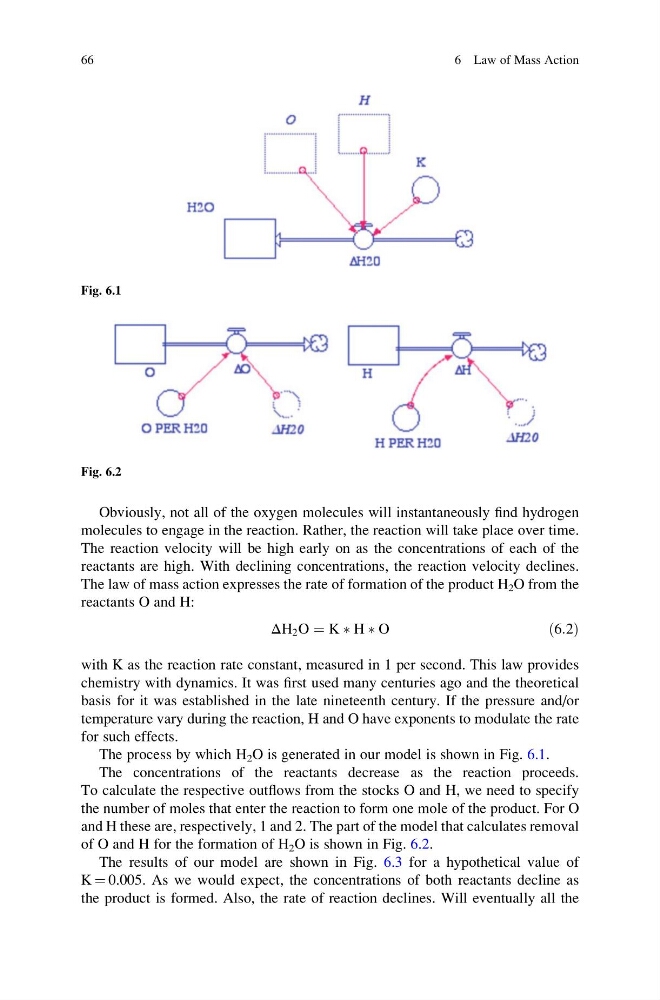
The process by which H 2 O is generated in our model is shown in Fig. 6.1.
The concentrations of the reactants decrease as the reaction proceeds.
To calculate the respective outflows from the stocks O and H, we need to specify
the number of moles that enter the reaction to form one mole of the product. For O
and H these are, respectively, 1 and 2. The part of the model that calculates removal
of O and H for the formation of H 2 O is shown in Fig. 6.2.
The results of our model are shown in Fig. 6.3 for a hypothetical value of
K ¼ 0.005. As we would expect, the concentrations of both reactants decline as
the product is formed. Also, the rate of reaction declines. Will eventually all the
Fig. 6.1
Fig. 6.2
66
6 Law of Mass Action
molecules to engage in the reaction. Rather, the reaction will take place over time.
The reaction velocity will be high early on as the concentrations of each of the
reactants are high. With declining concentrations, the reaction velocity declines.
The law of mass action expresses the rate of formation of the product H 2 O from the
reactants O and H:
ΔH 2 O ¼ K Ã H Ã O
ð6:2Þ
with K as the reaction rate constant, measured in 1 per second. This law provides
chemistry with dynamics. It was first used many centuries ago and the theoretical
basis for it was established in the late nineteenth century. If the pressure and/or
temperature vary during the reaction, H and O have exponents to modulate the rate
for such effects.
The process by which H 2 O is generated in our model is shown in Fig. 6.1.
The concentrations of the reactants decrease as the reaction proceeds.
To calculate the respective outflows from the stocks O and H, we need to specify
the number of moles that enter the reaction to form one mole of the product. For O
and H these are, respectively, 1 and 2. The part of the model that calculates removal
of O and H for the formation of H 2 O is shown in Fig. 6.2.
The results of our model are shown in Fig. 6.3 for a hypothetical value of
K ¼ 0.005. As we would expect, the concentrations of both reactants decline as
the product is formed. Also, the rate of reaction declines. Will eventually all the
Fig. 6.1
Fig. 6.2
66
6 Law of Mass Action