

2.4 Population with Varying Carrying Capacity
Model Equations
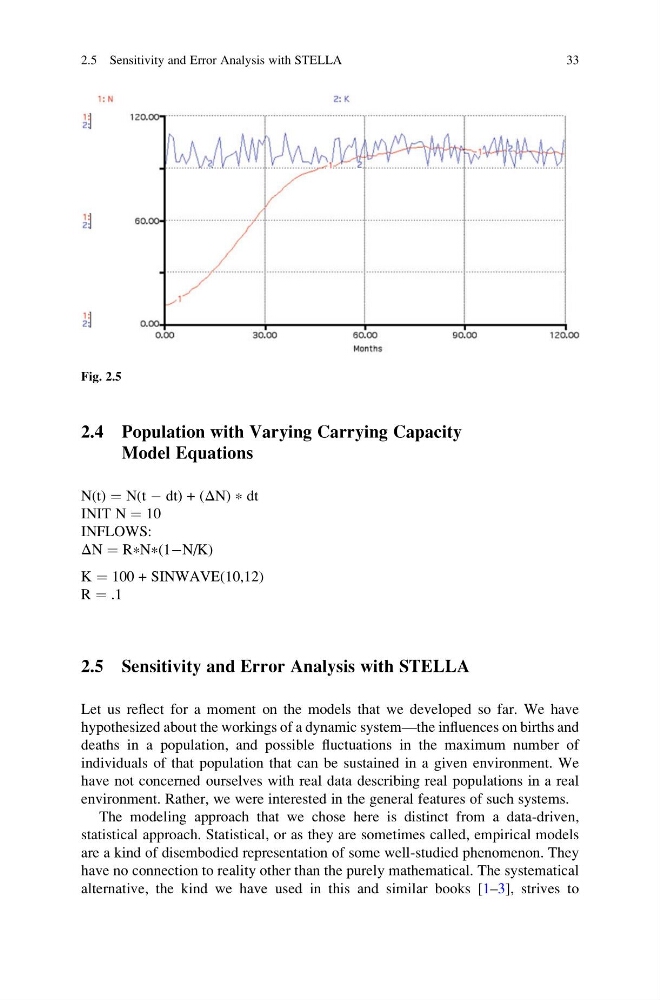
N(t) ¼ N(t À dt) + (ΔN) * dt
INIT N ¼ 10
INFLOWS:
ΔN ¼ R * N * (1ÀN/K)
K ¼ 100 + SINWAVE(10,12)
R ¼ .1
2.5 Sensitivity and Error Analysis with STELLA
Let us reflect for a moment on the models that we developed so far. We have
hypothesized about the workings of a dynamic system—the influences on births and
deaths in a population, and possible fluctuations in the maximum number of
individuals of that population that can be sustained in a given environment. We
have not concerned ourselves with real data describing real populations in a real
environment. Rather, we were interested in the general features of such systems.
The modeling approach that we chose here is distinct from a data-driven,
statistical approach. Statistical, or as they are sometimes called, empirical models
are a kind of disembodied representation of some well-studied phenomenon. They
have no connection to reality other than the purely mathematical. The systematical
alternative, the kind we have used in this and similar books [1–3], strives to
Fig. 2.5
2.5 Sensitivity and Error Analysis with STELLA
33
Model Equations
N(t) ¼ N(t À dt) + (ΔN) * dt
INIT N ¼ 10
INFLOWS:
ΔN ¼ R * N * (1ÀN/K)
K ¼ 100 + SINWAVE(10,12)
R ¼ .1
2.5 Sensitivity and Error Analysis with STELLA
Let us reflect for a moment on the models that we developed so far. We have
hypothesized about the workings of a dynamic system—the influences on births and
deaths in a population, and possible fluctuations in the maximum number of
individuals of that population that can be sustained in a given environment. We
have not concerned ourselves with real data describing real populations in a real
environment. Rather, we were interested in the general features of such systems.
The modeling approach that we chose here is distinct from a data-driven,
statistical approach. Statistical, or as they are sometimes called, empirical models
are a kind of disembodied representation of some well-studied phenomenon. They
have no connection to reality other than the purely mathematical. The systematical
alternative, the kind we have used in this and similar books [1–3], strives to
Fig. 2.5
2.5 Sensitivity and Error Analysis with STELLA
33