

SUN LUMINOSITY ¼ IF TIME < 150 THEN 0:01 Ã TIME
ELSE IF TIME ! 150 AND TIME 200 THEN 1
ELSE 1:5 À 0:01 Ã TIME À 150
ð
Þ
ð44:13Þ
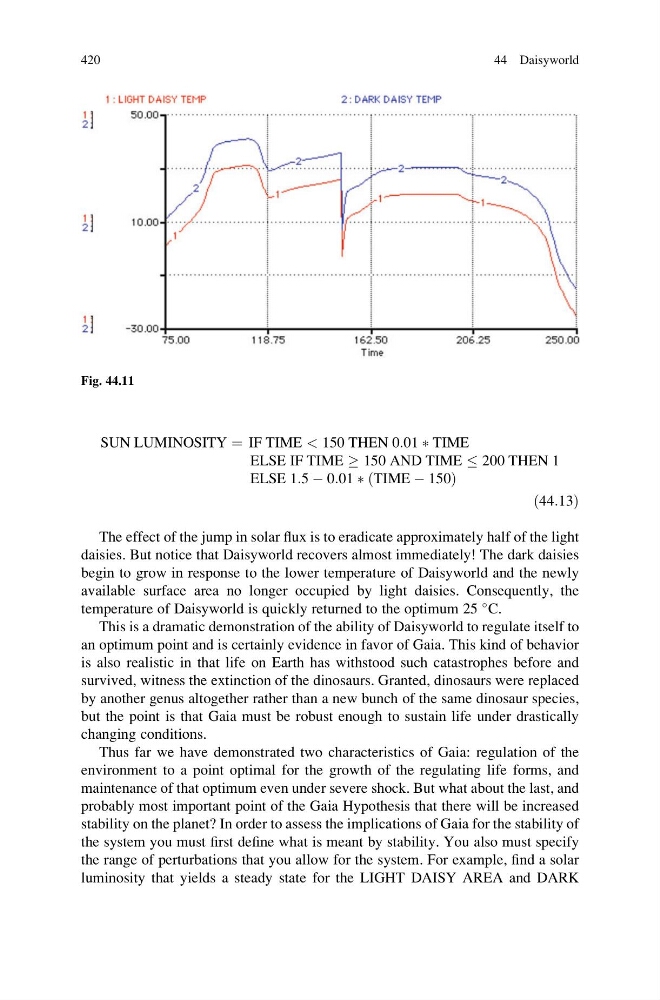
The effect of the jump in solar flux is to eradicate approximately half of the light
daisies. But notice that Daisyworld recovers almost immediately! The dark daisies
begin to grow in response to the lower temperature of Daisyworld and the newly
available surface area no longer occupied by light daisies. Consequently, the
temperature of Daisyworld is quickly returned to the optimum 25
C.
This is a dramatic demonstration of the ability of Daisyworld to regulate itself to
an optimum point and is certainly evidence in favor of Gaia. This kind of behavior
is also realistic in that life on Earth has withstood such catastrophes before and
survived, witness the extinction of the dinosaurs. Granted, dinosaurs were replaced
by another genus altogether rather than a new bunch of the same dinosaur species,
but the point is that Gaia must be robust enough to sustain life under drastically
changing conditions.
Thus far we have demonstrated two characteristics of Gaia: regulation of the
environment to a point optimal for the growth of the regulating life forms, and
maintenance of that optimum even under severe shock. But what about the last, and
probably most important point of the Gaia Hypothesis that there will be increased
stability on the planet? In order to assess the implications of Gaia for the stability of
the system you must first define what is meant by stability. You also must specify
the range of perturbations that you allow for the system. For example, find a solar
luminosity that yields a steady state for the LIGHT DAISY AREA and DARK
Fig. 44.11
420
44 Daisyworld
ELSE IF TIME ! 150 AND TIME 200 THEN 1
ELSE 1:5 À 0:01 Ã TIME À 150
ð
Þ
ð44:13Þ
The effect of the jump in solar flux is to eradicate approximately half of the light
daisies. But notice that Daisyworld recovers almost immediately! The dark daisies
begin to grow in response to the lower temperature of Daisyworld and the newly
available surface area no longer occupied by light daisies. Consequently, the
temperature of Daisyworld is quickly returned to the optimum 25
C.
This is a dramatic demonstration of the ability of Daisyworld to regulate itself to
an optimum point and is certainly evidence in favor of Gaia. This kind of behavior
is also realistic in that life on Earth has withstood such catastrophes before and
survived, witness the extinction of the dinosaurs. Granted, dinosaurs were replaced
by another genus altogether rather than a new bunch of the same dinosaur species,
but the point is that Gaia must be robust enough to sustain life under drastically
changing conditions.
Thus far we have demonstrated two characteristics of Gaia: regulation of the
environment to a point optimal for the growth of the regulating life forms, and
maintenance of that optimum even under severe shock. But what about the last, and
probably most important point of the Gaia Hypothesis that there will be increased
stability on the planet? In order to assess the implications of Gaia for the stability of
the system you must first define what is meant by stability. You also must specify
the range of perturbations that you allow for the system. For example, find a solar
luminosity that yields a steady state for the LIGHT DAISY AREA and DARK
Fig. 44.11
420
44 Daisyworld