

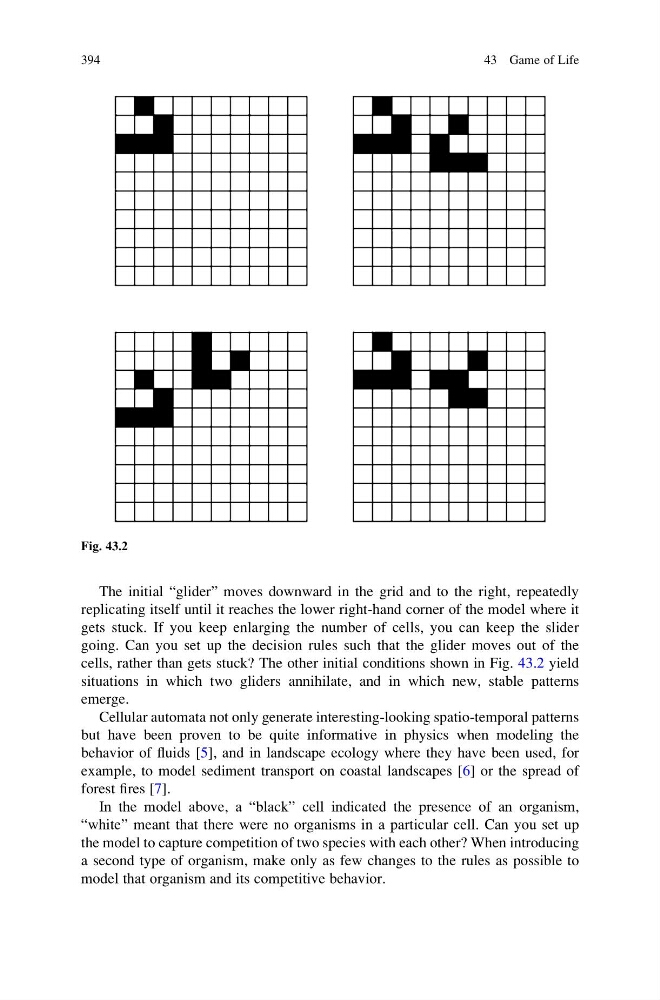
The initial “glider” moves downward in the grid and to the right, repeatedly
replicating itself until it reaches the lower right-hand corner of the model where it
gets stuck. If you keep enlarging the number of cells, you can keep the slider
going. Can you set up the decision rules such that the glider moves out of the
cells, rather than gets stuck? The other initial conditions shown in Fig. 43.2 yield
situations in which two gliders annihilate, and in which new, stable patterns
emerge.
Cellular automata not only generate interesting-looking spatio-temporal patterns
but have been proven to be quite informative in physics when modeling the
behavior of fluids [5], and in landscape ecology where they have been used, for
example, to model sediment transport on coastal landscapes [6] or the spread of
forest fires [7].
In the model above, a “black” cell indicated the presence of an organism,
“white” meant that there were no organisms in a particular cell. Can you set up
the model to capture competition of two species with each other? When introducing
a second type of organism, make only as few changes to the rules as possible to
model that organism and its competitive behavior.
Fig. 43.2
394
43 Game of Life
replicating itself until it reaches the lower right-hand corner of the model where it
gets stuck. If you keep enlarging the number of cells, you can keep the slider
going. Can you set up the decision rules such that the glider moves out of the
cells, rather than gets stuck? The other initial conditions shown in Fig. 43.2 yield
situations in which two gliders annihilate, and in which new, stable patterns
emerge.
Cellular automata not only generate interesting-looking spatio-temporal patterns
but have been proven to be quite informative in physics when modeling the
behavior of fluids [5], and in landscape ecology where they have been used, for
example, to model sediment transport on coastal landscapes [6] or the spread of
forest fires [7].
In the model above, a “black” cell indicated the presence of an organism,
“white” meant that there were no organisms in a particular cell. Can you set up
the model to capture competition of two species with each other? When introducing
a second type of organism, make only as few changes to the rules as possible to
model that organism and its competitive behavior.
Fig. 43.2
394
43 Game of Life