

One of the natural system controls not now used in forestry relates to the idea of
patch size. Natural systems no doubt avoid large catastrophes because they operate
in patches, where the degree of maturity of adjacent patches is nearly always
different. Consequently, pests and fires find difficulty in spreading beyond a patch
and the size of the catastrophe is kept small. Current forestry practice seems to be
disconnected from such natural system behavior. Our model is not a regional one
and so such interpatch dynamics are not captured. However, we have modeled such
patch dynamics in Chap. 40, and you may want to combine the approach of that
chapter with the one developed here.
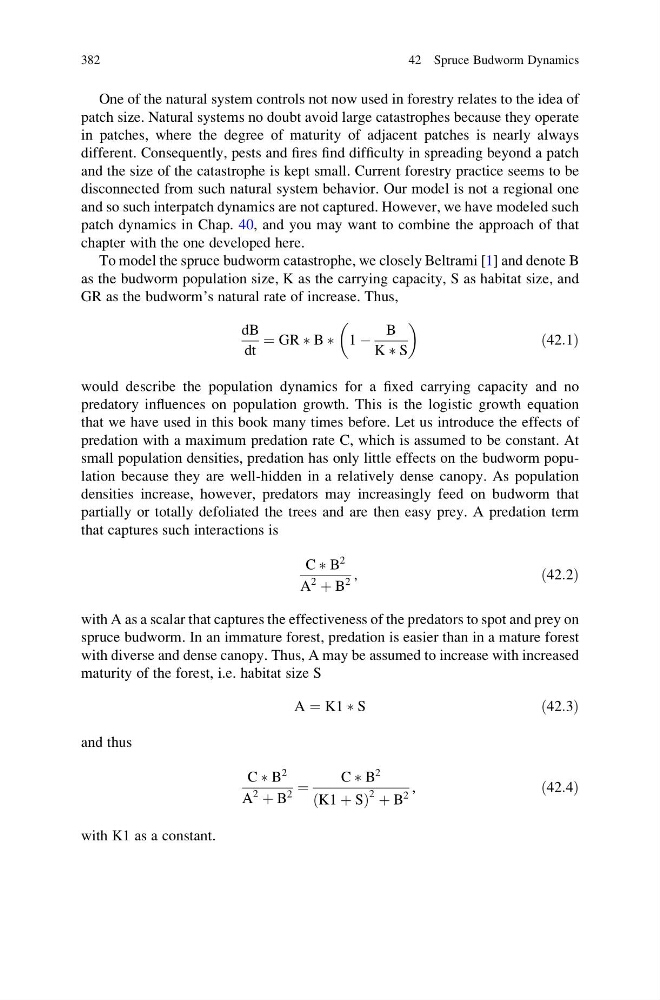
To model the spruce budworm catastrophe, we closely Beltrami [1] and denote B
as the budworm population size, K as the carrying capacity, S as habitat size, and
GR as the budworm’s natural rate of increase. Thus,
dB
dt
¼ GR Ã B Ã 1 À
B
K Ã S
ð42:1Þ
would describe the population dynamics for a fixed carrying capacity and no
predatory influences on population growth. This is the logistic growth equation
that we have used in this book many times before. Let us introduce the effects of
predation with a maximum predation rate C, which is assumed to be constant. At
small population densities, predation has only little effects on the budworm population because they are well-hidden in a relatively dense canopy. As population
densities increase, however, predators may increasingly feed on budworm that
partially or totally defoliated the trees and are then easy prey. A predation term
that captures such interactions is
C Ã B
2
A
2
þ B
2
,
ð42:2Þ
with A as a scalar that captures the effectiveness of the predators to spot and prey on
spruce budworm. In an immature forest, predation is easier than in a mature forest
with diverse and dense canopy. Thus, A may be assumed to increase with increased
maturity of the forest, i.e. habitat size S
A ¼ K1 Ã S
ð42:3Þ
and thus
C Ã B
2
A
2
þ B
2
¼
C Ã B
2
K1 þ S
ð
Þ
2 þ B
2
,
ð42:4Þ
with K1 as a constant.
382
42 Spruce Budworm Dynamics
patch size. Natural systems no doubt avoid large catastrophes because they operate
in patches, where the degree of maturity of adjacent patches is nearly always
different. Consequently, pests and fires find difficulty in spreading beyond a patch
and the size of the catastrophe is kept small. Current forestry practice seems to be
disconnected from such natural system behavior. Our model is not a regional one
and so such interpatch dynamics are not captured. However, we have modeled such
patch dynamics in Chap. 40, and you may want to combine the approach of that
chapter with the one developed here.
To model the spruce budworm catastrophe, we closely Beltrami [1] and denote B
as the budworm population size, K as the carrying capacity, S as habitat size, and
GR as the budworm’s natural rate of increase. Thus,
dB
dt
¼ GR Ã B Ã 1 À
B
K Ã S
ð42:1Þ
would describe the population dynamics for a fixed carrying capacity and no
predatory influences on population growth. This is the logistic growth equation
that we have used in this book many times before. Let us introduce the effects of
predation with a maximum predation rate C, which is assumed to be constant. At
small population densities, predation has only little effects on the budworm population because they are well-hidden in a relatively dense canopy. As population
densities increase, however, predators may increasingly feed on budworm that
partially or totally defoliated the trees and are then easy prey. A predation term
that captures such interactions is
C Ã B
2
A
2
þ B
2
,
ð42:2Þ
with A as a scalar that captures the effectiveness of the predators to spot and prey on
spruce budworm. In an immature forest, predation is easier than in a mature forest
with diverse and dense canopy. Thus, A may be assumed to increase with increased
maturity of the forest, i.e. habitat size S
A ¼ K1 Ã S
ð42:3Þ
and thus
C Ã B
2
A
2
þ B
2
¼
C Ã B
2
K1 þ S
ð
Þ
2 þ B
2
,
ð42:4Þ
with K1 as a constant.
382
42 Spruce Budworm Dynamics