

Each individual snow flake potentially adds to the instability of the system. When a
critical point is reached, the next snow flake may trigger an avalanche that affects a
large part of the system. Temporary stability is quickly reached if the avalanche was
not too dramatic. Even if not of a large scale, the avalanche adds to the “stress” of
the system downhill, making it more susceptible to further avalanches as more
snow falls at those regions or as additional small avalanches are received from
higher on the hill. Ultimately, a large-scale, catastrophic event may occur which
affects the entire system, not just individual regions. The system components
re-group and finally enter a phase of new, temporary stability.
So, evolutionary processes are at work making the system more “efficient” in
some sense. This is evolution toward catastrophe. A system in such a state can
remerge to a stable state by another process of evolution, likely faster than the first
kind, and this new stable state may not be very efficient. Large living natural
systems are likely constrained from operating at or near peak efficiency by random
intervention of uncoordinated external processes at the regional levels.
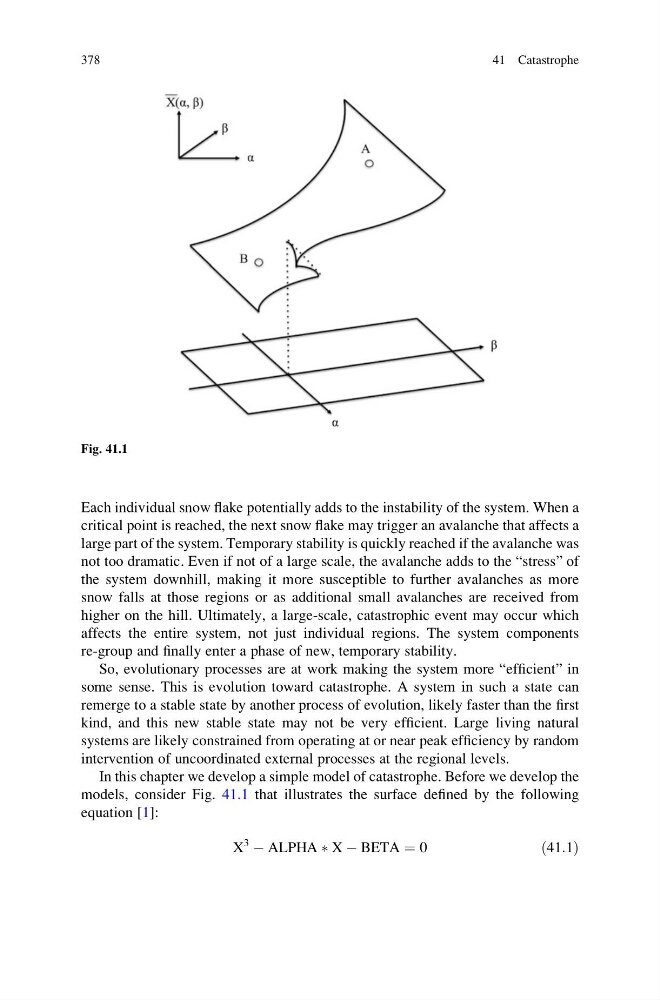
In this chapter we develop a simple model of catastrophe. Before we develop the
models, consider Fig. 41.1 that illustrates the surface defined by the following
equation [1]:
X
3
À ALPHA Ã X À BETA ¼ 0
ð41:1Þ
Fig. 41.1
378
41 Catastrophe
critical point is reached, the next snow flake may trigger an avalanche that affects a
large part of the system. Temporary stability is quickly reached if the avalanche was
not too dramatic. Even if not of a large scale, the avalanche adds to the “stress” of
the system downhill, making it more susceptible to further avalanches as more
snow falls at those regions or as additional small avalanches are received from
higher on the hill. Ultimately, a large-scale, catastrophic event may occur which
affects the entire system, not just individual regions. The system components
re-group and finally enter a phase of new, temporary stability.
So, evolutionary processes are at work making the system more “efficient” in
some sense. This is evolution toward catastrophe. A system in such a state can
remerge to a stable state by another process of evolution, likely faster than the first
kind, and this new stable state may not be very efficient. Large living natural
systems are likely constrained from operating at or near peak efficiency by random
intervention of uncoordinated external processes at the regional levels.
In this chapter we develop a simple model of catastrophe. Before we develop the
models, consider Fig. 41.1 that illustrates the surface defined by the following
equation [1]:
X
3
À ALPHA Ã X À BETA ¼ 0
ð41:1Þ
Fig. 41.1
378
41 Catastrophe