

controlled by SEVERITY. SURVIVAL is set to 0.008 and reflects year to year
variation in egg survival due to flooding. SEVERITY is set equal to 0.1 and reflects
year to year variation in winter severity and subsequent winter kill:
WINTERKILL ¼ PULSE LARVAL Ã SEVERITY, 50, 52
ð
Þ
ð 37:1Þ
Diminishing predation on late juvenile fish as the summer progresses is indicated
by the controller variable SEASONAL SHIFT, which is a pulse that diminishes
over time:
SEASONAL SHIFT ¼ 1 À PULSE 1; 8; 52
ð
Þ
ð37:2Þ
Here, the built-in PULSE function takes on the value of 1, which happens for the
first time in period 8 and repeats itself every 52 periods.
Predation on larvae and small fish, i.e. early and late juveniles, is specified as
shown in Figs. 37.3 and 37.4.
Predators are divided into three categories; juveniles (young of year or YOY),
small predators, and adults. The STELLA diagram that captures the corresponding
age cohort dynamic is shown in Figs. 37.5 and 37.6.
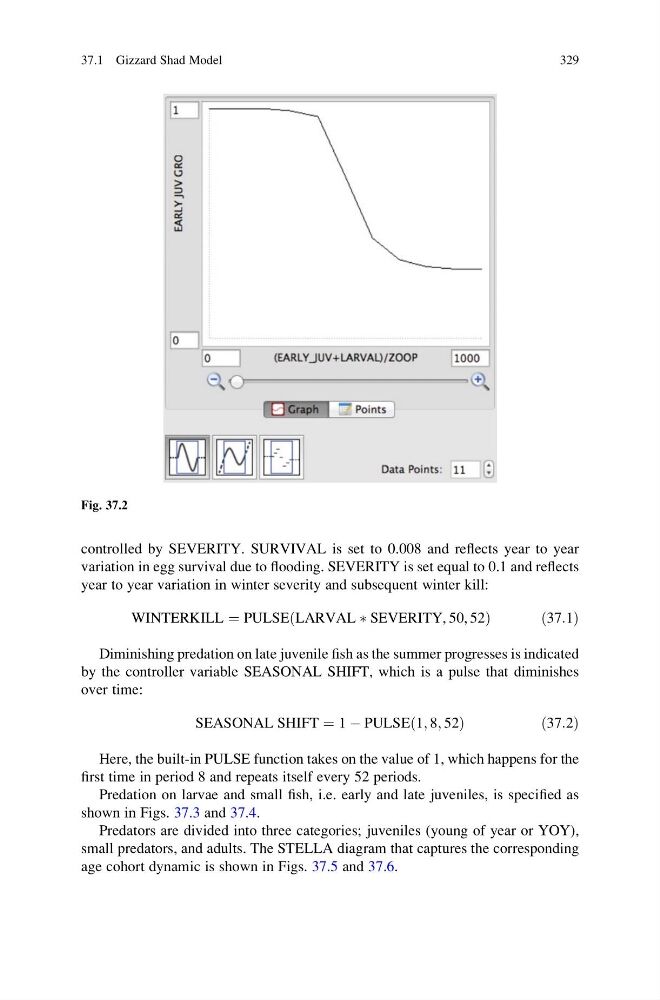
Fig. 37.2
37.1 Gizzard Shad Model
329
variation in egg survival due to flooding. SEVERITY is set equal to 0.1 and reflects
year to year variation in winter severity and subsequent winter kill:
WINTERKILL ¼ PULSE LARVAL Ã SEVERITY, 50, 52
ð
Þ
ð 37:1Þ
Diminishing predation on late juvenile fish as the summer progresses is indicated
by the controller variable SEASONAL SHIFT, which is a pulse that diminishes
over time:
SEASONAL SHIFT ¼ 1 À PULSE 1; 8; 52
ð
Þ
ð37:2Þ
Here, the built-in PULSE function takes on the value of 1, which happens for the
first time in period 8 and repeats itself every 52 periods.
Predation on larvae and small fish, i.e. early and late juveniles, is specified as
shown in Figs. 37.3 and 37.4.
Predators are divided into three categories; juveniles (young of year or YOY),
small predators, and adults. The STELLA diagram that captures the corresponding
age cohort dynamic is shown in Figs. 37.5 and 37.6.
Fig. 37.2
37.1 Gizzard Shad Model
329