

cascade may thwart any attempt to improve water quality by adding predators to a
system containing a substantial population of gizzard shad. Thus the question
arises: Under what conditions could a lake manager hope to control gizzard shad
populations and improve water quality through biomanipulation? In this chapter we
examine the effect of various biomanipulation regimes, the effect of predator death
rates, and gizzard shad egg survival.
Let us model a community of primary producers, zooplankton, planktivores
(gizzard shad), and a predator species that forages optimal size classes of gizzard
shad. The model is set up to run for approximately 10 years of simulated time.
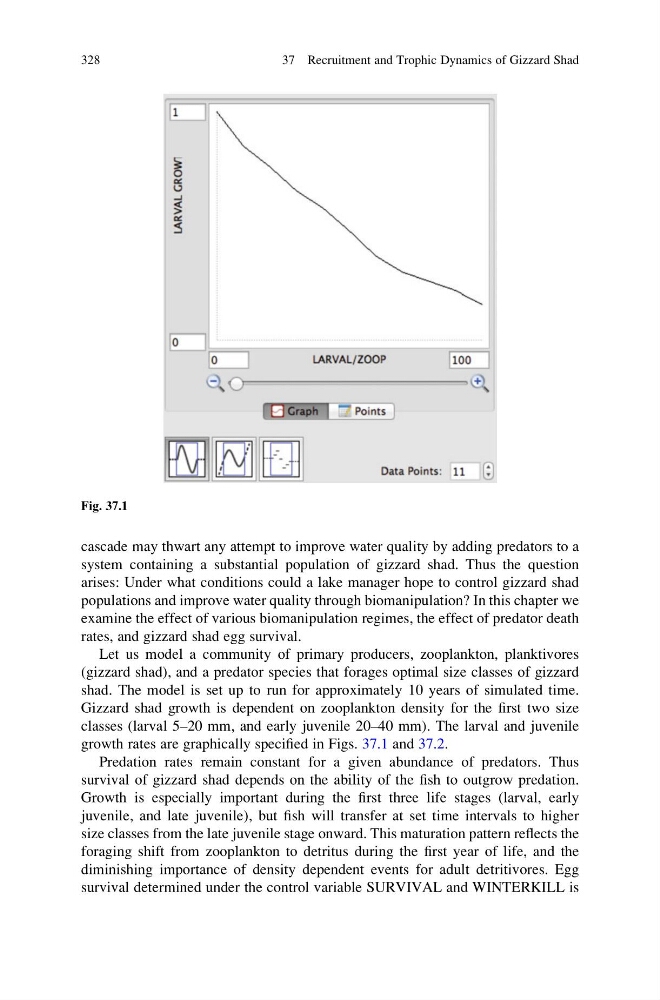
Gizzard shad growth is dependent on zooplankton density for the first two size
classes (larval 5–20 mm, and early juvenile 20–40 mm). The larval and juvenile
growth rates are graphically specified in Figs. 37.1 and 37.2.
Predation rates remain constant for a given abundance of predators. Thus
survival of gizzard shad depends on the ability of the fish to outgrow predation.
Growth is especially important during the first three life stages (larval, early
juvenile, and late juvenile), but fish will transfer at set time intervals to higher
size classes from the late juvenile stage onward. This maturation pattern reflects the
foraging shift from zooplankton to detritus during the first year of life, and the
diminishing importance of density dependent events for adult detritivores. Egg
survival determined under the control variable SURVIVAL and WINTERKILL is
Fig. 37.1
328
37 Recruitment and Trophic Dynamics of Gizzard Shad
system containing a substantial population of gizzard shad. Thus the question
arises: Under what conditions could a lake manager hope to control gizzard shad
populations and improve water quality through biomanipulation? In this chapter we
examine the effect of various biomanipulation regimes, the effect of predator death
rates, and gizzard shad egg survival.
Let us model a community of primary producers, zooplankton, planktivores
(gizzard shad), and a predator species that forages optimal size classes of gizzard
shad. The model is set up to run for approximately 10 years of simulated time.
Gizzard shad growth is dependent on zooplankton density for the first two size
classes (larval 5–20 mm, and early juvenile 20–40 mm). The larval and juvenile
growth rates are graphically specified in Figs. 37.1 and 37.2.
Predation rates remain constant for a given abundance of predators. Thus
survival of gizzard shad depends on the ability of the fish to outgrow predation.
Growth is especially important during the first three life stages (larval, early
juvenile, and late juvenile), but fish will transfer at set time intervals to higher
size classes from the late juvenile stage onward. This maturation pattern reflects the
foraging shift from zooplankton to detritus during the first year of life, and the
diminishing importance of density dependent events for adult detritivores. Egg
survival determined under the control variable SURVIVAL and WINTERKILL is
Fig. 37.1
328
37 Recruitment and Trophic Dynamics of Gizzard Shad