

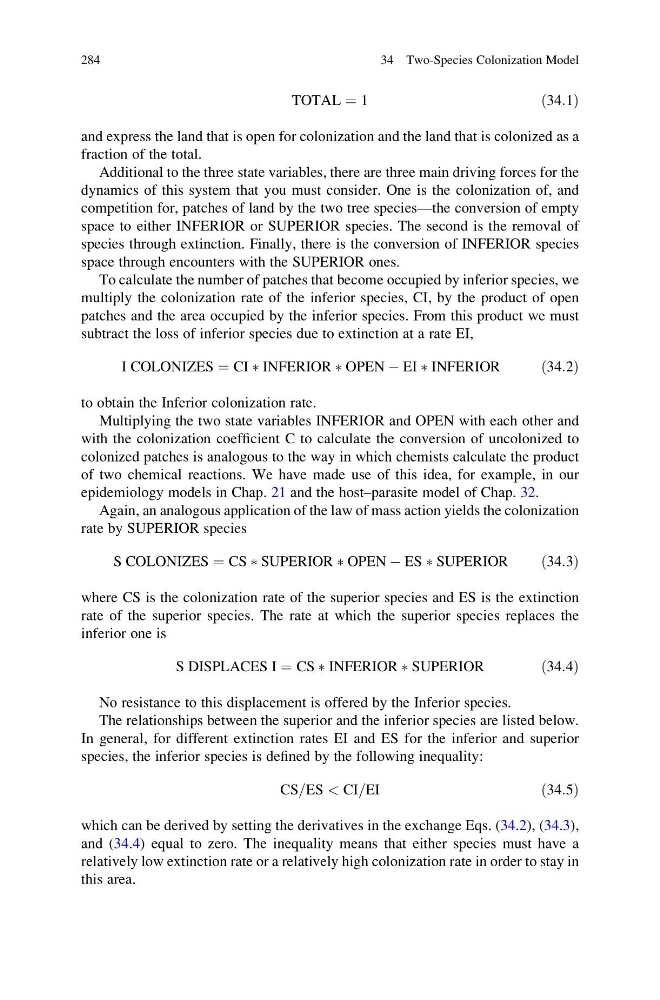
TOTAL ¼ 1
ð34:1Þ
and express the land that is open for colonization and the land that is colonized as a
fraction of the total.
Additional to the three state variables, there are three main driving forces for the
dynamics of this system that you must consider. One is the colonization of, and
competition for, patches of land by the two tree species—the conversion of empty
space to either INFERIOR or SUPERIOR species. The second is the removal of
species through extinction. Finally, there is the conversion of INFERIOR species
space through encounters with the SUPERIOR ones.
To calculate the number of patches that become occupied by inferior species, we
multiply the colonization rate of the inferior species, CI, by the product of open
patches and the area occupied by the inferior species. From this product we must
subtract the loss of inferior species due to extinction at a rate EI,
I COLONIZES ¼ CI Ã INFERIOR Ã OPEN À EI Ã INFERIOR
ð34:2Þ
to obtain the Inferior colonization rate.
Multiplying the two state variables INFERIOR and OPEN with each other and
with the colonization coefficient C to calculate the conversion of uncolonized to
colonized patches is analogous to the way in which chemists calculate the product
of two chemical reactions. We have made use of this idea, for example, in our
epidemiology models in Chap. 21 and the host–parasite model of Chap. 32.
Again, an analogous application of the law of mass action yields the colonization
rate by SUPERIOR species
S COLONIZES ¼ CS Ã SUPERIOR Ã OPEN À ES Ã SUPERIOR
ð34:3Þ
where CS is the colonization rate of the superior species and ES is the extinction
rate of the superior species. The rate at which the superior species replaces the
inferior one is
S DISPLACES I ¼ CS Ã INFERIOR Ã SUPERIOR
ð34:4Þ
No resistance to this displacement is offered by the Inferior species.
The relationships between the superior and the inferior species are listed below.
In general, for different extinction rates EI and ES for the inferior and superior
species, the inferior species is defined by the following inequality:
CS=ES < CI=EI
ð34:5Þ
which can be derived by setting the derivatives in the exchange Eqs. (34.2), (34.3),
and (34.4) equal to zero. The inequality means that either species must have a
relatively low extinction rate or a relatively high colonization rate in order to stay in
this area.
284
34 Two-Species Colonization Model
ð34:1Þ
and express the land that is open for colonization and the land that is colonized as a
fraction of the total.
Additional to the three state variables, there are three main driving forces for the
dynamics of this system that you must consider. One is the colonization of, and
competition for, patches of land by the two tree species—the conversion of empty
space to either INFERIOR or SUPERIOR species. The second is the removal of
species through extinction. Finally, there is the conversion of INFERIOR species
space through encounters with the SUPERIOR ones.
To calculate the number of patches that become occupied by inferior species, we
multiply the colonization rate of the inferior species, CI, by the product of open
patches and the area occupied by the inferior species. From this product we must
subtract the loss of inferior species due to extinction at a rate EI,
I COLONIZES ¼ CI Ã INFERIOR Ã OPEN À EI Ã INFERIOR
ð34:2Þ
to obtain the Inferior colonization rate.
Multiplying the two state variables INFERIOR and OPEN with each other and
with the colonization coefficient C to calculate the conversion of uncolonized to
colonized patches is analogous to the way in which chemists calculate the product
of two chemical reactions. We have made use of this idea, for example, in our
epidemiology models in Chap. 21 and the host–parasite model of Chap. 32.
Again, an analogous application of the law of mass action yields the colonization
rate by SUPERIOR species
S COLONIZES ¼ CS Ã SUPERIOR Ã OPEN À ES Ã SUPERIOR
ð34:3Þ
where CS is the colonization rate of the superior species and ES is the extinction
rate of the superior species. The rate at which the superior species replaces the
inferior one is
S DISPLACES I ¼ CS Ã INFERIOR Ã SUPERIOR
ð34:4Þ
No resistance to this displacement is offered by the Inferior species.
The relationships between the superior and the inferior species are listed below.
In general, for different extinction rates EI and ES for the inferior and superior
species, the inferior species is defined by the following inequality:
CS=ES < CI=EI
ð34:5Þ
which can be derived by setting the derivatives in the exchange Eqs. (34.2), (34.3),
and (34.4) equal to zero. The inequality means that either species must have a
relatively low extinction rate or a relatively high colonization rate in order to stay in
this area.
284
34 Two-Species Colonization Model