

the whole new generation of the two populations is formed just before the beginning
of that generation. So in the sense of this model, a DT less than one has no meaning.
Do a sensitivity analysis on the initial values of H and P, on R, A, and K.
We have modeled in this chapter one type of species interaction that is almost
exclusively found among insects. Typically, both the parasitoid and host have a
number of lifecycle stages—eggs, larvae, pupae, and adults—and their interaction
is limited to a subset of these. Can you modify the model to account for the fact that
it is typically only the larvae of the host that get parasitized by adult parasitoids?
How does this disaggregation of the parasitoid and host population affect your
results? Can you find parameters and initial values that generate alternatively steady
state, limit cycles, or chaos? What is the appropriate DT to use here and how are the
results affected by its choice?
32.2 Nicholson–Bailey Host–Parasitoid Model Equations
H(t) ¼ H(t À dt) + (ΔH) * dt
INIT H ¼ 10
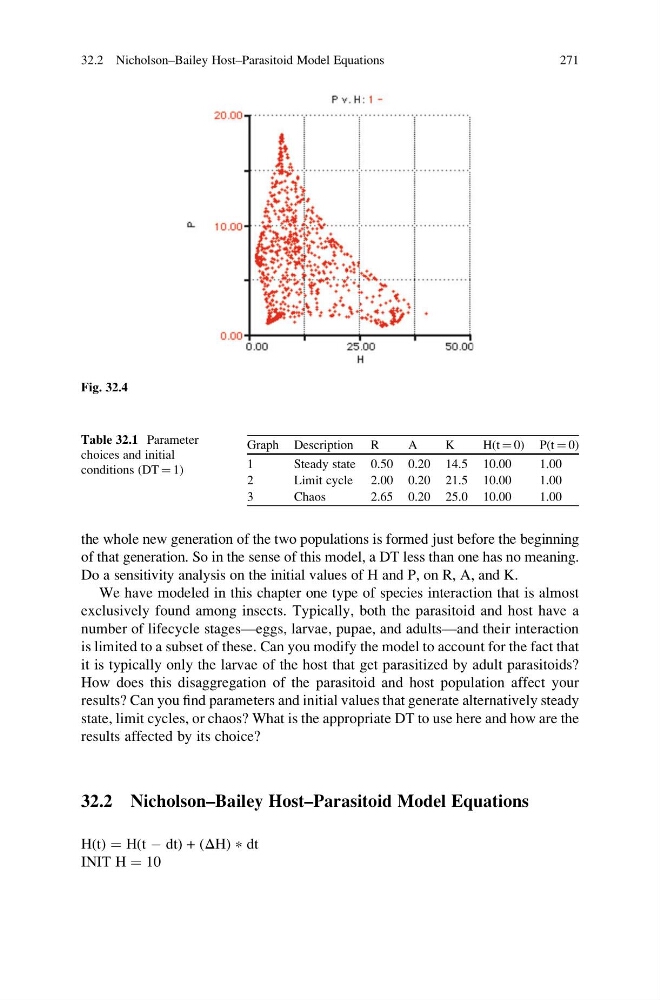
Table 32.1 Parameter
choices and initial
conditions (DT ¼ 1)
Graph Description R
A
K
H(t ¼ 0) P(t ¼ 0)
1
Steady state 0.50 0.20 14.5 10.00
1.00
2
Limit cycle 2.00 0.20 21.5 10.00
1.00
3
Chaos
2.65 0.20 25.0 10.00
1.00
Fig. 32.4
32.2 Nicholson–Bailey Host–Parasitoid Model Equations
271
of that generation. So in the sense of this model, a DT less than one has no meaning.
Do a sensitivity analysis on the initial values of H and P, on R, A, and K.
We have modeled in this chapter one type of species interaction that is almost
exclusively found among insects. Typically, both the parasitoid and host have a
number of lifecycle stages—eggs, larvae, pupae, and adults—and their interaction
is limited to a subset of these. Can you modify the model to account for the fact that
it is typically only the larvae of the host that get parasitized by adult parasitoids?
How does this disaggregation of the parasitoid and host population affect your
results? Can you find parameters and initial values that generate alternatively steady
state, limit cycles, or chaos? What is the appropriate DT to use here and how are the
results affected by its choice?
32.2 Nicholson–Bailey Host–Parasitoid Model Equations
H(t) ¼ H(t À dt) + (ΔH) * dt
INIT H ¼ 10
Table 32.1 Parameter
choices and initial
conditions (DT ¼ 1)
Graph Description R
A
K
H(t ¼ 0) P(t ¼ 0)
1
Steady state 0.50 0.20 14.5 10.00
1.00
2
Limit cycle 2.00 0.20 21.5 10.00
1.00
3
Chaos
2.65 0.20 25.0 10.00
1.00
Fig. 32.4
32.2 Nicholson–Bailey Host–Parasitoid Model Equations
271