

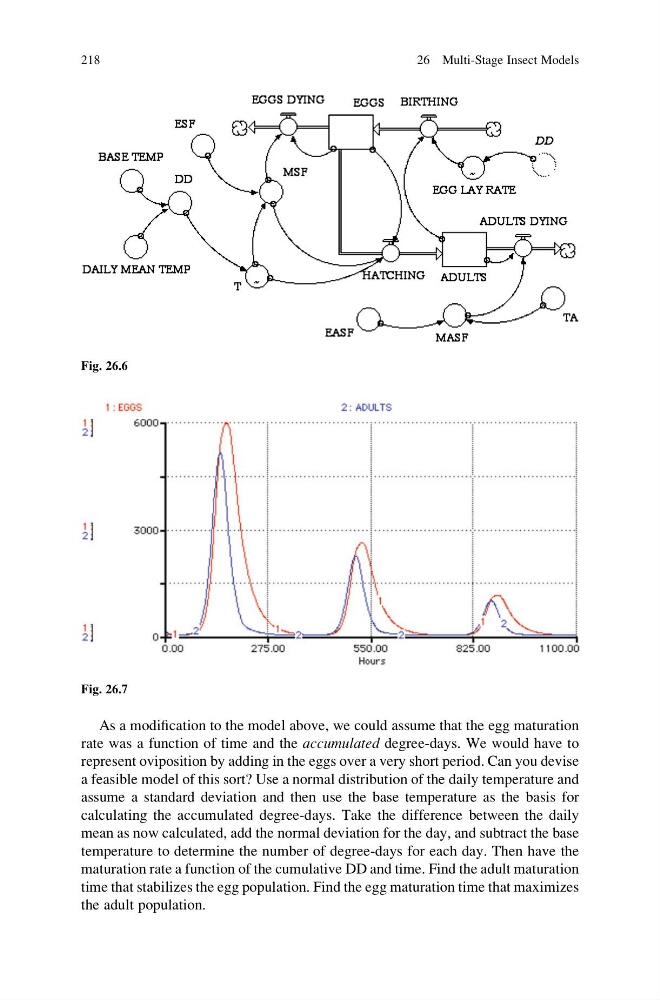
As a modification to the model above, we could assume that the egg maturation
rate was a function of time and the accumulated degree-days. We would have to
represent oviposition by adding in the eggs over a very short period. Can you devise
a feasible model of this sort? Use a normal distribution of the daily temperature and
assume a standard deviation and then use the base temperature as the basis for
calculating the accumulated degree-days. Take the difference between the daily
mean as now calculated, add the normal deviation for the day, and subtract the base
temperature to determine the number of degree-days for each day. Then have the
maturation rate a function of the cumulative DD and time. Find the adult maturation
time that stabilizes the egg population. Find the egg maturation time that maximizes
the adult population.
Fig. 26.6
Fig. 26.7
218
26 Multi-Stage Insect Models
rate was a function of time and the accumulated degree-days. We would have to
represent oviposition by adding in the eggs over a very short period. Can you devise
a feasible model of this sort? Use a normal distribution of the daily temperature and
assume a standard deviation and then use the base temperature as the basis for
calculating the accumulated degree-days. Take the difference between the daily
mean as now calculated, add the normal deviation for the day, and subtract the base
temperature to determine the number of degree-days for each day. Then have the
maturation rate a function of the cumulative DD and time. Find the adult maturation
time that stabilizes the egg population. Find the egg maturation time that maximizes
the adult population.
Fig. 26.6
Fig. 26.7
218
26 Multi-Stage Insect Models