

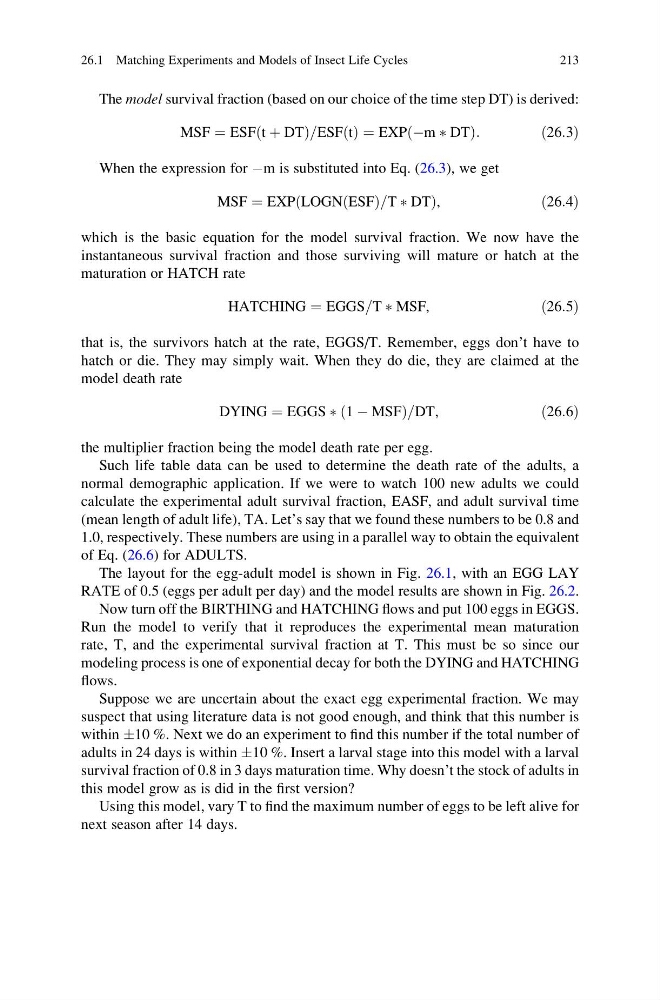
The model survival fraction (based on our choice of the time step DT) is derived:
MSF ¼ ESF t þ DT
ð
Þ=ESF t
ð Þ ¼ EXP Àm à DT
ð
Þ :
ð26:3Þ
When the expression for Àm is substituted into Eq. (26.3), we get
MSF ¼ EXP LOGN ESF
ð
Þ=T Ã DT
ð
Þ ,
ð26:4Þ
which is the basic equation for the model survival fraction. We now have the
instantaneous survival fraction and those surviving will mature or hatch at the
maturation or HATCH rate
HATCHING ¼ EGGS=T Ã MSF,
ð26:5Þ
that is, the survivors hatch at the rate, EGGS/T. Remember, eggs don’t have to
hatch or die. They may simply wait. When they do die, they are claimed at the
model death rate
DYING ¼ EGGS Ã 1 À MSF
ð
Þ =DT,
ð26:6Þ
the multiplier fraction being the model death rate per egg.
Such life table data can be used to determine the death rate of the adults, a
normal demographic application. If we were to watch 100 new adults we could
calculate the experimental adult survival fraction, EASF, and adult survival time
(mean length of adult life), TA. Let’s say that we found these numbers to be 0.8 and
1.0, respectively. These numbers are using in a parallel way to obtain the equivalent
of Eq. (26.6) for ADULTS.
The layout for the egg-adult model is shown in Fig. 26.1, with an EGG LAY
RATE of 0.5 (eggs per adult per day) and the model results are shown in Fig. 26.2.
Now turn off the BIRTHING and HATCHING flows and put 100 eggs in EGGS.
Run the model to verify that it reproduces the experimental mean maturation
rate, T, and the experimental survival fraction at T. This must be so since our
modeling process is one of exponential decay for both the DYING and HATCHING
flows.
Suppose we are uncertain about the exact egg experimental fraction. We may
suspect that using literature data is not good enough, and think that this number is
within Æ10 %. Next we do an experiment to find this number if the total number of
adults in 24 days is within Æ10 %. Insert a larval stage into this model with a larval
survival fraction of 0.8 in 3 days maturation time. Why doesn’t the stock of adults in
this model grow as is did in the first version?
Using this model, vary T to find the maximum number of eggs to be left alive for
next season after 14 days.
26.1 Matching Experiments and Models of Insect Life Cycles
213
MSF ¼ ESF t þ DT
ð
Þ=ESF t
ð Þ ¼ EXP Àm à DT
ð
Þ :
ð26:3Þ
When the expression for Àm is substituted into Eq. (26.3), we get
MSF ¼ EXP LOGN ESF
ð
Þ=T Ã DT
ð
Þ ,
ð26:4Þ
which is the basic equation for the model survival fraction. We now have the
instantaneous survival fraction and those surviving will mature or hatch at the
maturation or HATCH rate
HATCHING ¼ EGGS=T Ã MSF,
ð26:5Þ
that is, the survivors hatch at the rate, EGGS/T. Remember, eggs don’t have to
hatch or die. They may simply wait. When they do die, they are claimed at the
model death rate
DYING ¼ EGGS Ã 1 À MSF
ð
Þ =DT,
ð26:6Þ
the multiplier fraction being the model death rate per egg.
Such life table data can be used to determine the death rate of the adults, a
normal demographic application. If we were to watch 100 new adults we could
calculate the experimental adult survival fraction, EASF, and adult survival time
(mean length of adult life), TA. Let’s say that we found these numbers to be 0.8 and
1.0, respectively. These numbers are using in a parallel way to obtain the equivalent
of Eq. (26.6) for ADULTS.
The layout for the egg-adult model is shown in Fig. 26.1, with an EGG LAY
RATE of 0.5 (eggs per adult per day) and the model results are shown in Fig. 26.2.
Now turn off the BIRTHING and HATCHING flows and put 100 eggs in EGGS.
Run the model to verify that it reproduces the experimental mean maturation
rate, T, and the experimental survival fraction at T. This must be so since our
modeling process is one of exponential decay for both the DYING and HATCHING
flows.
Suppose we are uncertain about the exact egg experimental fraction. We may
suspect that using literature data is not good enough, and think that this number is
within Æ10 %. Next we do an experiment to find this number if the total number of
adults in 24 days is within Æ10 %. Insert a larval stage into this model with a larval
survival fraction of 0.8 in 3 days maturation time. Why doesn’t the stock of adults in
this model grow as is did in the first version?
Using this model, vary T to find the maximum number of eggs to be left alive for
next season after 14 days.
26.1 Matching Experiments and Models of Insect Life Cycles
213