

change in density and a corresponding change in population growth rate. In our
simple model the time lag was of paramount importance in generating population
cycles. Interestingly, regular periodic oscillations in density do not occur in
populations where dispersal is prevented, such as on island populations or
populations that are enclosed within vole-tight fences. In light of our model results
this suggests that blocking dispersal may influence the time-delayed component of
vole cycles. A greater understanding of the relationship between dispersal and its
potential effects on time-delayed responses may shed new light on the field of
microtine population dynamics. Third, modeling of population dynamics, combined with data from field studies, can provide insight into the mechanisms of
population change that not only enhance our understanding of the driving forces of
the system but further sharpen the focus of subsequent studies of these populations.
24.6 Sinusoidal Vole Model Equations
N(t) ¼ N(t À dt) + (ΔN) * dt
INIT N ¼ 2 {Individuals}
INFLOWS:
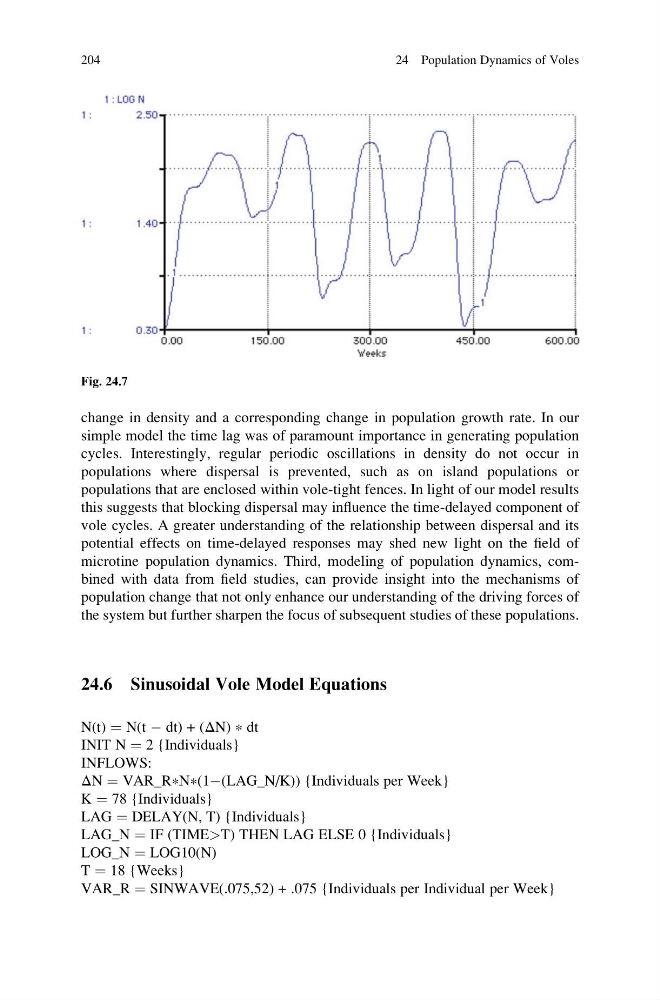
ΔN ¼ VAR_R * N * (1À(LAG_N/K)) {Individuals per Week}
K ¼ 78 {Individuals}
LAG ¼ DELAY(N, T) {Individuals}
LAG_N ¼ IF (TIME>T) THEN LAG ELSE 0 {Individuals}
LOG_N ¼ LOG10(N)
T ¼ 18 {Weeks}
VAR_R ¼ SINWAVE(.075,52) + .075 {Individuals per Individual per Week}
Fig. 24.7
204
24 Population Dynamics of Voles
simple model the time lag was of paramount importance in generating population
cycles. Interestingly, regular periodic oscillations in density do not occur in
populations where dispersal is prevented, such as on island populations or
populations that are enclosed within vole-tight fences. In light of our model results
this suggests that blocking dispersal may influence the time-delayed component of
vole cycles. A greater understanding of the relationship between dispersal and its
potential effects on time-delayed responses may shed new light on the field of
microtine population dynamics. Third, modeling of population dynamics, combined with data from field studies, can provide insight into the mechanisms of
population change that not only enhance our understanding of the driving forces of
the system but further sharpen the focus of subsequent studies of these populations.
24.6 Sinusoidal Vole Model Equations
N(t) ¼ N(t À dt) + (ΔN) * dt
INIT N ¼ 2 {Individuals}
INFLOWS:
ΔN ¼ VAR_R * N * (1À(LAG_N/K)) {Individuals per Week}
K ¼ 78 {Individuals}
LAG ¼ DELAY(N, T) {Individuals}
LAG_N ¼ IF (TIME>T) THEN LAG ELSE 0 {Individuals}
LOG_N ¼ LOG10(N)
T ¼ 18 {Weeks}
VAR_R ¼ SINWAVE(.075,52) + .075 {Individuals per Individual per Week}
Fig. 24.7
204
24 Population Dynamics of Voles