

The logistic model of population growth has been previously used as a starting
point for simulating vole dynamics, but has failed to generate cycles using parameters that are commonly observed. One attribute that may have been missing from
previous models is some form of time lag. It may be that vole populations behave in a
logistic fashion, but with a delayed response to changes in density. In this chapter we
construct a simple logistic model of population density to determine whether time
delayed components can be used to generate multiyear population cycles in voles.
The basic logistic equation for population growth is
ΔN ¼
dN
dt
¼ R Ã N Ã 1 À
N
K
ð24:1Þ
where R is the intrinsic rate of increase; K is the environmental carrying capacity;
and N is the population size or, in the case of a fixed area, the population density. In
real populations of animals there may often be a delay between a change in total
population size and the animals’ response to that change. For example, there may be
an increase in birth rates due to increasing food availability, but if reproduction is
limited by competition the new animals entering the population may not create any
appreciable impact until they reach adult size several months later. This may mean
that current density is dependent upon the density at some time period in the past, a
phenomenon known as delayed density dependence. Delayed density dependence
can be incorporated into our logistic equation as
ΔN ¼
dN
dt
¼ R Ã N Ã 1 À
N T
K
ð24:2Þ
where N T represents the population size at some earlier time period T.
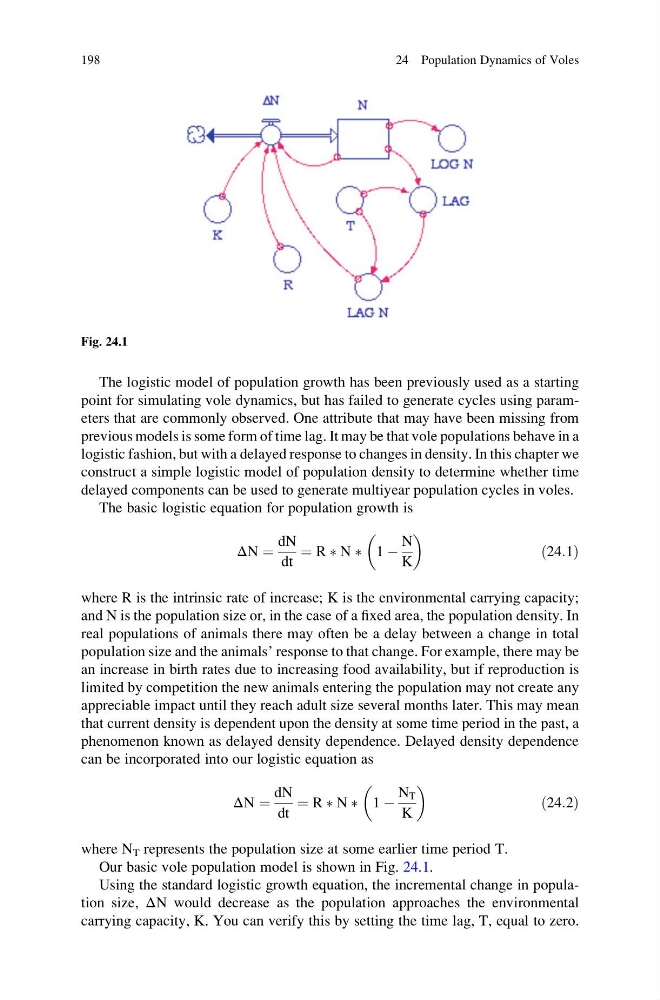
Our basic vole population model is shown in Fig. 24.1.
Using the standard logistic growth equation, the incremental change in population size, ΔN would decrease as the population approaches the environmental
carrying capacity, K. You can verify this by setting the time lag, T, equal to zero.
Fig. 24.1
198
24 Population Dynamics of Voles
point for simulating vole dynamics, but has failed to generate cycles using parameters that are commonly observed. One attribute that may have been missing from
previous models is some form of time lag. It may be that vole populations behave in a
logistic fashion, but with a delayed response to changes in density. In this chapter we
construct a simple logistic model of population density to determine whether time
delayed components can be used to generate multiyear population cycles in voles.
The basic logistic equation for population growth is
ΔN ¼
dN
dt
¼ R Ã N Ã 1 À
N
K
ð24:1Þ
where R is the intrinsic rate of increase; K is the environmental carrying capacity;
and N is the population size or, in the case of a fixed area, the population density. In
real populations of animals there may often be a delay between a change in total
population size and the animals’ response to that change. For example, there may be
an increase in birth rates due to increasing food availability, but if reproduction is
limited by competition the new animals entering the population may not create any
appreciable impact until they reach adult size several months later. This may mean
that current density is dependent upon the density at some time period in the past, a
phenomenon known as delayed density dependence. Delayed density dependence
can be incorporated into our logistic equation as
ΔN ¼
dN
dt
¼ R Ã N Ã 1 À
N T
K
ð24:2Þ
where N T represents the population size at some earlier time period T.
Our basic vole population model is shown in Fig. 24.1.
Using the standard logistic growth equation, the incremental change in population size, ΔN would decrease as the population approaches the environmental
carrying capacity, K. You can verify this by setting the time lag, T, equal to zero.
Fig. 24.1
198
24 Population Dynamics of Voles