

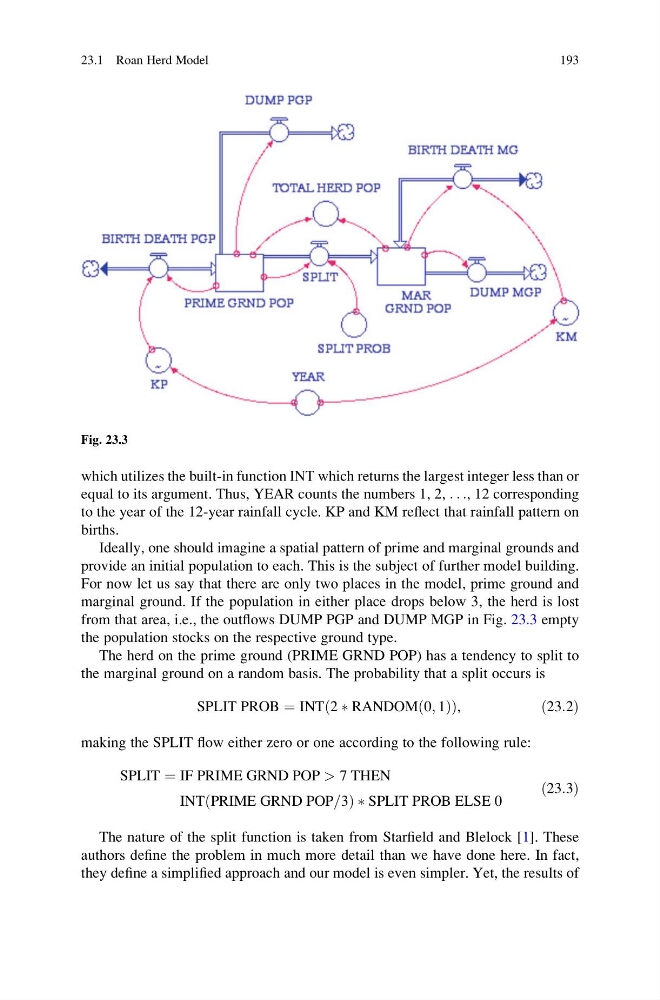
which utilizes the built-in function INT which returns the largest integer less than or
equal to its argument. Thus, YEAR counts the numbers 1, 2, . . ., 12 corresponding
to the year of the 12-year rainfall cycle. KP and KM reflect that rainfall pattern on
births.
Ideally, one should imagine a spatial pattern of prime and marginal grounds and
provide an initial population to each. This is the subject of further model building.
For now let us say that there are only two places in the model, prime ground and
marginal ground. If the population in either place drops below 3, the herd is lost
from that area, i.e., the outflows DUMP PGP and DUMP MGP in Fig. 23.3 empty
the population stocks on the respective ground type.
The herd on the prime ground (PRIME GRND POP) has a tendency to split to
the marginal ground on a random basis. The probability that a split occurs is
SPLIT PROB ¼ INT 2 Ã RANDOM 0; 1
ð Þ
ð
Þ ,
ð23:2Þ
making the SPLIT flow either zero or one according to the following rule:
SPLIT ¼ IF PRIME GRND POP > 7 THEN
INT PRIME GRND POP=3
ð
Þ Ã SPLIT PROB ELSE 0
ð23:3Þ
The nature of the split function is taken from Starfield and Blelock [1]. These
authors define the problem in much more detail than we have done here. In fact,
they define a simplified approach and our model is even simpler. Yet, the results of
Fig. 23.3
23.1 Roan Herd Model
193
equal to its argument. Thus, YEAR counts the numbers 1, 2, . . ., 12 corresponding
to the year of the 12-year rainfall cycle. KP and KM reflect that rainfall pattern on
births.
Ideally, one should imagine a spatial pattern of prime and marginal grounds and
provide an initial population to each. This is the subject of further model building.
For now let us say that there are only two places in the model, prime ground and
marginal ground. If the population in either place drops below 3, the herd is lost
from that area, i.e., the outflows DUMP PGP and DUMP MGP in Fig. 23.3 empty
the population stocks on the respective ground type.
The herd on the prime ground (PRIME GRND POP) has a tendency to split to
the marginal ground on a random basis. The probability that a split occurs is
SPLIT PROB ¼ INT 2 Ã RANDOM 0; 1
ð Þ
ð
Þ ,
ð23:2Þ
making the SPLIT flow either zero or one according to the following rule:
SPLIT ¼ IF PRIME GRND POP > 7 THEN
INT PRIME GRND POP=3
ð
Þ Ã SPLIT PROB ELSE 0
ð23:3Þ
The nature of the split function is taken from Starfield and Blelock [1]. These
authors define the problem in much more detail than we have done here. In fact,
they define a simplified approach and our model is even simpler. Yet, the results of
Fig. 23.3
23.1 Roan Herd Model
193