

21.2 Basic Epidemic Model Equations
I(t) ¼ I(t À dt) + (CONTRACTION À REMOVAL) * dt
INIT I ¼ 20
INFLOWS:
CONTRACTION ¼ BETA * S * I
OUTFLOWS:
REMOVAL ¼ I
S(t) ¼ S(t À dt) + (NONIMMUNE_IMMIGRANTS À CONTRACTION) * dt
INIT S ¼ 1000
INFLOWS:
NONIMMUNE_IMMIGRANTS ¼ 7
OUTFLOWS:
CONTRACTION ¼ BETA * S * I
BETA ¼ .002
21.3 Two Infective Populations
Let us expand on the model of the previous section and assume that an individual breaks
out with the disease upon contact with a virus that can either be carried by members of
the same population or by organisms of another species. Prominent examples are the
Marburg and Ebola viruses that can spread from monkeys to humans. For a powerful
description of the dynamics of these viruses see, for example, Preston [1].
We begin our model with the set up of the previous section and duplicate it to
capture the spread of the disease in the second population and from that population
to the other one. To duplicate the STELLA model of the previous section, select the
entire model by choosing Select All from the Edit menu and then copy it. Then
make the necessary changes in the names of the variables and the connections
among the two model parts. Notice that we only captured here the one-way
movement of the virus from the infective stock I2 to S1 (Fig. 21.3). You can easily
explore the case of the virus spreading from any of the two populations to the other.
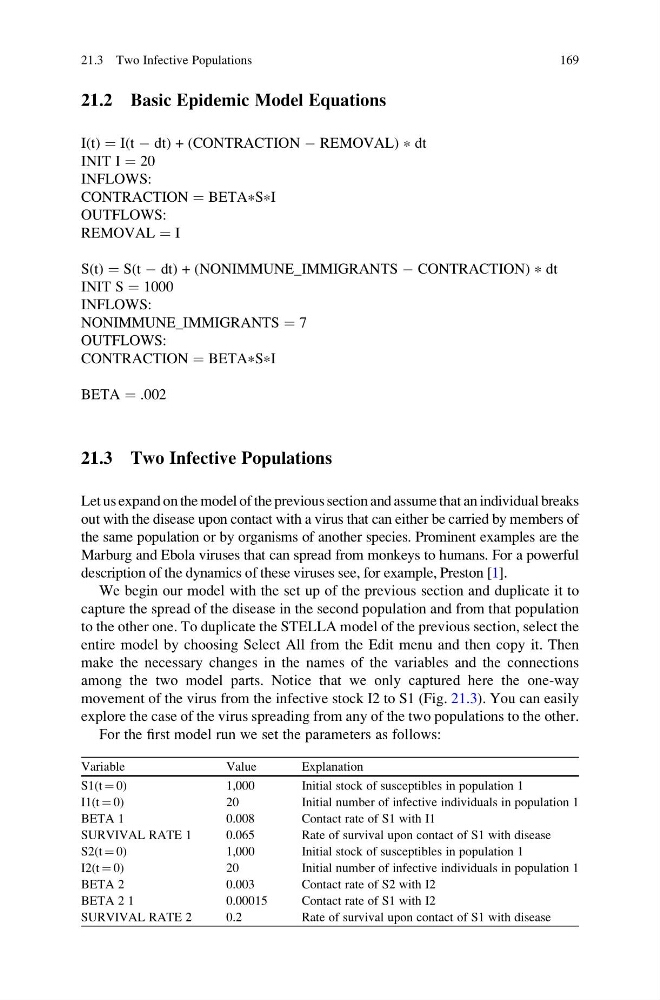
For the first model run we set the parameters as follows:
Variable
Value
Explanation
S1(t ¼ 0)
1,000
Initial stock of susceptibles in population 1
I1(t ¼ 0)
20
Initial number of infective individuals in population 1
BETA 1
0.008
Contact rate of S1 with I1
SURVIVAL RATE 1
0.065
Rate of survival upon contact of S1 with disease
S2(t ¼ 0)
1,000
Initial stock of susceptibles in population 1
I2(t ¼ 0)
20
Initial number of infective individuals in population 1
BETA 2
0.003
Contact rate of S2 with I2
BETA 2 1
0.00015
Contact rate of S1 with I2
SURVIVAL RATE 2
0.2
Rate of survival upon contact of S1 with disease
21.3 Two Infective Populations
169
I(t) ¼ I(t À dt) + (CONTRACTION À REMOVAL) * dt
INIT I ¼ 20
INFLOWS:
CONTRACTION ¼ BETA * S * I
OUTFLOWS:
REMOVAL ¼ I
S(t) ¼ S(t À dt) + (NONIMMUNE_IMMIGRANTS À CONTRACTION) * dt
INIT S ¼ 1000
INFLOWS:
NONIMMUNE_IMMIGRANTS ¼ 7
OUTFLOWS:
CONTRACTION ¼ BETA * S * I
BETA ¼ .002
21.3 Two Infective Populations
Let us expand on the model of the previous section and assume that an individual breaks
out with the disease upon contact with a virus that can either be carried by members of
the same population or by organisms of another species. Prominent examples are the
Marburg and Ebola viruses that can spread from monkeys to humans. For a powerful
description of the dynamics of these viruses see, for example, Preston [1].
We begin our model with the set up of the previous section and duplicate it to
capture the spread of the disease in the second population and from that population
to the other one. To duplicate the STELLA model of the previous section, select the
entire model by choosing Select All from the Edit menu and then copy it. Then
make the necessary changes in the names of the variables and the connections
among the two model parts. Notice that we only captured here the one-way
movement of the virus from the infective stock I2 to S1 (Fig. 21.3). You can easily
explore the case of the virus spreading from any of the two populations to the other.
For the first model run we set the parameters as follows:
Variable
Value
Explanation
S1(t ¼ 0)
1,000
Initial stock of susceptibles in population 1
I1(t ¼ 0)
20
Initial number of infective individuals in population 1
BETA 1
0.008
Contact rate of S1 with I1
SURVIVAL RATE 1
0.065
Rate of survival upon contact of S1 with disease
S2(t ¼ 0)
1,000
Initial stock of susceptibles in population 1
I2(t ¼ 0)
20
Initial number of infective individuals in population 1
BETA 2
0.003
Contact rate of S2 with I2
BETA 2 1
0.00015
Contact rate of S1 with I2
SURVIVAL RATE 2
0.2
Rate of survival upon contact of S1 with disease
21.3 Two Infective Populations
169