

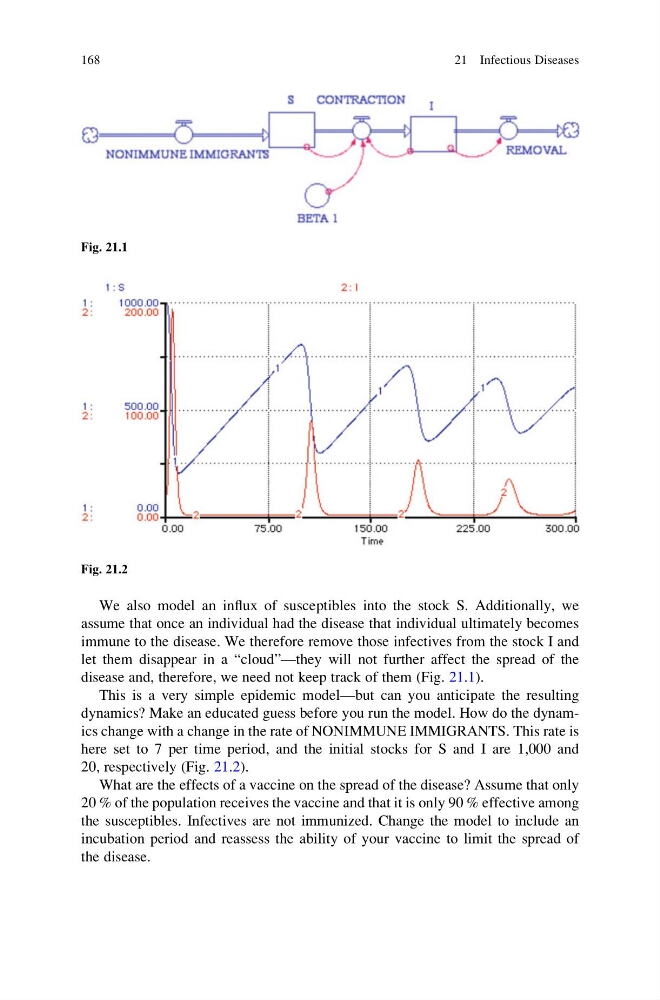
We also model an influx of susceptibles into the stock S. Additionally, we
assume that once an individual had the disease that individual ultimately becomes
immune to the disease. We therefore remove those infectives from the stock I and
let them disappear in a “cloud”—they will not further affect the spread of the
disease and, therefore, we need not keep track of them (Fig. 21.1).
This is a very simple epidemic model—but can you anticipate the resulting
dynamics? Make an educated guess before you run the model. How do the dynamics change with a change in the rate of NONIMMUNE IMMIGRANTS. This rate is
here set to 7 per time period, and the initial stocks for S and I are 1,000 and
20, respectively (Fig. 21.2).
What are the effects of a vaccine on the spread of the disease? Assume that only
20 % of the population receives the vaccine and that it is only 90 % effective among
the susceptibles. Infectives are not immunized. Change the model to include an
incubation period and reassess the ability of your vaccine to limit the spread of
the disease.
Fig. 21.1
Fig. 21.2
168
21 Infectious Diseases
assume that once an individual had the disease that individual ultimately becomes
immune to the disease. We therefore remove those infectives from the stock I and
let them disappear in a “cloud”—they will not further affect the spread of the
disease and, therefore, we need not keep track of them (Fig. 21.1).
This is a very simple epidemic model—but can you anticipate the resulting
dynamics? Make an educated guess before you run the model. How do the dynamics change with a change in the rate of NONIMMUNE IMMIGRANTS. This rate is
here set to 7 per time period, and the initial stocks for S and I are 1,000 and
20, respectively (Fig. 21.2).
What are the effects of a vaccine on the spread of the disease? Assume that only
20 % of the population receives the vaccine and that it is only 90 % effective among
the susceptibles. Infectives are not immunized. Change the model to include an
incubation period and reassess the ability of your vaccine to limit the spread of
the disease.
Fig. 21.1
Fig. 21.2
168
21 Infectious Diseases