

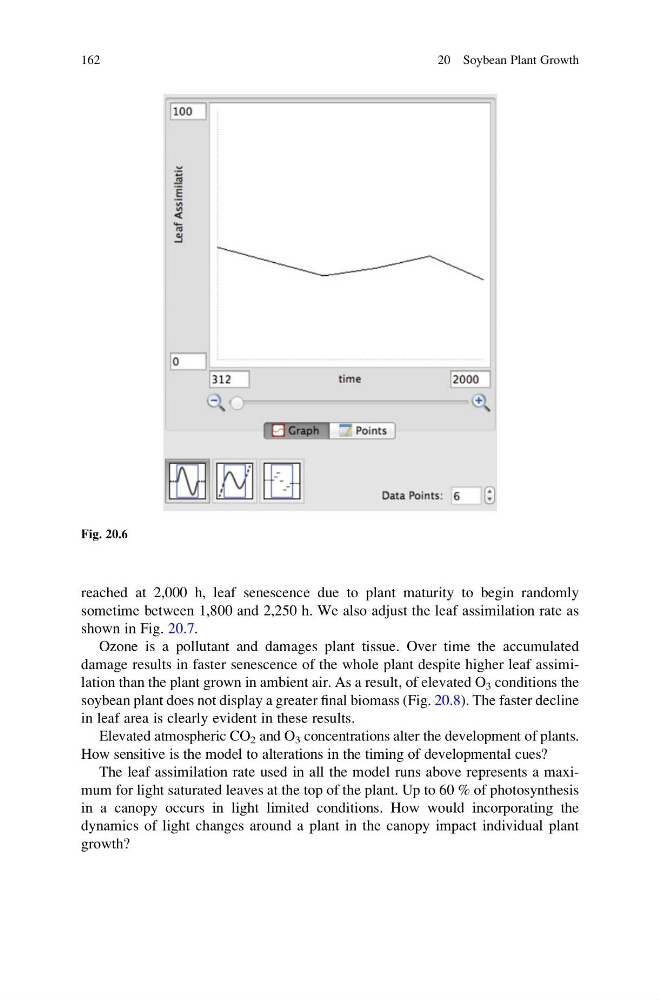
reached at 2,000 h, leaf senescence due to plant maturity to begin randomly
sometime between 1,800 and 2,250 h. We also adjust the leaf assimilation rate as
shown in Fig. 20.7.
Ozone is a pollutant and damages plant tissue. Over time the accumulated
damage results in faster senescence of the whole plant despite higher leaf assimilation than the plant grown in ambient air. As a result, of elevated O 3 conditions the
soybean plant does not display a greater final biomass (Fig. 20.8). The faster decline
in leaf area is clearly evident in these results.
Elevated atmospheric CO 2 and O 3 concentrations alter the development of plants.
How sensitive is the model to alterations in the timing of developmental cues?
The leaf assimilation rate used in all the model runs above represents a maximum for light saturated leaves at the top of the plant. Up to 60 % of photosynthesis
in a canopy occurs in light limited conditions. How would incorporating the
dynamics of light changes around a plant in the canopy impact individual plant
growth?
Fig. 20.6
162
20 Soybean Plant Growth
sometime between 1,800 and 2,250 h. We also adjust the leaf assimilation rate as
shown in Fig. 20.7.
Ozone is a pollutant and damages plant tissue. Over time the accumulated
damage results in faster senescence of the whole plant despite higher leaf assimilation than the plant grown in ambient air. As a result, of elevated O 3 conditions the
soybean plant does not display a greater final biomass (Fig. 20.8). The faster decline
in leaf area is clearly evident in these results.
Elevated atmospheric CO 2 and O 3 concentrations alter the development of plants.
How sensitive is the model to alterations in the timing of developmental cues?
The leaf assimilation rate used in all the model runs above represents a maximum for light saturated leaves at the top of the plant. Up to 60 % of photosynthesis
in a canopy occurs in light limited conditions. How would incorporating the
dynamics of light changes around a plant in the canopy impact individual plant
growth?
Fig. 20.6
162
20 Soybean Plant Growth