

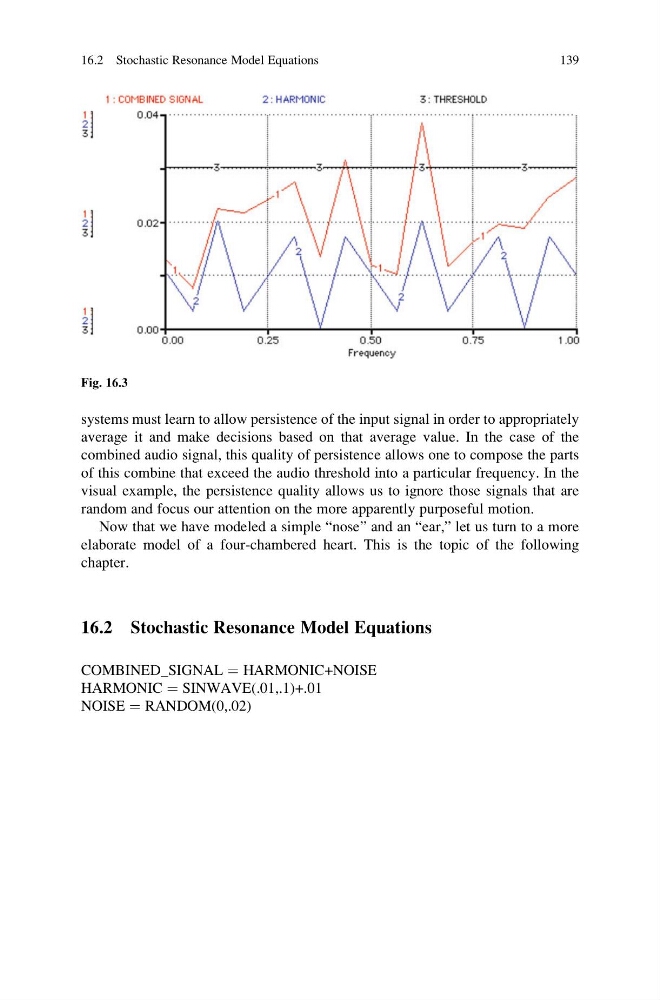
systems must learn to allow persistence of the input signal in order to appropriately
average it and make decisions based on that average value. In the case of the
combined audio signal, this quality of persistence allows one to compose the parts
of this combine that exceed the audio threshold into a particular frequency. In the
visual example, the persistence quality allows us to ignore those signals that are
random and focus our attention on the more apparently purposeful motion.
Now that we have modeled a simple “nose” and an “ear,” let us turn to a more
elaborate model of a four-chambered heart. This is the topic of the following
chapter.
16.2 Stochastic Resonance Model Equations
COMBINED_SIGNAL ¼ HARMONIC+NOISE
HARMONIC ¼ SINWAVE(.01,.1)+.01
NOISE ¼ RANDOM(0,.02)
Fig. 16.3
16.2 Stochastic Resonance Model Equations
139
average it and make decisions based on that average value. In the case of the
combined audio signal, this quality of persistence allows one to compose the parts
of this combine that exceed the audio threshold into a particular frequency. In the
visual example, the persistence quality allows us to ignore those signals that are
random and focus our attention on the more apparently purposeful motion.
Now that we have modeled a simple “nose” and an “ear,” let us turn to a more
elaborate model of a four-chambered heart. This is the topic of the following
chapter.
16.2 Stochastic Resonance Model Equations
COMBINED_SIGNAL ¼ HARMONIC+NOISE
HARMONIC ¼ SINWAVE(.01,.1)+.01
NOISE ¼ RANDOM(0,.02)
Fig. 16.3
16.2 Stochastic Resonance Model Equations
139