

The “frequency” of the noise is the DT. In every DT the random level of the
noise is changed. If the noise is not generated often enough, the signals become
impossibly masked by the noise.
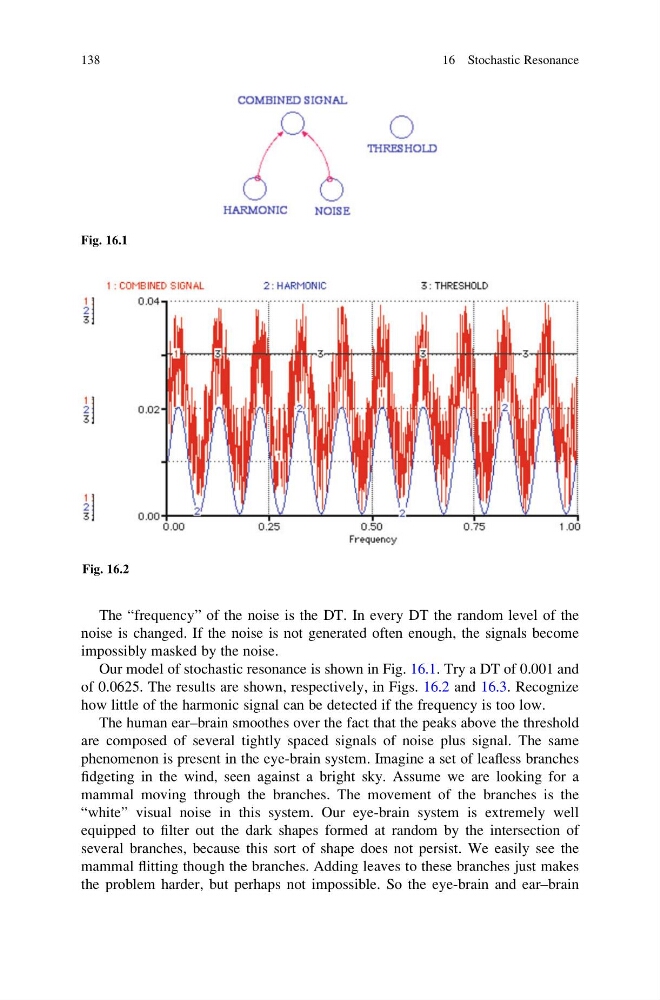
Our model of stochastic resonance is shown in Fig. 16.1. Try a DT of 0.001 and
of 0.0625. The results are shown, respectively, in Figs. 16.2 and 16.3. Recognize
how little of the harmonic signal can be detected if the frequency is too low.
The human ear–brain smoothes over the fact that the peaks above the threshold
are composed of several tightly spaced signals of noise plus signal. The same
phenomenon is present in the eye-brain system. Imagine a set of leafless branches
fidgeting in the wind, seen against a bright sky. Assume we are looking for a
mammal moving through the branches. The movement of the branches is the
“white” visual noise in this system. Our eye-brain system is extremely well
equipped to filter out the dark shapes formed at random by the intersection of
several branches, because this sort of shape does not persist. We easily see the
mammal flitting though the branches. Adding leaves to these branches just makes
the problem harder, but perhaps not impossible. So the eye-brain and ear–brain
Fig. 16.1
Fig. 16.2
138
16 Stochastic Resonance
noise is changed. If the noise is not generated often enough, the signals become
impossibly masked by the noise.
Our model of stochastic resonance is shown in Fig. 16.1. Try a DT of 0.001 and
of 0.0625. The results are shown, respectively, in Figs. 16.2 and 16.3. Recognize
how little of the harmonic signal can be detected if the frequency is too low.
The human ear–brain smoothes over the fact that the peaks above the threshold
are composed of several tightly spaced signals of noise plus signal. The same
phenomenon is present in the eye-brain system. Imagine a set of leafless branches
fidgeting in the wind, seen against a bright sky. Assume we are looking for a
mammal moving through the branches. The movement of the branches is the
“white” visual noise in this system. Our eye-brain system is extremely well
equipped to filter out the dark shapes formed at random by the intersection of
several branches, because this sort of shape does not persist. We easily see the
mammal flitting though the branches. Adding leaves to these branches just makes
the problem harder, but perhaps not impossible. So the eye-brain and ear–brain
Fig. 16.1
Fig. 16.2
138
16 Stochastic Resonance