

The model does not depict a perfect nose. There are too few receptors. Add more
receptors and increase the range of the possible odors. Change the sensitivity of
some receptor such that if there is too much odor of a particular strength or for a
particular duration, that receptor gets “numb” and provides the wrong signals to the
brain. How can the brain minimize those errors? Can you reprogram this model
such that any continuous odor is eventually ignored, until a sudden change in the
level of the odor is introduced?
15.2 Odor Sensing Model Equations
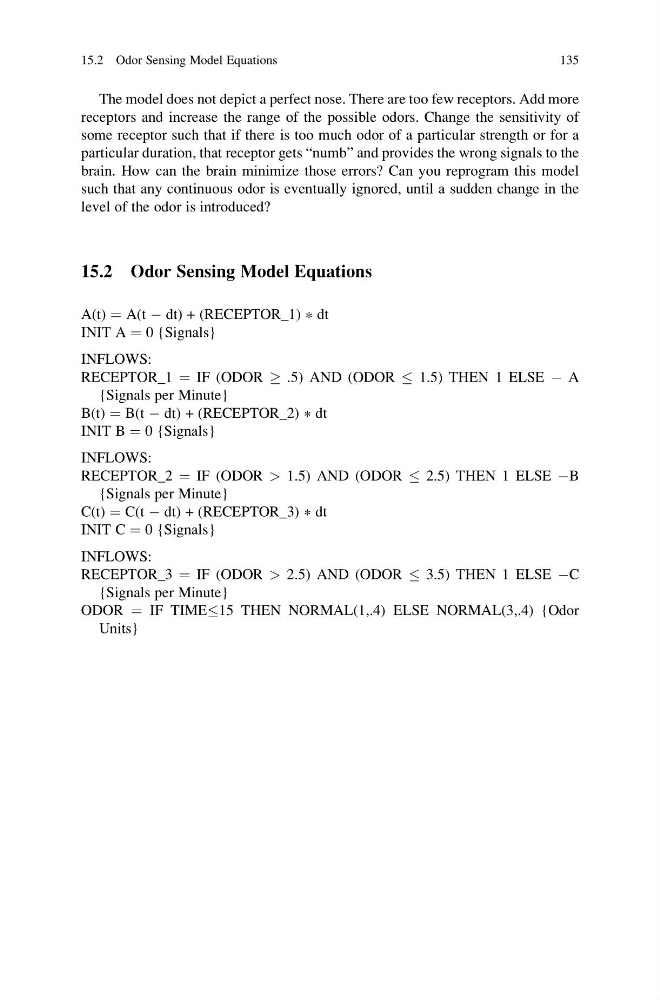
A(t) ¼ A(t À dt) + (RECEPTOR_1) * dt
INIT A ¼ 0 {Signals}
INFLOWS:
RECEPTOR_1 ¼ IF (ODOR ! .5) AND (ODOR
1.5) THEN 1 ELSE À A
{Signals per Minute}
B(t) ¼ B(t À dt) + (RECEPTOR_2) * dt
INIT B ¼ 0 {Signals}
INFLOWS:
RECEPTOR_2 ¼ IF (ODOR > 1.5) AND (ODOR
2.5) THEN 1 ELSE ÀB
{Signals per Minute}
C(t) ¼ C(t À dt) + (RECEPTOR_3) * dt
INIT C ¼ 0 {Signals}
INFLOWS:
RECEPTOR_3 ¼ IF (ODOR > 2.5) AND (ODOR
3.5) THEN 1 ELSE ÀC
{Signals per Minute}
ODOR ¼ IF TIME 15 THEN NORMAL(1,.4) ELSE NORMAL(3,.4) {Odor
Units}
15.2 Odor Sensing Model Equations
135
receptors and increase the range of the possible odors. Change the sensitivity of
some receptor such that if there is too much odor of a particular strength or for a
particular duration, that receptor gets “numb” and provides the wrong signals to the
brain. How can the brain minimize those errors? Can you reprogram this model
such that any continuous odor is eventually ignored, until a sudden change in the
level of the odor is introduced?
15.2 Odor Sensing Model Equations
A(t) ¼ A(t À dt) + (RECEPTOR_1) * dt
INIT A ¼ 0 {Signals}
INFLOWS:
RECEPTOR_1 ¼ IF (ODOR ! .5) AND (ODOR
1.5) THEN 1 ELSE À A
{Signals per Minute}
B(t) ¼ B(t À dt) + (RECEPTOR_2) * dt
INIT B ¼ 0 {Signals}
INFLOWS:
RECEPTOR_2 ¼ IF (ODOR > 1.5) AND (ODOR
2.5) THEN 1 ELSE ÀB
{Signals per Minute}
C(t) ¼ C(t À dt) + (RECEPTOR_3) * dt
INIT C ¼ 0 {Signals}
INFLOWS:
RECEPTOR_3 ¼ IF (ODOR > 2.5) AND (ODOR
3.5) THEN 1 ELSE ÀC
{Signals per Minute}
ODOR ¼ IF TIME 15 THEN NORMAL(1,.4) ELSE NORMAL(3,.4) {Odor
Units}
15.2 Odor Sensing Model Equations
135