

RECEPTOR 1 ¼ IF ODOR ! :5
ð
ÞAND ODOR 1:5
ð
ÞTHEN 1 ELSE À A
ð15:2Þ
RECEPTOR 2 ¼ IF ODOR > 1:5
ð
ÞAND ODOR 2:5
ð
ÞTHEN 1 ELSE À B
ð15:3Þ
RECEPTOR 3 ¼ IF ODOR > 2:5
ð
ÞAND ODOR 3:5
ð
ÞTHEN 1 ELSE À C
ð15:4Þ
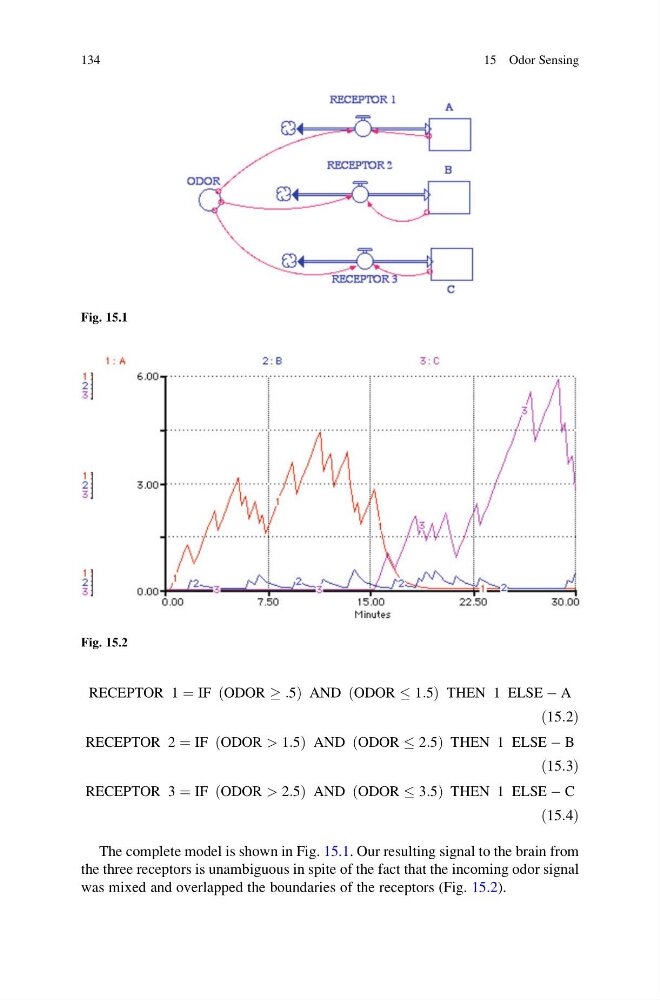
The complete model is shown in Fig. 15.1. Our resulting signal to the brain from
the three receptors is unambiguous in spite of the fact that the incoming odor signal
was mixed and overlapped the boundaries of the receptors (Fig. 15.2).
Fig. 15.1
Fig. 15.2
134
15 Odor Sensing
ð
ÞAND ODOR 1:5
ð
ÞTHEN 1 ELSE À A
ð15:2Þ
RECEPTOR 2 ¼ IF ODOR > 1:5
ð
ÞAND ODOR 2:5
ð
ÞTHEN 1 ELSE À B
ð15:3Þ
RECEPTOR 3 ¼ IF ODOR > 2:5
ð
ÞAND ODOR 3:5
ð
ÞTHEN 1 ELSE À C
ð15:4Þ
The complete model is shown in Fig. 15.1. Our resulting signal to the brain from
the three receptors is unambiguous in spite of the fact that the incoming odor signal
was mixed and overlapped the boundaries of the receptors (Fig. 15.2).
Fig. 15.1
Fig. 15.2
134
15 Odor Sensing