

Following this model of the behavior of an individual cell in response to the impulses
from its environment, we will model the behavior of an entire organism in response to
changes in its physical surroundings. This is the topic of the following chapter.
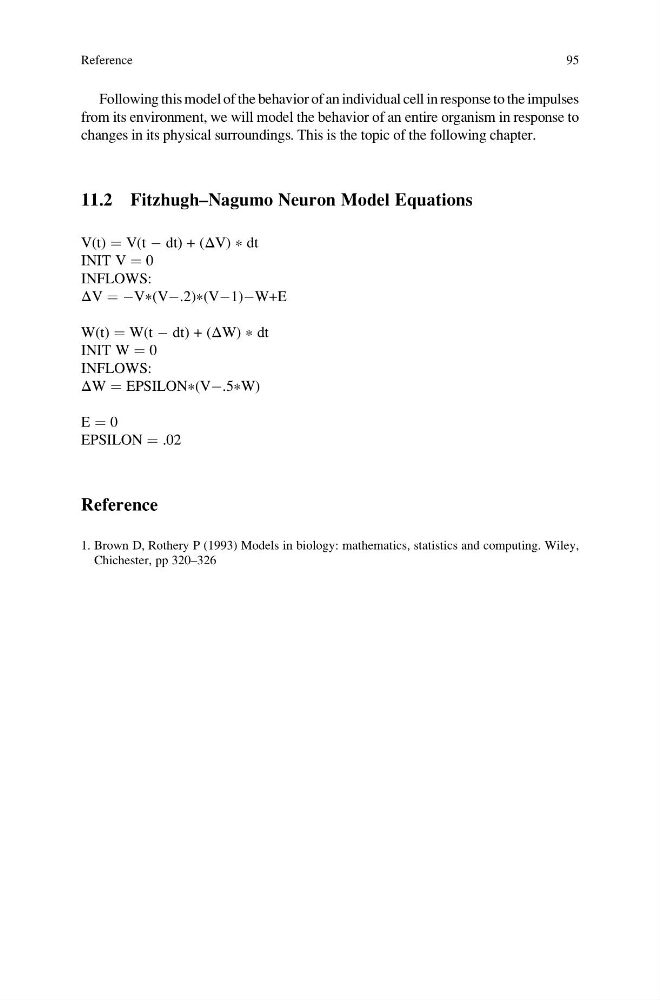
11.2 Fitzhugh–Nagumo Neuron Model Equations
V(t) ¼ V(t À dt) + (ΔV) * dt
INIT V ¼ 0
INFLOWS:
ΔV ¼ ÀV * (VÀ.2) * (VÀ1)ÀW+E
W(t) ¼ W(t À dt) + (ΔW) * dt
INIT W ¼ 0
INFLOWS:
ΔW ¼ EPSILON * (VÀ.5 * W)
E ¼ 0
EPSILON ¼ .02
Reference
1. Brown D, Rothery P (1993) Models in biology: mathematics, statistics and computing. Wiley,
Chichester, pp 320–326
Reference
95
from its environment, we will model the behavior of an entire organism in response to
changes in its physical surroundings. This is the topic of the following chapter.
11.2 Fitzhugh–Nagumo Neuron Model Equations
V(t) ¼ V(t À dt) + (ΔV) * dt
INIT V ¼ 0
INFLOWS:
ΔV ¼ ÀV * (VÀ.2) * (VÀ1)ÀW+E
W(t) ¼ W(t À dt) + (ΔW) * dt
INIT W ¼ 0
INFLOWS:
ΔW ¼ EPSILON * (VÀ.5 * W)
E ¼ 0
EPSILON ¼ .02
Reference
1. Brown D, Rothery P (1993) Models in biology: mathematics, statistics and computing. Wiley,
Chichester, pp 320–326
Reference
95