

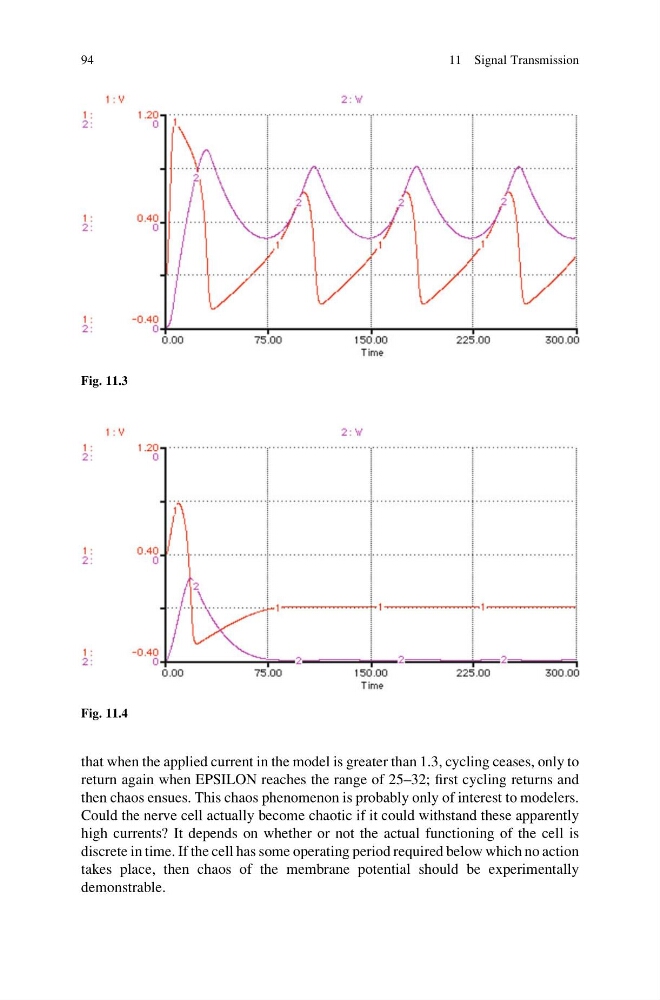
that when the applied current in the model is greater than 1.3, cycling ceases, only to
return again when EPSILON reaches the range of 25–32; first cycling returns and
then chaos ensues. This chaos phenomenon is probably only of interest to modelers.
Could the nerve cell actually become chaotic if it could withstand these apparently
high currents? It depends on whether or not the actual functioning of the cell is
discrete in time. If the cell has some operating period required below which no action
takes place, then chaos of the membrane potential should be experimentally
demonstrable.
Fig. 11.4
Fig. 11.3
94
11 Signal Transmission
return again when EPSILON reaches the range of 25–32; first cycling returns and
then chaos ensues. This chaos phenomenon is probably only of interest to modelers.
Could the nerve cell actually become chaotic if it could withstand these apparently
high currents? It depends on whether or not the actual functioning of the cell is
discrete in time. If the cell has some operating period required below which no action
takes place, then chaos of the membrane potential should be experimentally
demonstrable.
Fig. 11.4
Fig. 11.3
94
11 Signal Transmission