

16. Theoretical Properties of Extinction by Inbreeding Depression
279
Random genetic drift in a multilocus system causes fluctuations in the mean
gene frequency of all loci in addition to the dispersion of gene frequencies between loci. The dispersion of gene frequencies between loci was modeled as
increases in the variance of gene frequencies and inbreeding coefficient. The
effect of genetic drift to the mean gene frequency was incorporated into the model
by means of randomly sampling the mean gene frequency in the next generation
from normal variates generated from the mean gene frequency after mutation and
selection in the present generation. The mean gene frequency in the next generation is q t+1 = q t * + γ t , where γ t is a random normal variate with mean 0 and standard
deviation √q t * (1 − q t * )/(2nN), and q t * denotes the mean gene frequency after
mutation and selection but before reproduction in the tth generation, N is the
population size, and n is the number of loci.
Dynamics
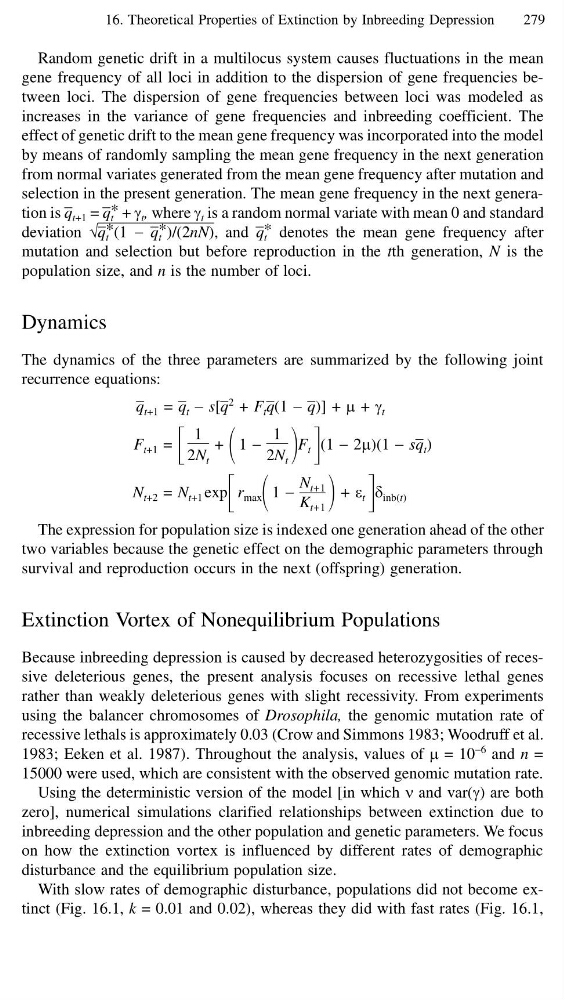
The dynamics of the three parameters are summarized by the following joint
recurrence equations:
q t+1 = q t − s[q
2 + F t q(1 − q)] + µ + γ t
F t+1 = ΄
1
2N t
+ 1 −
1
2N t F t ΅ (1 − 2µ)(1 − sq t )
N t+2 = N t+1 exp ΄ r max 1 −
N t+1
K t+1 + ε t ΅ δ inb(t)
The expression for population size is indexed one generation ahead of the other
two variables because the genetic effect on the demographic parameters through
survival and reproduction occurs in the next (offspring) generation.
Extinction Vortex of Nonequilibrium Populations
Because inbreeding depression is caused by decreased heterozygosities of recessive deleterious genes, the present analysis focuses on recessive lethal genes
rather than weakly deleterious genes with slight recessivity. From experiments
using the balancer chromosomes of Drosophila, the genomic mutation rate of
recessive lethals is approximately 0.03 (Crow and Simmons 1983; Woodruff et al.
1983; Eeken et al. 1987). Throughout the analysis, values of µ = 10
−6 and n =
15000 were used, which are consistent with the observed genomic mutation rate.
Using the deterministic version of the model [in which ν and var(γ) are both
zero], numerical simulations clarified relationships between extinction due to
inbreeding depression and the other population and genetic parameters. We focus
on how the extinction vortex is influenced by different rates of demographic
disturbance and the equilibrium population size.
With slow rates of demographic disturbance, populations did not become extinct (Fig. 16.1, k = 0.01 and 0.02), whereas they did with fast rates (Fig. 16.1,
279
Random genetic drift in a multilocus system causes fluctuations in the mean
gene frequency of all loci in addition to the dispersion of gene frequencies between loci. The dispersion of gene frequencies between loci was modeled as
increases in the variance of gene frequencies and inbreeding coefficient. The
effect of genetic drift to the mean gene frequency was incorporated into the model
by means of randomly sampling the mean gene frequency in the next generation
from normal variates generated from the mean gene frequency after mutation and
selection in the present generation. The mean gene frequency in the next generation is q t+1 = q t * + γ t , where γ t is a random normal variate with mean 0 and standard
deviation √q t * (1 − q t * )/(2nN), and q t * denotes the mean gene frequency after
mutation and selection but before reproduction in the tth generation, N is the
population size, and n is the number of loci.
Dynamics
The dynamics of the three parameters are summarized by the following joint
recurrence equations:
q t+1 = q t − s[q
2 + F t q(1 − q)] + µ + γ t
F t+1 = ΄
1
2N t
+ 1 −
1
2N t F t ΅ (1 − 2µ)(1 − sq t )
N t+2 = N t+1 exp ΄ r max 1 −
N t+1
K t+1 + ε t ΅ δ inb(t)
The expression for population size is indexed one generation ahead of the other
two variables because the genetic effect on the demographic parameters through
survival and reproduction occurs in the next (offspring) generation.
Extinction Vortex of Nonequilibrium Populations
Because inbreeding depression is caused by decreased heterozygosities of recessive deleterious genes, the present analysis focuses on recessive lethal genes
rather than weakly deleterious genes with slight recessivity. From experiments
using the balancer chromosomes of Drosophila, the genomic mutation rate of
recessive lethals is approximately 0.03 (Crow and Simmons 1983; Woodruff et al.
1983; Eeken et al. 1987). Throughout the analysis, values of µ = 10
−6 and n =
15000 were used, which are consistent with the observed genomic mutation rate.
Using the deterministic version of the model [in which ν and var(γ) are both
zero], numerical simulations clarified relationships between extinction due to
inbreeding depression and the other population and genetic parameters. We focus
on how the extinction vortex is influenced by different rates of demographic
disturbance and the equilibrium population size.
With slow rates of demographic disturbance, populations did not become extinct (Fig. 16.1, k = 0.01 and 0.02), whereas they did with fast rates (Fig. 16.1,