

16. Theoretical Properties of Extinction by Inbreeding Depression
277
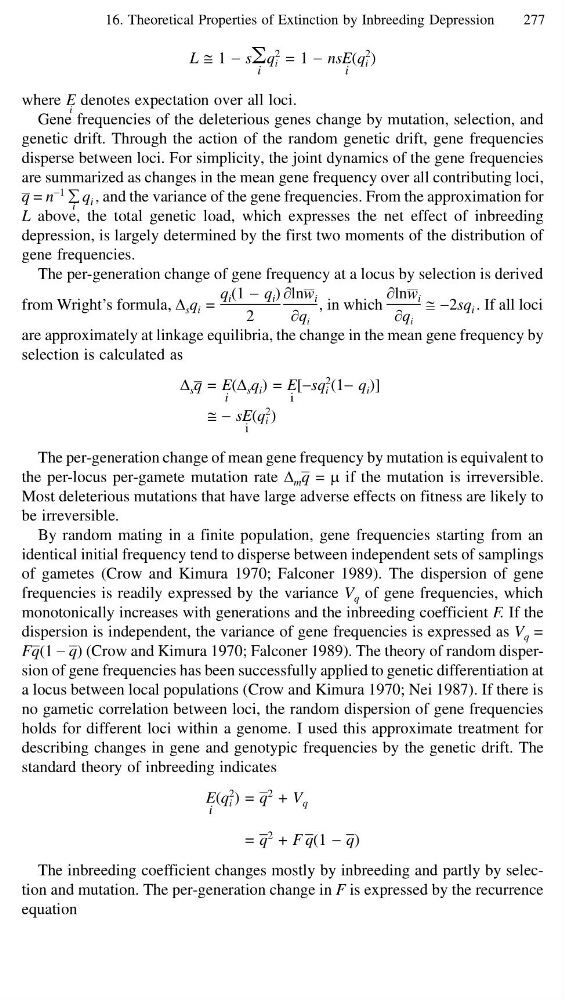
L ≅ 1 − s͚
i
q i
2 = 1 − nsE
i
(q i
2
)
where E denotes expectation over all loci.
i
Gene frequencies of the deleterious genes change by mutation, selection, and
genetic drift. Through the action of the random genetic drift, gene frequencies
disperse between loci. For simplicity, the joint dynamics of the gene frequencies
are summarized as changes in the mean gene frequency over all contributing loci,
q = n
−1
∑ q i , and the variance of the gene frequencies. From the approximation for
i
L above, the total genetic load, which expresses the net effect of inbreeding
depression, is largely determined by the first two moments of the distribution of
gene frequencies.
The per-generation change of gene frequency at a locus by selection is derived
from Wright’s formula, ∆ s q i =
q i (1 − q i )
2
∂lnw i
∂q i
, in which
∂lnw i
∂q i
≅ −2sq i . If all loci
are approximately at linkage equilibria, the change in the mean gene frequency by
selection is calculated as
∆ s q = E
i
(∆ s q i ) = E
i
[−sq i
2 (1− q i )]
≅ − sE
i
(q i
2
)
The per-generation change of mean gene frequency by mutation is equivalent to
the per-locus per-gamete mutation rate ∆ m q = µ if the mutation is irreversible.
Most deleterious mutations that have large adverse effects on fitness are likely to
be irreversible.
By random mating in a finite population, gene frequencies starting from an
identical initial frequency tend to disperse between independent sets of samplings
of gametes (Crow and Kimura 1970; Falconer 1989). The dispersion of gene
frequencies is readily expressed by the variance V q of gene frequencies, which
monotonically increases with generations and the inbreeding coefficient F. If the
dispersion is independent, the variance of gene frequencies is expressed as V q =
Fq(1 − q) (Crow and Kimura 1970; Falconer 1989). The theory of random dispersion of gene frequencies has been successfully applied to genetic differentiation at
a locus between local populations (Crow and Kimura 1970; Nei 1987). If there is
no gametic correlation between loci, the random dispersion of gene frequencies
holds for different loci within a genome. I used this approximate treatment for
describing changes in gene and genotypic frequencies by the genetic drift. The
standard theory of inbreeding indicates
E
i
(q i
2 ) = q
2 + V q
= q
2 + F q(1 − q)
The inbreeding coefficient changes mostly by inbreeding and partly by selection and mutation. The per-generation change in F is expressed by the recurrence
equation
277
L ≅ 1 − s͚
i
q i
2 = 1 − nsE
i
(q i
2
)
where E denotes expectation over all loci.
i
Gene frequencies of the deleterious genes change by mutation, selection, and
genetic drift. Through the action of the random genetic drift, gene frequencies
disperse between loci. For simplicity, the joint dynamics of the gene frequencies
are summarized as changes in the mean gene frequency over all contributing loci,
q = n
−1
∑ q i , and the variance of the gene frequencies. From the approximation for
i
L above, the total genetic load, which expresses the net effect of inbreeding
depression, is largely determined by the first two moments of the distribution of
gene frequencies.
The per-generation change of gene frequency at a locus by selection is derived
from Wright’s formula, ∆ s q i =
q i (1 − q i )
2
∂lnw i
∂q i
, in which
∂lnw i
∂q i
≅ −2sq i . If all loci
are approximately at linkage equilibria, the change in the mean gene frequency by
selection is calculated as
∆ s q = E
i
(∆ s q i ) = E
i
[−sq i
2 (1− q i )]
≅ − sE
i
(q i
2
)
The per-generation change of mean gene frequency by mutation is equivalent to
the per-locus per-gamete mutation rate ∆ m q = µ if the mutation is irreversible.
Most deleterious mutations that have large adverse effects on fitness are likely to
be irreversible.
By random mating in a finite population, gene frequencies starting from an
identical initial frequency tend to disperse between independent sets of samplings
of gametes (Crow and Kimura 1970; Falconer 1989). The dispersion of gene
frequencies is readily expressed by the variance V q of gene frequencies, which
monotonically increases with generations and the inbreeding coefficient F. If the
dispersion is independent, the variance of gene frequencies is expressed as V q =
Fq(1 − q) (Crow and Kimura 1970; Falconer 1989). The theory of random dispersion of gene frequencies has been successfully applied to genetic differentiation at
a locus between local populations (Crow and Kimura 1970; Nei 1987). If there is
no gametic correlation between loci, the random dispersion of gene frequencies
holds for different loci within a genome. I used this approximate treatment for
describing changes in gene and genotypic frequencies by the genetic drift. The
standard theory of inbreeding indicates
E
i
(q i
2 ) = q
2 + V q
= q
2 + F q(1 − q)
The inbreeding coefficient changes mostly by inbreeding and partly by selection and mutation. The per-generation change in F is expressed by the recurrence
equation