

208
Fr´ ed´ eric Gosselin and Jean-Dominique Lebreton
The supercritical, critical, or subcritical behavior of a MT BP is determined by
µ, the dominant eigenvalue of M (i.e., the asymptotic multiplication rate of the
deterministic counterpart of the model) (Joffe and Spitzer 1967). In particular, the
process is subcritical if and only if µ is less than 1. Then, ultimate extinction (i.e.,
reaching the state, [0, 0, . . ., 0]) is certain, the MT BP has a QSD associated with
the asymptotic growth rate λ = µ (Joffe and Spitzer 1967). Therefore, when µ < 1,
the MT BP is quasi-stationary. Furthermore, provided the QSD has a finite first
moment and M is a Leslie matrix, we can prove that the QSD is then a stochastic
extension of the stable age distribution (e.g., Caswell 1989) of matrix population
models.
Case Study: The Alsace White Stork
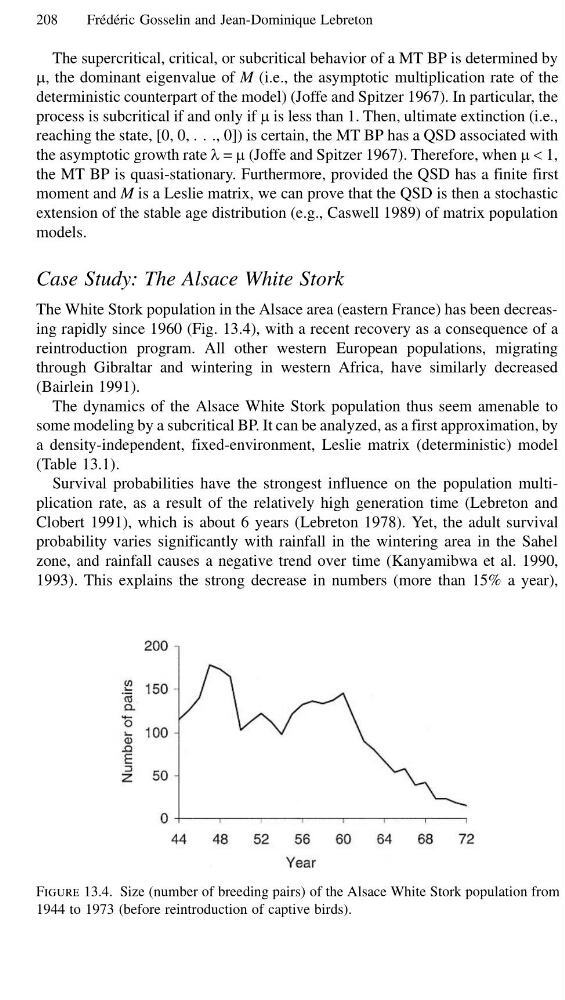
The White Stork population in the Alsace area (eastern France) has been decreasing rapidly since 1960 (Fig. 13.4), with a recent recovery as a consequence of a
reintroduction program. All other western European populations, migrating
through Gibraltar and wintering in western Africa, have similarly decreased
(Bairlein 1991).
The dynamics of the Alsace White Stork population thus seem amenable to
some modeling by a subcritical BP. It can be analyzed, as a first approximation, by
a density-independent, fixed-environment, Leslie matrix (deterministic) model
(Table 13.1).
Survival probabilities have the strongest influence on the population multiplication rate, as a result of the relatively high generation time (Lebreton and
Clobert 1991), which is about 6 years (Lebreton 1978). Yet, the adult survival
probability varies significantly with rainfall in the wintering area in the Sahel
zone, and rainfall causes a negative trend over time (Kanyamibwa et al. 1990,
1993). This explains the strong decrease in numbers (more than 15% a year),
Figure 13.4. Size (number of breeding pairs) of the Alsace White Stork population from
1944 to 1973 (before reintroduction of captive birds).
Fr´ ed´ eric Gosselin and Jean-Dominique Lebreton
The supercritical, critical, or subcritical behavior of a MT BP is determined by
µ, the dominant eigenvalue of M (i.e., the asymptotic multiplication rate of the
deterministic counterpart of the model) (Joffe and Spitzer 1967). In particular, the
process is subcritical if and only if µ is less than 1. Then, ultimate extinction (i.e.,
reaching the state, [0, 0, . . ., 0]) is certain, the MT BP has a QSD associated with
the asymptotic growth rate λ = µ (Joffe and Spitzer 1967). Therefore, when µ < 1,
the MT BP is quasi-stationary. Furthermore, provided the QSD has a finite first
moment and M is a Leslie matrix, we can prove that the QSD is then a stochastic
extension of the stable age distribution (e.g., Caswell 1989) of matrix population
models.
Case Study: The Alsace White Stork
The White Stork population in the Alsace area (eastern France) has been decreasing rapidly since 1960 (Fig. 13.4), with a recent recovery as a consequence of a
reintroduction program. All other western European populations, migrating
through Gibraltar and wintering in western Africa, have similarly decreased
(Bairlein 1991).
The dynamics of the Alsace White Stork population thus seem amenable to
some modeling by a subcritical BP. It can be analyzed, as a first approximation, by
a density-independent, fixed-environment, Leslie matrix (deterministic) model
(Table 13.1).
Survival probabilities have the strongest influence on the population multiplication rate, as a result of the relatively high generation time (Lebreton and
Clobert 1991), which is about 6 years (Lebreton 1978). Yet, the adult survival
probability varies significantly with rainfall in the wintering area in the Sahel
zone, and rainfall causes a negative trend over time (Kanyamibwa et al. 1990,
1993). This explains the strong decrease in numbers (more than 15% a year),
Figure 13.4. Size (number of breeding pairs) of the Alsace White Stork population from
1944 to 1973 (before reintroduction of captive birds).