

12. Individual-Based Models and Assessment of Population Variability
195
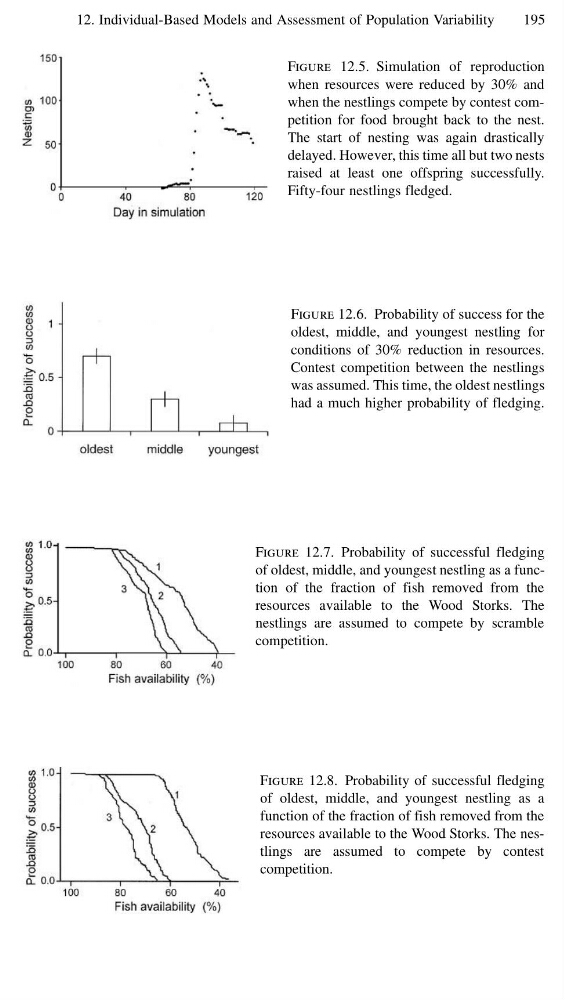
Figure 12.5. Simulation of reproduction
when resources were reduced by 30% and
when the nestlings compete by contest competition for food brought back to the nest.
The start of nesting was again drastically
delayed. However, this time all but two nests
raised at least one offspring successfully.
Fifty-four nestlings fledged.
Figure 12.6. Probability of success for the
oldest, middle, and youngest nestling for
conditions of 30% reduction in resources.
Contest competition between the nestlings
was assumed. This time, the oldest nestlings
had a much higher probability of fledging.
Figure 12.7. Probability of successful fledging
of oldest, middle, and youngest nestling as a function of the fraction of fish removed from the
resources available to the Wood Storks. The
nestlings are assumed to compete by scramble
competition.
Figure 12.8. Probability of successful fledging
of oldest, middle, and youngest nestling as a
function of the fraction of fish removed from the
resources available to the Wood Storks. The nestlings are assumed to compete by contest
competition.
195
Figure 12.5. Simulation of reproduction
when resources were reduced by 30% and
when the nestlings compete by contest competition for food brought back to the nest.
The start of nesting was again drastically
delayed. However, this time all but two nests
raised at least one offspring successfully.
Fifty-four nestlings fledged.
Figure 12.6. Probability of success for the
oldest, middle, and youngest nestling for
conditions of 30% reduction in resources.
Contest competition between the nestlings
was assumed. This time, the oldest nestlings
had a much higher probability of fledging.
Figure 12.7. Probability of successful fledging
of oldest, middle, and youngest nestling as a function of the fraction of fish removed from the
resources available to the Wood Storks. The
nestlings are assumed to compete by scramble
competition.
Figure 12.8. Probability of successful fledging
of oldest, middle, and youngest nestling as a
function of the fraction of fish removed from the
resources available to the Wood Storks. The nestlings are assumed to compete by contest
competition.