

8. Whaling Models for Cetacean Conservation
121
The Japanese government has suggested that harvests of Minke Whales may
actually release the larger rorquals from competition and thereby hasten their
recovery. Although data supporting the Japanese hypothesis are weak, if true, this
may make a defensible case for commercial harvest of Minke Whales in the
Antarctic. To examine the hypothesis, a population trajectory was calculated for
Southern Hemisphere Blue Whales by using the population model underlying the
CLA and compared with a trajectory from a Lotka-Volterra model of two-species
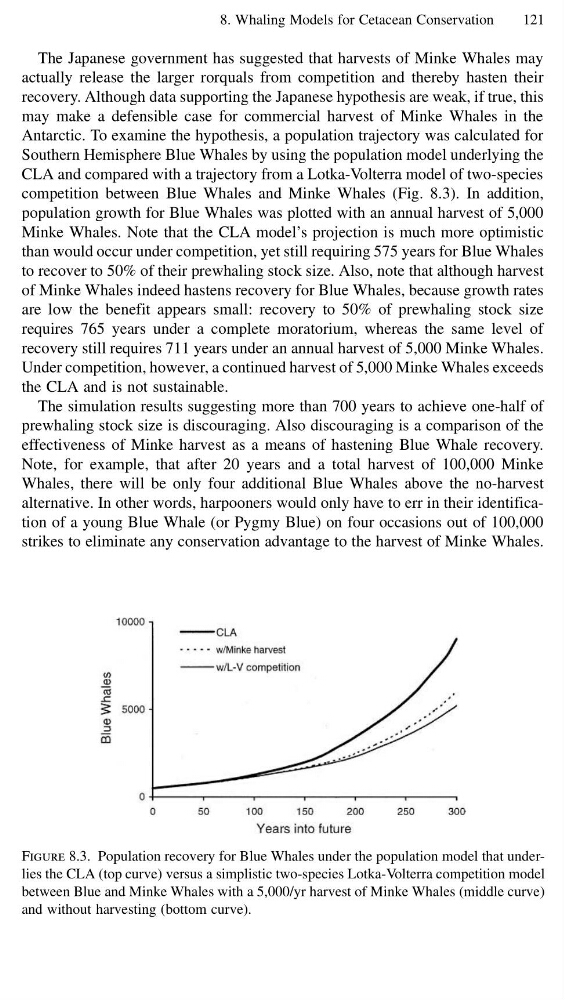
competition between Blue Whales and Minke Whales (Fig. 8.3). In addition,
population growth for Blue Whales was plotted with an annual harvest of 5,000
Minke Whales. Note that the CLA model’s projection is much more optimistic
than would occur under competition, yet still requiring 575 years for Blue Whales
to recover to 50% of their prewhaling stock size. Also, note that although harvest
of Minke Whales indeed hastens recovery for Blue Whales, because growth rates
are low the benefit appears small: recovery to 50% of prewhaling stock size
requires 765 years under a complete moratorium, whereas the same level of
recovery still requires 711 years under an annual harvest of 5,000 Minke Whales.
Under competition, however, a continued harvest of 5,000 Minke Whales exceeds
the CLA and is not sustainable.
The simulation results suggesting more than 700 years to achieve one-half of
prewhaling stock size is discouraging. Also discouraging is a comparison of the
effectiveness of Minke harvest as a means of hastening Blue Whale recovery.
Note, for example, that after 20 years and a total harvest of 100,000 Minke
Whales, there will be only four additional Blue Whales above the no-harvest
alternative. In other words, harpooners would only have to err in their identification of a young Blue Whale (or Pygmy Blue) on four occasions out of 100,000
strikes to eliminate any conservation advantage to the harvest of Minke Whales.
Figure 8.3. Population recovery for Blue Whales under the population model that underlies the CLA (top curve) versus a simplistic two-species Lotka-Volterra competition model
between Blue and Minke Whales with a 5,000/yr harvest of Minke Whales (middle curve)
and without harvesting (bottom curve).
121
The Japanese government has suggested that harvests of Minke Whales may
actually release the larger rorquals from competition and thereby hasten their
recovery. Although data supporting the Japanese hypothesis are weak, if true, this
may make a defensible case for commercial harvest of Minke Whales in the
Antarctic. To examine the hypothesis, a population trajectory was calculated for
Southern Hemisphere Blue Whales by using the population model underlying the
CLA and compared with a trajectory from a Lotka-Volterra model of two-species
competition between Blue Whales and Minke Whales (Fig. 8.3). In addition,
population growth for Blue Whales was plotted with an annual harvest of 5,000
Minke Whales. Note that the CLA model’s projection is much more optimistic
than would occur under competition, yet still requiring 575 years for Blue Whales
to recover to 50% of their prewhaling stock size. Also, note that although harvest
of Minke Whales indeed hastens recovery for Blue Whales, because growth rates
are low the benefit appears small: recovery to 50% of prewhaling stock size
requires 765 years under a complete moratorium, whereas the same level of
recovery still requires 711 years under an annual harvest of 5,000 Minke Whales.
Under competition, however, a continued harvest of 5,000 Minke Whales exceeds
the CLA and is not sustainable.
The simulation results suggesting more than 700 years to achieve one-half of
prewhaling stock size is discouraging. Also discouraging is a comparison of the
effectiveness of Minke harvest as a means of hastening Blue Whale recovery.
Note, for example, that after 20 years and a total harvest of 100,000 Minke
Whales, there will be only four additional Blue Whales above the no-harvest
alternative. In other words, harpooners would only have to err in their identification of a young Blue Whale (or Pygmy Blue) on four occasions out of 100,000
strikes to eliminate any conservation advantage to the harvest of Minke Whales.
Figure 8.3. Population recovery for Blue Whales under the population model that underlies the CLA (top curve) versus a simplistic two-species Lotka-Volterra competition model
between Blue and Minke Whales with a 5,000/yr harvest of Minke Whales (middle curve)
and without harvesting (bottom curve).