

120
Mark S. Boyce
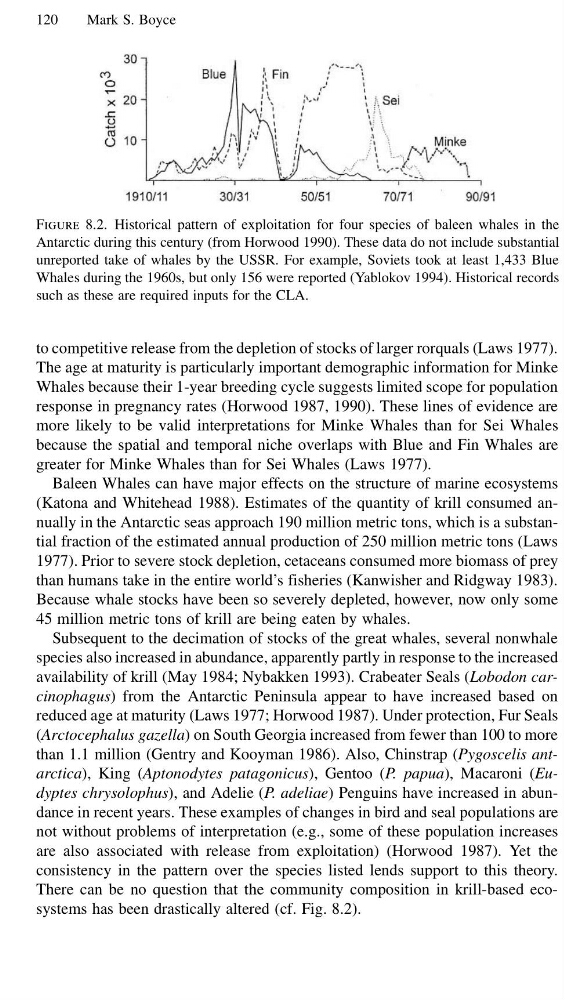
Figure 8.2. Historical pattern of exploitation for four species of baleen whales in the
Antarctic during this century (from Horwood 1990). These data do not include substantial
unreported take of whales by the USSR. For example, Soviets took at least 1,433 Blue
Whales during the 1960s, but only 156 were reported (Yablokov 1994). Historical records
such as these are required inputs for the CLA.
to competitive release from the depletion of stocks of larger rorquals (Laws 1977).
The age at maturity is particularly important demographic information for Minke
Whales because their 1-year breeding cycle suggests limited scope for population
response in pregnancy rates (Horwood 1987, 1990). These lines of evidence are
more likely to be valid interpretations for Minke Whales than for Sei Whales
because the spatial and temporal niche overlaps with Blue and Fin Whales are
greater for Minke Whales than for Sei Whales (Laws 1977).
Baleen Whales can have major effects on the structure of marine ecosystems
(Katona and Whitehead 1988). Estimates of the quantity of krill consumed annually in the Antarctic seas approach 190 million metric tons, which is a substantial fraction of the estimated annual production of 250 million metric tons (Laws
1977). Prior to severe stock depletion, cetaceans consumed more biomass of prey
than humans take in the entire world’s fisheries (Kanwisher and Ridgway 1983).
Because whale stocks have been so severely depleted, however, now only some
45 million metric tons of krill are being eaten by whales.
Subsequent to the decimation of stocks of the great whales, several nonwhale
species also increased in abundance, apparently partly in response to the increased
availability of krill (May 1984; Nybakken 1993). Crabeater Seals (Lobodon carcinophagus) from the Antarctic Peninsula appear to have increased based on
reduced age at maturity (Laws 1977; Horwood 1987). Under protection, Fur Seals
(Arctocephalus gazella) on South Georgia increased from fewer than 100 to more
than 1.1 million (Gentry and Kooyman 1986). Also, Chinstrap (Pygoscelis antarctica), King (Aptonodytes patagonicus), Gentoo (P. papua), Macaroni (Eudyptes chrysolophus), and Adelie (P. adeliae) Penguins have increased in abundance in recent years. These examples of changes in bird and seal populations are
not without problems of interpretation (e.g., some of these population increases
are also associated with release from exploitation) (Horwood 1987). Yet the
consistency in the pattern over the species listed lends support to this theory.
There can be no question that the community composition in krill-based ecosystems has been drastically altered (cf. Fig. 8.2).
Mark S. Boyce
Figure 8.2. Historical pattern of exploitation for four species of baleen whales in the
Antarctic during this century (from Horwood 1990). These data do not include substantial
unreported take of whales by the USSR. For example, Soviets took at least 1,433 Blue
Whales during the 1960s, but only 156 were reported (Yablokov 1994). Historical records
such as these are required inputs for the CLA.
to competitive release from the depletion of stocks of larger rorquals (Laws 1977).
The age at maturity is particularly important demographic information for Minke
Whales because their 1-year breeding cycle suggests limited scope for population
response in pregnancy rates (Horwood 1987, 1990). These lines of evidence are
more likely to be valid interpretations for Minke Whales than for Sei Whales
because the spatial and temporal niche overlaps with Blue and Fin Whales are
greater for Minke Whales than for Sei Whales (Laws 1977).
Baleen Whales can have major effects on the structure of marine ecosystems
(Katona and Whitehead 1988). Estimates of the quantity of krill consumed annually in the Antarctic seas approach 190 million metric tons, which is a substantial fraction of the estimated annual production of 250 million metric tons (Laws
1977). Prior to severe stock depletion, cetaceans consumed more biomass of prey
than humans take in the entire world’s fisheries (Kanwisher and Ridgway 1983).
Because whale stocks have been so severely depleted, however, now only some
45 million metric tons of krill are being eaten by whales.
Subsequent to the decimation of stocks of the great whales, several nonwhale
species also increased in abundance, apparently partly in response to the increased
availability of krill (May 1984; Nybakken 1993). Crabeater Seals (Lobodon carcinophagus) from the Antarctic Peninsula appear to have increased based on
reduced age at maturity (Laws 1977; Horwood 1987). Under protection, Fur Seals
(Arctocephalus gazella) on South Georgia increased from fewer than 100 to more
than 1.1 million (Gentry and Kooyman 1986). Also, Chinstrap (Pygoscelis antarctica), King (Aptonodytes patagonicus), Gentoo (P. papua), Macaroni (Eudyptes chrysolophus), and Adelie (P. adeliae) Penguins have increased in abundance in recent years. These examples of changes in bird and seal populations are
not without problems of interpretation (e.g., some of these population increases
are also associated with release from exploitation) (Horwood 1987). Yet the
consistency in the pattern over the species listed lends support to this theory.
There can be no question that the community composition in krill-based ecosystems has been drastically altered (cf. Fig. 8.2).