

Suspension Feeders on Sandy Beaches
Emerita ana/oga
20°
24°
28°
Ag
Ho
32° LC
40°
MB
44°
48°
52°
I n
o
I 0
100 1
_% 5g...Ll ___ I_u.D_
I o
• n
o
65
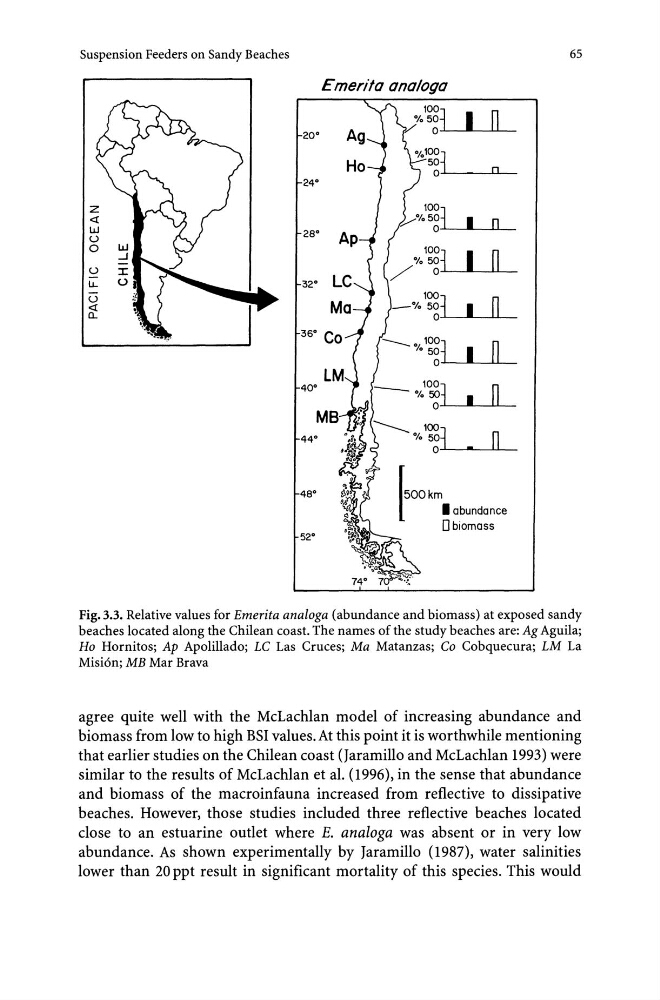
Fig. 3.3. Relative values for Emerita analoga (abundance and biomass) at exposed sandy
beaches located along the Chilean coast. The names of the study beaches are: Ag Aguila;
Ho Hornitos; Ap Apolillado; LC Las Cruces; Ma Matanzas; Co Cobquecura; LM La
Misi6n; MB Mar Brava
agree quite well with the McLachlan model of increasing abundance and
biomass from low to high BSI values. At this point it is worthwhile mentioning
that earlier studies on the Chilean coast (Jaramillo and McLachlan 1993) were
similar to the results of McLachlan et al. (1996), in the sense that abundance
and biomass of the macroinfauna increased from reflective to dissipative
beaches. However, those studies included three reflective beaches located
close to an estuarine outlet where E. analoga was absent or in very low
abundance. As shown experimentally by Jaramillo (1987), water salinities
lower than 20 ppt result in significant mortality of this species. This would
Emerita ana/oga
20°
24°
28°
Ag
Ho
32° LC
40°
MB
44°
48°
52°
I n
o
I 0
100 1
_% 5g...Ll ___ I_u.D_
I o
• n
o
65
Fig. 3.3. Relative values for Emerita analoga (abundance and biomass) at exposed sandy
beaches located along the Chilean coast. The names of the study beaches are: Ag Aguila;
Ho Hornitos; Ap Apolillado; LC Las Cruces; Ma Matanzas; Co Cobquecura; LM La
Misi6n; MB Mar Brava
agree quite well with the McLachlan model of increasing abundance and
biomass from low to high BSI values. At this point it is worthwhile mentioning
that earlier studies on the Chilean coast (Jaramillo and McLachlan 1993) were
similar to the results of McLachlan et al. (1996), in the sense that abundance
and biomass of the macroinfauna increased from reflective to dissipative
beaches. However, those studies included three reflective beaches located
close to an estuarine outlet where E. analoga was absent or in very low
abundance. As shown experimentally by Jaramillo (1987), water salinities
lower than 20 ppt result in significant mortality of this species. This would