

Benthic Suspension Feeders in Shallow Coastal Water
21
1.2.2 Vermetids (Gastropoda)
The Vermetidae are a small family of warm-water sessile gastropods capable
of building upright feeding tubes to take advantage of the water flow
(Schiparelli and Cattaneo-Vietti 1999). Most, if not all, vermetids are able to
filter suspended particles out of the inhalant current with their ctenidial cilia,
but for the majority their main source of food is particles trapped on a
mucous net secreted by the pedal gland and released into the water by the
pedal tentacles (Hadfield et al. 1972; Hughes 1979). The close proximity of
individual vermetids in a colony or aggregation causes individual mucous
nets to overlap. These communal nets are thought to be more efficient at
catching particles in conditions of rapidly and unpredictably varying
currents (Hughes 1979). Furthermore, Schiparelli and Cattaneo-Vietti (1999)
report that, in the Mediterranean Sea, the reef builder Dendropoma petraeum
does not produce erect feeding tubes in wave-swept high-energy environments. However, in adjacent subtidal and less energetic environments, vertical
feeding tubes are common. These investigators argue that the ability of
vermetids to modify the direction and shape of their calcareous feeding tubes
gives them the plasticity to win the competition for substrate space over other
sessile organisms and qualifies them as keystone species whose absence
would dramatically change the functional character of the system. Hughes
(1979) also contends that by forming reefs with individual densities up to
60,OOO/m2 (Table 1.1), Dendropoma facilitates fertilization and provides a
smooth profile less susceptible to wave damage. Safriel (1974) reports that
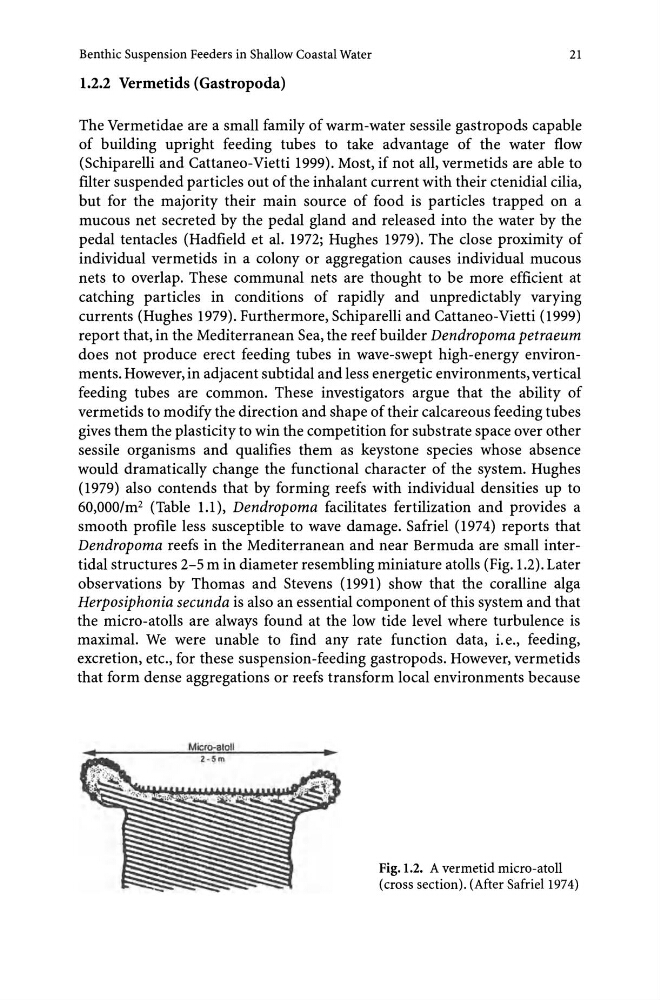
Dendropoma reefs in the Mediterranean and near Bermuda are small intertidal structures 2-5 m in diameter resembling miniature atolls (Fig. 1.2). Later
observations by Thomas and Stevens (1991) show that the coralline alga
Herposiphonia secunda is also an essential component of this system and that
the micro-atolls are always found at the low tide level where turbulence is
maximal. We were unable to find any rate function data, i. e., feeding,
excretion, etc., for these suspension-feeding gastropods. However, vermetids
that form dense aggregations or reefs transform local environments because
Fig. 1.2. A vermetid micro-atoll
(cross section). (After Safriel1974)
21
1.2.2 Vermetids (Gastropoda)
The Vermetidae are a small family of warm-water sessile gastropods capable
of building upright feeding tubes to take advantage of the water flow
(Schiparelli and Cattaneo-Vietti 1999). Most, if not all, vermetids are able to
filter suspended particles out of the inhalant current with their ctenidial cilia,
but for the majority their main source of food is particles trapped on a
mucous net secreted by the pedal gland and released into the water by the
pedal tentacles (Hadfield et al. 1972; Hughes 1979). The close proximity of
individual vermetids in a colony or aggregation causes individual mucous
nets to overlap. These communal nets are thought to be more efficient at
catching particles in conditions of rapidly and unpredictably varying
currents (Hughes 1979). Furthermore, Schiparelli and Cattaneo-Vietti (1999)
report that, in the Mediterranean Sea, the reef builder Dendropoma petraeum
does not produce erect feeding tubes in wave-swept high-energy environments. However, in adjacent subtidal and less energetic environments, vertical
feeding tubes are common. These investigators argue that the ability of
vermetids to modify the direction and shape of their calcareous feeding tubes
gives them the plasticity to win the competition for substrate space over other
sessile organisms and qualifies them as keystone species whose absence
would dramatically change the functional character of the system. Hughes
(1979) also contends that by forming reefs with individual densities up to
60,OOO/m2 (Table 1.1), Dendropoma facilitates fertilization and provides a
smooth profile less susceptible to wave damage. Safriel (1974) reports that
Dendropoma reefs in the Mediterranean and near Bermuda are small intertidal structures 2-5 m in diameter resembling miniature atolls (Fig. 1.2). Later
observations by Thomas and Stevens (1991) show that the coralline alga
Herposiphonia secunda is also an essential component of this system and that
the micro-atolls are always found at the low tide level where turbulence is
maximal. We were unable to find any rate function data, i. e., feeding,
excretion, etc., for these suspension-feeding gastropods. However, vermetids
that form dense aggregations or reefs transform local environments because
Fig. 1.2. A vermetid micro-atoll
(cross section). (After Safriel1974)