

The Leaf Canopy of Seagrass Beds: Faunal Community in a Salinity Gradient
223
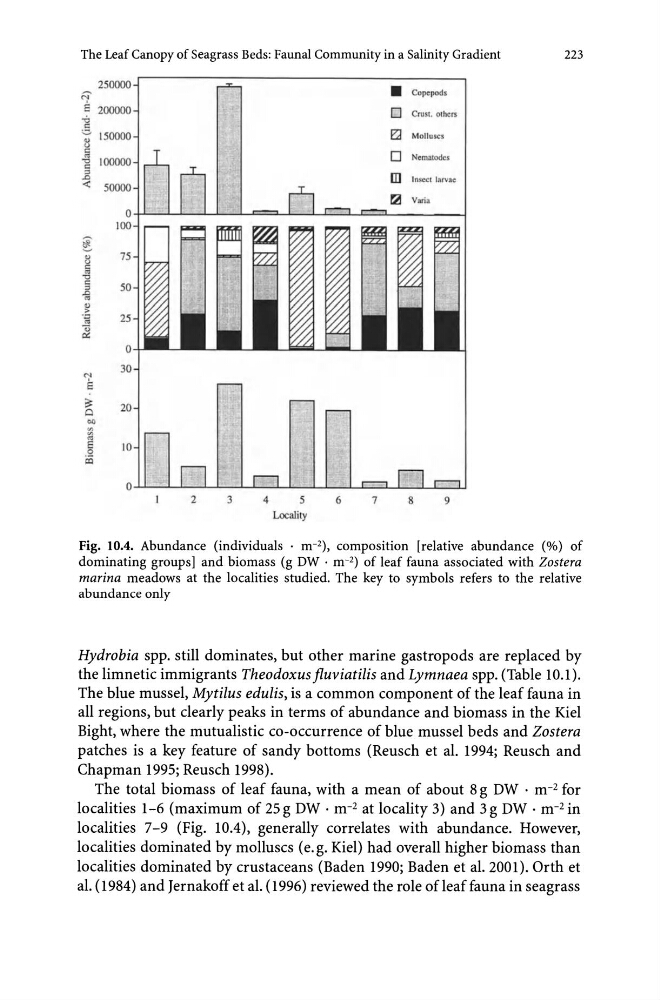
Fig. 10.4. Abundance (individuals . m- 2 ), composition [relative abundance (%) of
dominating groups] and biomass (g DW . m- 2 ) of leaf fauna associated with Zostera
marina meadows at the localities studied. The key to symbols refers to the relative
abundance only
Hydrobia spp. still dominates, but other marine gastropods are replaced by
the limnetic immigrants Theodoxus fluviatilis and Lymnaea spp. (Table 10.l).
The blue mussel, Mytilus edulis, is a common component of the leaf fauna in
all regions, but clearly peaks in terms of abundance and biomass in the Kiel
Bight, where the mutualistic co-occurrence of blue mussel beds and Zostera
patches is a key feature of sandy bottoms (Reusch et al. 1994; Reusch and
Chapman 1995; Reusch 1998).
The total biomass of leaf fauna, with a mean of about 8 g DW . m- 2 for
localities 1-6 (maximum of 25 g DW . m- 2 at locality 3) and 3 g DW . m- 2 in
localities 7-9 (Fig. 10.4), generally correlates with abundance. However,
localities dominated by molluscs (e. g. Kiel) had overall higher biomass than
localities dominated by crustaceans (Baden 1990; Baden et al. 2001). Orth et
al. (1984) and Jernakoff et al. (1996) reviewed the role of leaf fauna in seagrass
223
Fig. 10.4. Abundance (individuals . m- 2 ), composition [relative abundance (%) of
dominating groups] and biomass (g DW . m- 2 ) of leaf fauna associated with Zostera
marina meadows at the localities studied. The key to symbols refers to the relative
abundance only
Hydrobia spp. still dominates, but other marine gastropods are replaced by
the limnetic immigrants Theodoxus fluviatilis and Lymnaea spp. (Table 10.l).
The blue mussel, Mytilus edulis, is a common component of the leaf fauna in
all regions, but clearly peaks in terms of abundance and biomass in the Kiel
Bight, where the mutualistic co-occurrence of blue mussel beds and Zostera
patches is a key feature of sandy bottoms (Reusch et al. 1994; Reusch and
Chapman 1995; Reusch 1998).
The total biomass of leaf fauna, with a mean of about 8 g DW . m- 2 for
localities 1-6 (maximum of 25 g DW . m- 2 at locality 3) and 3 g DW . m- 2 in
localities 7-9 (Fig. 10.4), generally correlates with abundance. However,
localities dominated by molluscs (e. g. Kiel) had overall higher biomass than
localities dominated by crustaceans (Baden 1990; Baden et al. 2001). Orth et
al. (1984) and Jernakoff et al. (1996) reviewed the role of leaf fauna in seagrass