

Competitive Bioturbators in the Wadden Sea and Ariake Sound
East
China
Sea
-
10km
~
31· N
only
e N harmandJ
present
only
O N Ja,OOllIea
pJesen!
bOth
159
() N h8f'mandJ
& N Japo!m;a
present
P
ghost shrimps
PIesent
u U. momillerum
extant
U mOlllilferum
X (almost)
extinct
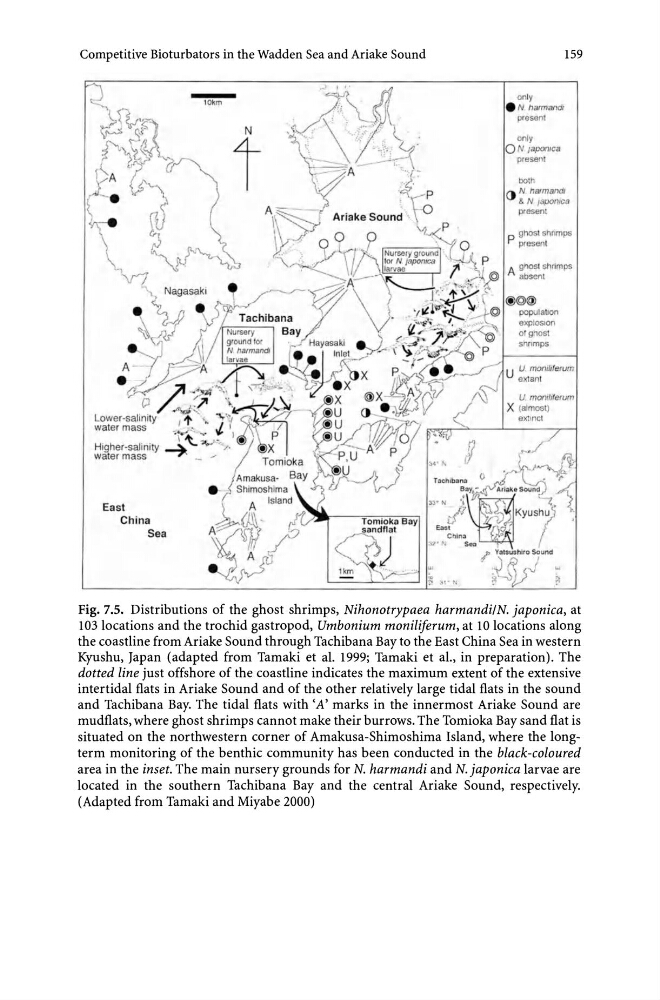
Fig. 7.5. Distributions of the ghost shrimps, Nihonotrypaea harmandilN. japonica, at
103 locations and the trochid gastropod, Umbonium moniliferum, at 10 locations along
the coastline from Ariake Sound through Tachibana Bay to the East China Sea in western
Kyushu, Japan (adapted from Tamaki et a1. 1999; Tamaki et a1., in preparation). The
dotted line just offshore of the coastline indicates the maximum extent of the extensive
intertidal flats in Ariake Sound and of the other relatively large tidal flats in the sound
and Tachibana Bay. The tidal flats with 'A' marks in the innermost Ariake Sound are
mudflats, where ghost shrimps cannot make their burrows. The Tomioka Bay sand flat is
situated on the northwestern corner of Amakusa-Shimoshima Island, where the longterm monitoring of the benthic community has been conducted in the black-coloured
area in the inset. The main nursery grounds for N. harmandi and N. japonica larvae are
located in the southern Tachibana Bay and the central Ariake Sound, respectively.
(Adapted from Tamaki and Miyabe 2000)
East
China
Sea
-
10km
~
31· N
only
e N harmandJ
present
only
O N Ja,OOllIea
pJesen!
bOth
159
() N h8f'mandJ
& N Japo!m;a
present
P
ghost shrimps
PIesent
u U. momillerum
extant
U mOlllilferum
X (almost)
extinct
Fig. 7.5. Distributions of the ghost shrimps, Nihonotrypaea harmandilN. japonica, at
103 locations and the trochid gastropod, Umbonium moniliferum, at 10 locations along
the coastline from Ariake Sound through Tachibana Bay to the East China Sea in western
Kyushu, Japan (adapted from Tamaki et a1. 1999; Tamaki et a1., in preparation). The
dotted line just offshore of the coastline indicates the maximum extent of the extensive
intertidal flats in Ariake Sound and of the other relatively large tidal flats in the sound
and Tachibana Bay. The tidal flats with 'A' marks in the innermost Ariake Sound are
mudflats, where ghost shrimps cannot make their burrows. The Tomioka Bay sand flat is
situated on the northwestern corner of Amakusa-Shimoshima Island, where the longterm monitoring of the benthic community has been conducted in the black-coloured
area in the inset. The main nursery grounds for N. harmandi and N. japonica larvae are
located in the southern Tachibana Bay and the central Ariake Sound, respectively.
(Adapted from Tamaki and Miyabe 2000)