

Sediment Dynamics by Bioturbating Organisms
129
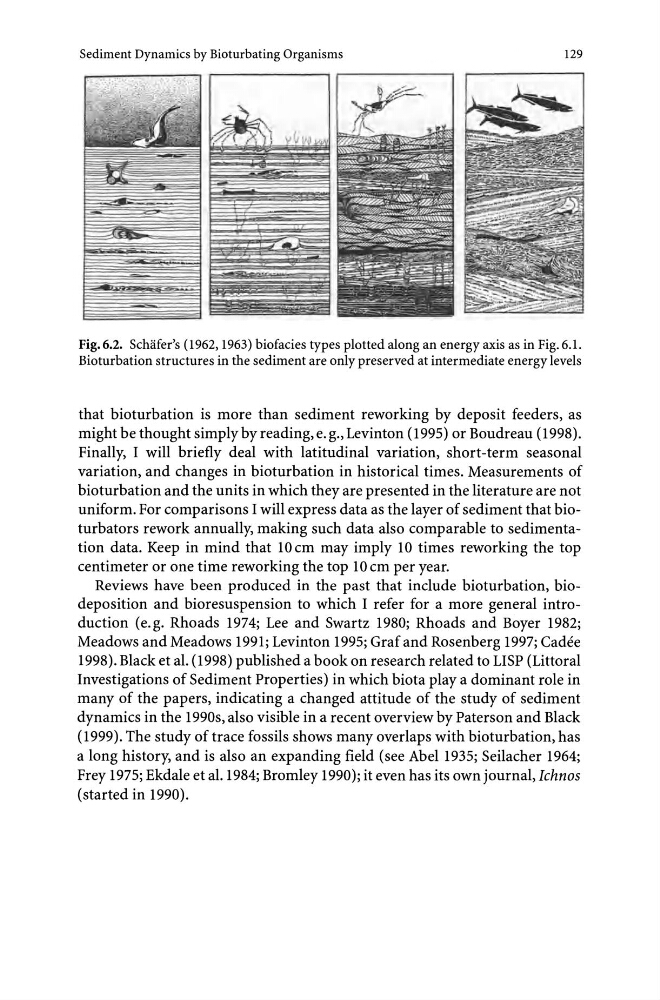
Fig. 6.2. Schafer's (1962, 1963) biofacies types plotted along an energy axis as in Fig. 6.1.
Bioturbation structures in the sediment are only preserved at intermediate energy levels
that bioturbation is more than sediment reworking by deposit feeders, as
might be thought simply by reading, e.g., Levinton (1995) or Boudreau (1998).
Finally, I will briefly deal with latitudinal variation, short-term seasonal
variation, and changes in bioturbation in historical times. Measurements of
bioturbation and the units in which they are presented in the literature are not
uniform. For comparisons I will express data as the layer of sediment that bioturbators rework annually, making such data also comparable to sedimentation data. Keep in mind that 10cm may imply 10 times reworking the top
centimeter or one time reworking the top 10 cm per year.
Reviews have been produced in the past that include bioturbation, biodeposition and bioresuspension to which I refer for a more general introduction (e.g. Rhoads 1974; Lee and Swartz 1980; Rhoads and Boyer 1982;
Meadows and Meadows 1991; Levinton 1995; Graf and Rosenberg 1997; Cadee
1998). Black et al. (1998) published a book on research related to LISP (Littoral
Investigations of Sediment Properties) in which biota playa dominant role in
many of the papers, indicating a changed attitude of the study of sediment
dynamics in the 1990s, also visible in a recent overview by Paterson and Black
(1999). The study of trace fossils shows many overlaps with bioturbation, has
a long history, and is also an expanding field (see Abel 1935; Seilacher 1964;
Frey 1975; Ekdale et al.1984; Bromley 1990); it even has its own journal, Ichnos
(started in 1990).
129
Fig. 6.2. Schafer's (1962, 1963) biofacies types plotted along an energy axis as in Fig. 6.1.
Bioturbation structures in the sediment are only preserved at intermediate energy levels
that bioturbation is more than sediment reworking by deposit feeders, as
might be thought simply by reading, e.g., Levinton (1995) or Boudreau (1998).
Finally, I will briefly deal with latitudinal variation, short-term seasonal
variation, and changes in bioturbation in historical times. Measurements of
bioturbation and the units in which they are presented in the literature are not
uniform. For comparisons I will express data as the layer of sediment that bioturbators rework annually, making such data also comparable to sedimentation data. Keep in mind that 10cm may imply 10 times reworking the top
centimeter or one time reworking the top 10 cm per year.
Reviews have been produced in the past that include bioturbation, biodeposition and bioresuspension to which I refer for a more general introduction (e.g. Rhoads 1974; Lee and Swartz 1980; Rhoads and Boyer 1982;
Meadows and Meadows 1991; Levinton 1995; Graf and Rosenberg 1997; Cadee
1998). Black et al. (1998) published a book on research related to LISP (Littoral
Investigations of Sediment Properties) in which biota playa dominant role in
many of the papers, indicating a changed attitude of the study of sediment
dynamics in the 1990s, also visible in a recent overview by Paterson and Black
(1999). The study of trace fossils shows many overlaps with bioturbation, has
a long history, and is also an expanding field (see Abel 1935; Seilacher 1964;
Frey 1975; Ekdale et al.1984; Bromley 1990); it even has its own journal, Ichnos
(started in 1990).