

110
D.M. Paterson and S.E. Hagerthey
Smooth turbulellt flow
Rough IlIrbulellt flow
Free stream
Logarithmic layer
- - _
Laminar sub-layer
c=========~~
Microbial inti lling
c========>Cohesive
Hydrodynamically smooth
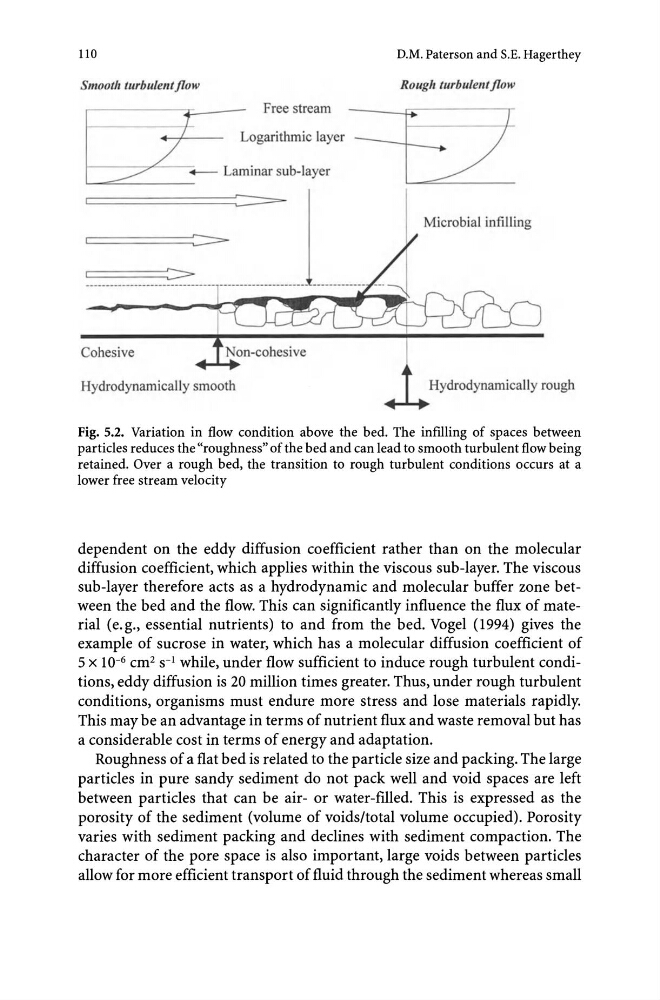
Fig. 5.2. Variation in flow condition above the bed. The infilling of spaces between
particles reduces the "roughness" of the bed and can lead to smooth turbulent flow being
retained. Over a rough bed, the transition to rough turbulent conditions occurs at a
lower free stream velocity
dependent on the eddy diffusion coefficient rather than on the molecular
diffusion coefficient, which applies within the viscous sub-layer. The viscous
sub-layer therefore acts as a hydrodynamic and molecular buffer zone between the bed and the flow. This can significantly influence the flux of material (e.g., essential nutrients) to and from the bed. Vogel (1994) gives the
example of sucrose in water, which has a molecular diffusion coefficient of
5 x 10- 6 cm 2 S-1 while, under flow sufficient to induce rough turbulent conditions, eddy diffusion is 20 million times greater. Thus, under rough turbulent
conditions, organisms must endure more stress and lose materials rapidly.
This may be an advantage in terms of nutrient flux and waste removal but has
a considerable cost in terms of energy and adaptation.
Roughness of a flat bed is related to the particle size and packing. The large
particles in pure sandy sediment do not pack well and void spaces are left
between particles that can be air- or water-filled. This is expressed as the
porosity of the sediment (volume of voids/total volume occupied). Porosity
varies with sediment packing and declines with sediment compaction. The
character of the pore space is also important, large voids between particles
allow for more efficient transport of fluid through the sediment whereas small
D.M. Paterson and S.E. Hagerthey
Smooth turbulellt flow
Rough IlIrbulellt flow
Free stream
Logarithmic layer
- - _
Laminar sub-layer
c=========~~
Microbial inti lling
c========>Cohesive
Hydrodynamically smooth
Fig. 5.2. Variation in flow condition above the bed. The infilling of spaces between
particles reduces the "roughness" of the bed and can lead to smooth turbulent flow being
retained. Over a rough bed, the transition to rough turbulent conditions occurs at a
lower free stream velocity
dependent on the eddy diffusion coefficient rather than on the molecular
diffusion coefficient, which applies within the viscous sub-layer. The viscous
sub-layer therefore acts as a hydrodynamic and molecular buffer zone between the bed and the flow. This can significantly influence the flux of material (e.g., essential nutrients) to and from the bed. Vogel (1994) gives the
example of sucrose in water, which has a molecular diffusion coefficient of
5 x 10- 6 cm 2 S-1 while, under flow sufficient to induce rough turbulent conditions, eddy diffusion is 20 million times greater. Thus, under rough turbulent
conditions, organisms must endure more stress and lose materials rapidly.
This may be an advantage in terms of nutrient flux and waste removal but has
a considerable cost in terms of energy and adaptation.
Roughness of a flat bed is related to the particle size and packing. The large
particles in pure sandy sediment do not pack well and void spaces are left
between particles that can be air- or water-filled. This is expressed as the
porosity of the sediment (volume of voids/total volume occupied). Porosity
varies with sediment packing and declines with sediment compaction. The
character of the pore space is also important, large voids between particles
allow for more efficient transport of fluid through the sediment whereas small