

Icebergs in the North Atlantic ••.
N09
+ •.•
• •••• • • trIrO.
.... ...... ""
. : : : : : -: :~~~~
. , " .. . .... . , *."
80N
70N
.0"
80N
~
"
1:
~"
C
_ 01
i!I
.!~
"' ..
~.!!
'iio
> ..
70N
.. ~
u ..
.. ..
'1:>
::I..,
(/)N
\
~~
~o
...
.,<:>~
-Ito.$'
$
' "
t r
~~ u u
~~
p
-,8
.8 ..
1010
MO'
410/:,
71
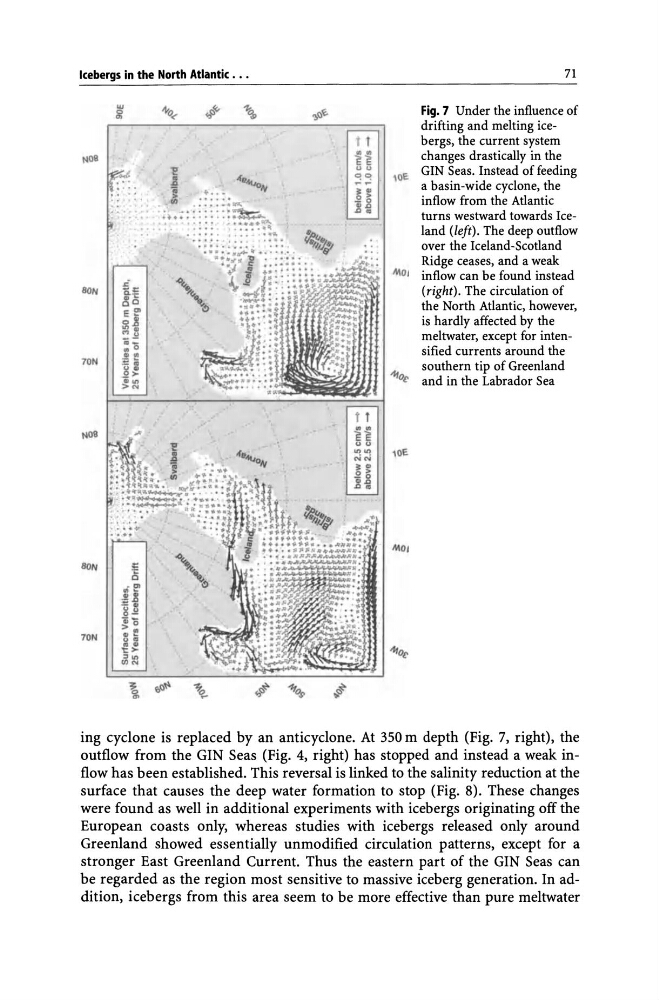
Fig. 7 Under the influence of
drifting and melting icebergs, the current system
changes drastically in the
GIN Seas. Instead of feeding
a basin-wide cyclone, the
inflow from the Atlantic
turns westward towards Iceland (left). The deep outflow
over the Iceland-Scotland
Ridge ceases, and a weak
inflow can be found instead
(right). The circulation of
the North Atlantic, however,
is hardly affected by the
meltwater, except for intensified currents around the
southern tip of Greenland
and in the Labrador Sea
ing cyclone is replaced by an anticyclone. At 350 m depth (Fig. 7, right), the
outflow from the GIN Seas (Fig. 4, right) has stopped and instead a weak inflow has been established. This reversal is linked to the salinity reduction at the
surface that causes the deep water formation to stop (Fig. 8). These changes
were found as well in additional experiments with icebergs originating off the
European coasts only, whereas studies with icebergs released only around
Greenland showed essentially unmodified circulation patterns, except for a
stronger East Greenland Current. Thus the eastern part of the GIN Seas can
be regarded as the region most sensitive to massive iceberg generation. In addition, icebergs from this area seem to be more effective than pure meltwater
N09
+ •.•
• •••• • • trIrO.
.... ...... ""
. : : : : : -: :~~~~
. , " .. . .... . , *."
80N
70N
.0"
80N
~
"
1:
~"
C
_ 01
i!I
.!~
"' ..
~.!!
'iio
> ..
70N
.. ~
u ..
.. ..
'1:>
::I..,
(/)N
\
~~
~o
...
.,<:>~
-Ito.$'
$
' "
t r
~~ u u
~~
p
-,8
.8 ..
1010
MO'
410/:,
71
Fig. 7 Under the influence of
drifting and melting icebergs, the current system
changes drastically in the
GIN Seas. Instead of feeding
a basin-wide cyclone, the
inflow from the Atlantic
turns westward towards Iceland (left). The deep outflow
over the Iceland-Scotland
Ridge ceases, and a weak
inflow can be found instead
(right). The circulation of
the North Atlantic, however,
is hardly affected by the
meltwater, except for intensified currents around the
southern tip of Greenland
and in the Labrador Sea
ing cyclone is replaced by an anticyclone. At 350 m depth (Fig. 7, right), the
outflow from the GIN Seas (Fig. 4, right) has stopped and instead a weak inflow has been established. This reversal is linked to the salinity reduction at the
surface that causes the deep water formation to stop (Fig. 8). These changes
were found as well in additional experiments with icebergs originating off the
European coasts only, whereas studies with icebergs released only around
Greenland showed essentially unmodified circulation patterns, except for a
stronger East Greenland Current. Thus the eastern part of the GIN Seas can
be regarded as the region most sensitive to massive iceberg generation. In addition, icebergs from this area seem to be more effective than pure meltwater