

450
Case 1
70~-----r----~--~
-
50- ------ - - -
40- -----%
30- -----20- --Fe-: -
10- -- - -
o
"C
If>
>.
III
8'
Q)
Q)
0.
<:
"0
II>
.><
f:
"§
"
~
:.::;
Q)
iii
...J
I. Lerche· S. Cao . S. Mallory· K. Petersen· A. Lowrie
--::
- -~ -
-0
Q)
Q)
0.
If>
iii
...J
Case 2
-
------- ...
--nIII
>.
III
C)
Q)
0
<:
"0
.x ()
f:
:E
:.::;
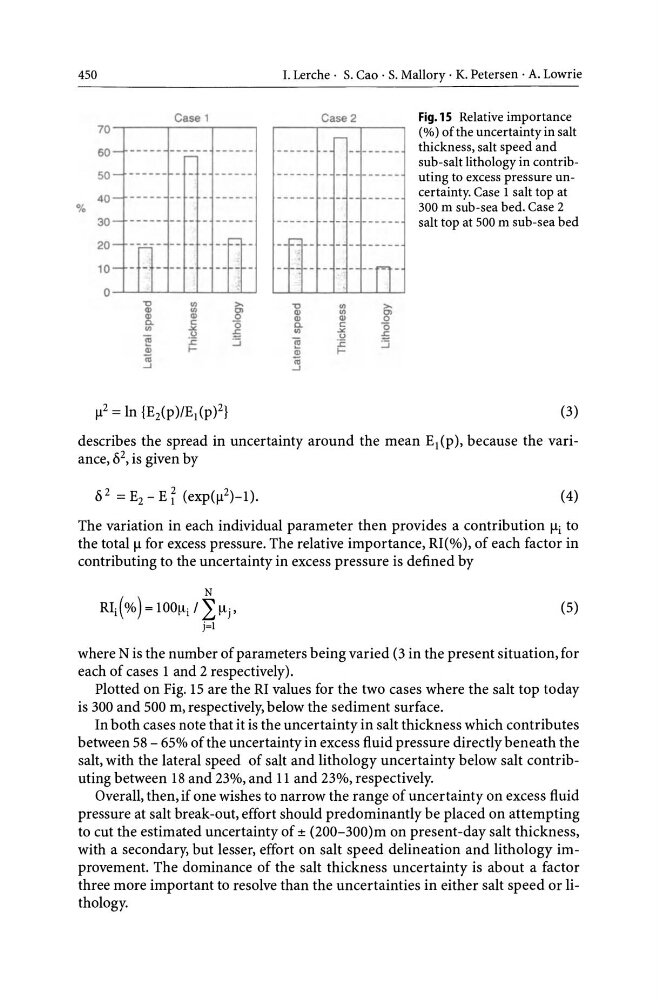
IFig.15 Relative importance
(%) of the uncertainty in salt
thickness, salt speed and
sub-salt lithology in contributing to excess pressure uncertainty. Case 1 salt top at
300 m sub-sea bed. Case 2
salt top at 500 m sub-sea bed
(3)
describes the spread in uncertainty around the mean E 1 (p), because the variance, {)2, is given by
(4)
The variation in each individual parameter then provides a contribution fli to
the total fl for excess pressure. The relative importance, RI(%), of each factor in
contributing to the uncertainty in excess pressure is defined by
N
RIi (%) = 100!ti /2!tj'
j=!
(5)
where N is the number of parameters being varied (3 in the present situation, for
each of cases 1 and 2 respectively).
Plotted on Fig. 15 are the RI values for the two cases where the salt top today
is 300 and 500 m, respectively, below the sediment surface.
In both cases note that it is the uncertainty in salt thickness which contributes
between 58 - 65% of the uncertainty in excess fluid pressure directly beneath the
salt, with the lateral speed of salt and lithology uncertainty below salt contributing between 18 and 23%, and 11 and 23%, respectively.
Overall, then, if one wishes to narrow the range of uncertainty on excess fluid
pressure at salt break-out, effort should predominantly be placed on attempting
to cut the estimated uncertainty of ± (200-300)m on present-day salt thickness,
with a secondary, but lesser, effort on salt speed delineation and lithology improvement. The dominance of the salt thickness uncertainty is about a factor
three more important to resolve than the uncertainties in either salt speed or lithology.
Case 1
70~-----r----~--~
-
50- ------ - - -
40- -----%
30- -----20- --Fe-: -
10- -- - -
o
"C
If>
>.
III
8'
Q)
Q)
0.
<:
"0
II>
.><
f:
"§
"
~
:.::;
Q)
iii
...J
I. Lerche· S. Cao . S. Mallory· K. Petersen· A. Lowrie
--::
- -~ -
-0
Q)
Q)
0.
If>
iii
...J
Case 2
-
------- ...
--nIII
>.
III
C)
Q)
0
<:
"0
.x ()
f:
:E
:.::;
IFig.15 Relative importance
(%) of the uncertainty in salt
thickness, salt speed and
sub-salt lithology in contributing to excess pressure uncertainty. Case 1 salt top at
300 m sub-sea bed. Case 2
salt top at 500 m sub-sea bed
(3)
describes the spread in uncertainty around the mean E 1 (p), because the variance, {)2, is given by
(4)
The variation in each individual parameter then provides a contribution fli to
the total fl for excess pressure. The relative importance, RI(%), of each factor in
contributing to the uncertainty in excess pressure is defined by
N
RIi (%) = 100!ti /2!tj'
j=!
(5)
where N is the number of parameters being varied (3 in the present situation, for
each of cases 1 and 2 respectively).
Plotted on Fig. 15 are the RI values for the two cases where the salt top today
is 300 and 500 m, respectively, below the sediment surface.
In both cases note that it is the uncertainty in salt thickness which contributes
between 58 - 65% of the uncertainty in excess fluid pressure directly beneath the
salt, with the lateral speed of salt and lithology uncertainty below salt contributing between 18 and 23%, and 11 and 23%, respectively.
Overall, then, if one wishes to narrow the range of uncertainty on excess fluid
pressure at salt break-out, effort should predominantly be placed on attempting
to cut the estimated uncertainty of ± (200-300)m on present-day salt thickness,
with a secondary, but lesser, effort on salt speed delineation and lithology improvement. The dominance of the salt thickness uncertainty is about a factor
three more important to resolve than the uncertainties in either salt speed or lithology.