

Modeling Sediment Resuspension in Coastal Areas
1.. 100
!' ,.,
~ 10 ~~oftf+::'+'''::'''".
~
~
~ ~~5~~--~~--~~~~7Ll--~--7 L3--~~75
0 .. ,. into 1993
31
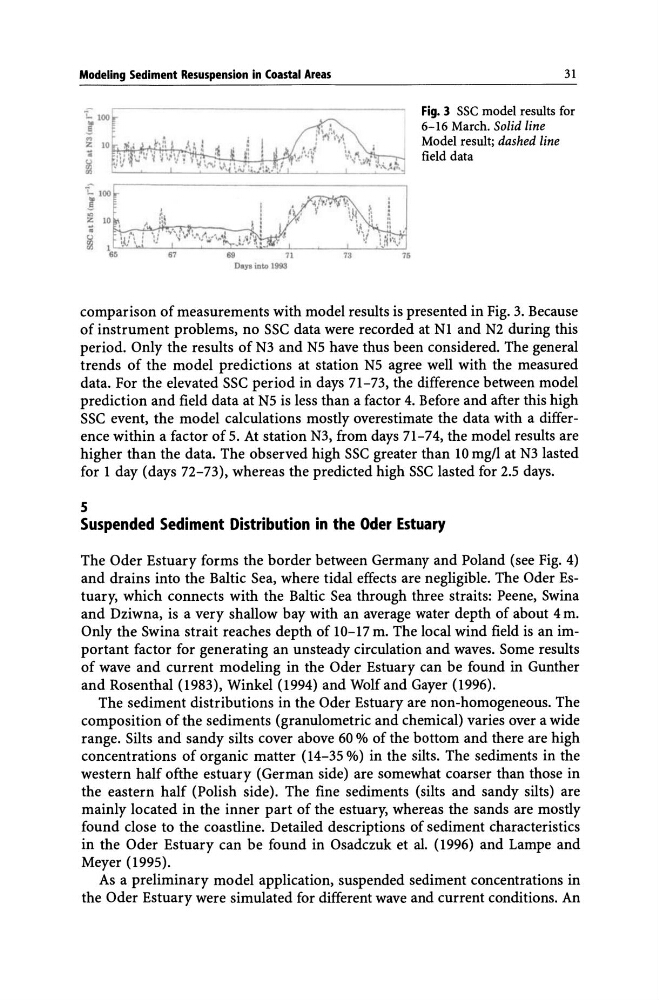
Fig. 3 sse model results for
6-16 March. Solid line
Model result; dashed line
field data
comparison of measurements with model results is presented in Fig. 3. Because
of instrument problems, no sse data were recorded at Nl and N2 during this
period. Only the results of N3 and Ns have thus been considered. The general
trends of the model predictions at station Ns agree well with the measured
data. For the elevated sse period in days 71-73, the difference between model
prediction and field data at Ns is less than a factor 4. Before and after this high
sse event, the model calculations mostly overestimate the data with a difference within a factor of 5. At station N3, from days 71-74, the model results are
higher than the data. The observed high sse greater than lO mg!l at N3 lasted
for 1 day (days 72-73), whereas the predicted high sse lasted for 2.5 days.
5
Suspended Sediment Distribution in the Oder Estuary
The Oder Estuary forms the border between Germany and Poland (see Fig. 4)
and drains into the Baltic Sea, where tidal effects are negligible. The Oder Estuary, which connects with the Baltic Sea through three straits: Peene, Swina
and Dziwna, is a very shallow bay with an average water depth of about 4 m.
Only the Swina strait reaches depth of 10-17 m. The local wind field is an important factor for generating an unsteady circulation and waves. Some results
of wave and current modeling in the Oder Estuary can be found in Gunther
and Rosenthal (1983), Winkel (1994) and Wolf and Gayer (1996).
The sediment distributions in the Oder Estuary are non-homogeneous. The
composition of the sediments (granulometric and chemical) varies over a wide
range. Silts and sandy silts cover above 60 % of the bottom and there are high
concentrations of organic matter (14-35 %) in the silts. The sediments in the
western half ofthe estuary (German side) are somewhat coarser than those in
the eastern half (Polish side). The fine sediments (silts and sandy silts) are
mainly located in the inner part of the estuary, whereas the sands are mostly
found close to the coastline. Detailed descriptions of sediment characteristics
in the Oder Estuary can be found in Osadczuk et al. (1996) and Lampe and
Meyer (1995).
As a preliminary model application, suspended sediment concentrations in
the Oder Estuary were simulated for different wave and current conditions. An
1.. 100
!' ,.,
~ 10 ~~oftf+::'+'''::'''".
~
~
~ ~~5~~--~~--~~~~7Ll--~--7 L3--~~75
0 .. ,. into 1993
31
Fig. 3 sse model results for
6-16 March. Solid line
Model result; dashed line
field data
comparison of measurements with model results is presented in Fig. 3. Because
of instrument problems, no sse data were recorded at Nl and N2 during this
period. Only the results of N3 and Ns have thus been considered. The general
trends of the model predictions at station Ns agree well with the measured
data. For the elevated sse period in days 71-73, the difference between model
prediction and field data at Ns is less than a factor 4. Before and after this high
sse event, the model calculations mostly overestimate the data with a difference within a factor of 5. At station N3, from days 71-74, the model results are
higher than the data. The observed high sse greater than lO mg!l at N3 lasted
for 1 day (days 72-73), whereas the predicted high sse lasted for 2.5 days.
5
Suspended Sediment Distribution in the Oder Estuary
The Oder Estuary forms the border between Germany and Poland (see Fig. 4)
and drains into the Baltic Sea, where tidal effects are negligible. The Oder Estuary, which connects with the Baltic Sea through three straits: Peene, Swina
and Dziwna, is a very shallow bay with an average water depth of about 4 m.
Only the Swina strait reaches depth of 10-17 m. The local wind field is an important factor for generating an unsteady circulation and waves. Some results
of wave and current modeling in the Oder Estuary can be found in Gunther
and Rosenthal (1983), Winkel (1994) and Wolf and Gayer (1996).
The sediment distributions in the Oder Estuary are non-homogeneous. The
composition of the sediments (granulometric and chemical) varies over a wide
range. Silts and sandy silts cover above 60 % of the bottom and there are high
concentrations of organic matter (14-35 %) in the silts. The sediments in the
western half ofthe estuary (German side) are somewhat coarser than those in
the eastern half (Polish side). The fine sediments (silts and sandy silts) are
mainly located in the inner part of the estuary, whereas the sands are mostly
found close to the coastline. Detailed descriptions of sediment characteristics
in the Oder Estuary can be found in Osadczuk et al. (1996) and Lampe and
Meyer (1995).
As a preliminary model application, suspended sediment concentrations in
the Oder Estuary were simulated for different wave and current conditions. An