

432
1.000
.§ 2.000
.c .....
Co
Cl)
o 3,000
4,000
5,000
o
1. Lerche· S. Cao . S. Mallory· K. Petersen· A. Lowrie
Cumulative Probability «=)
10 20 30 40 50 60 70 80 90 100
Vitrinite Reflectance (?)
- - - - 0 . 6
_
-
-
. 0.8
- - - - - 1.0
- - - 1 . 2
- - - ' 1.4
- - - -
1.6
- - - - - 1 . 8
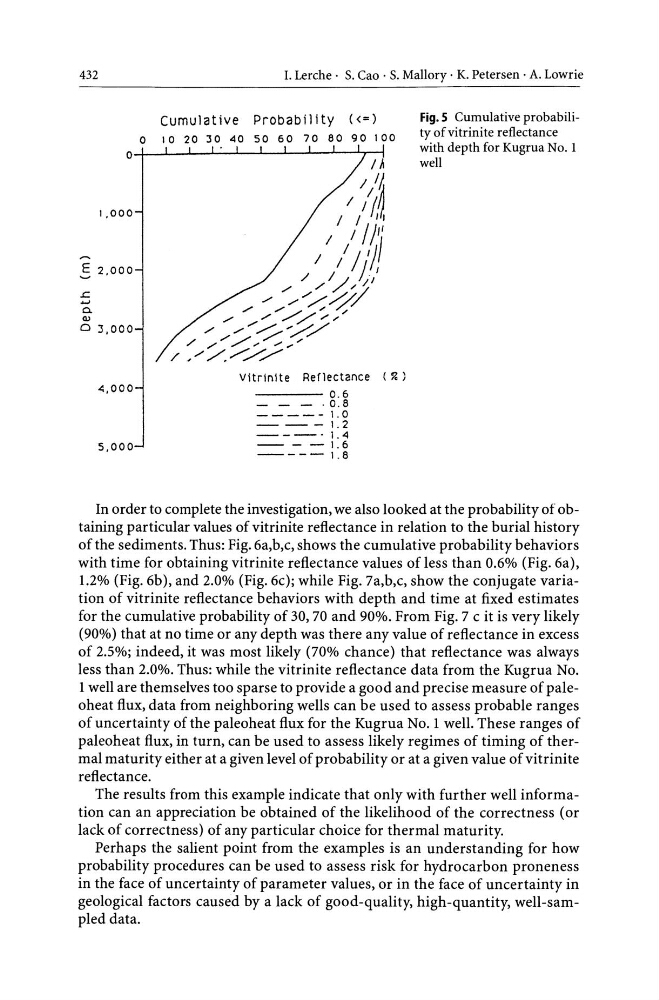
Fig.S Cumulative probability of vitrinite reflectance
with depth for Kugrua No.1
well
In order to complete the investigation, we also looked at the probability of obtaining particular values of vitrinite reflectance in relation to the burial history
of the sediments. Thus: Fig. 6a,b,c, shows the cumulative probability behaviors
with time for obtaining vitrinite reflectance values of less than 0.6% (Fig. 6a),
l.2% (Fig. 6b), and 2.0% (Fig. 6c); while Fig. 7a,b,c, show the conjugate variation of vitrinite reflectance behaviors with depth and time at fixed estimates
for the cumulative probability of 30, 70 and 90%. From Fig. 7 c it is very likely
(90%) that at no time or any depth was there any value of reflectance in excess
of 2.5%; indeed, it was most likely (70% chance) that reflectance was always
less than 2.0%. Thus: while the vitrinite reflectance data from the Kugrua No.
1 well are themselves too sparse to provide a good and precise measure of paleoheat flux, data from neighboring wells can be used to assess probable ranges
of uncertainty of the paleoheat flux for the Kugrua No.1 well. These ranges of
paleoheat flux, in turn, can be used to assess likely regimes of timing of thermal maturity either at a given level of probability or at a given value of vitrinite
reflectance.
The results from this example indicate that only with further well information can an appreciation be obtained of the likelihood of the correctness (or
lack of correctness) of any particular choice for thermal maturity.
Perhaps the salient point from the examples is an understanding for how
probability procedures can be used to assess risk for hydrocarbon proneness
in the face of uncertainty of parameter values, or in the face of uncertainty in
geological factors caused by a lack of good-quality, high-quantity, well-sampled data.
1.000
.§ 2.000
.c .....
Co
Cl)
o 3,000
4,000
5,000
o
1. Lerche· S. Cao . S. Mallory· K. Petersen· A. Lowrie
Cumulative Probability «=)
10 20 30 40 50 60 70 80 90 100
Vitrinite Reflectance (?)
- - - - 0 . 6
_
-
-
. 0.8
- - - - - 1.0
- - - 1 . 2
- - - ' 1.4
- - - -
1.6
- - - - - 1 . 8
Fig.S Cumulative probability of vitrinite reflectance
with depth for Kugrua No.1
well
In order to complete the investigation, we also looked at the probability of obtaining particular values of vitrinite reflectance in relation to the burial history
of the sediments. Thus: Fig. 6a,b,c, shows the cumulative probability behaviors
with time for obtaining vitrinite reflectance values of less than 0.6% (Fig. 6a),
l.2% (Fig. 6b), and 2.0% (Fig. 6c); while Fig. 7a,b,c, show the conjugate variation of vitrinite reflectance behaviors with depth and time at fixed estimates
for the cumulative probability of 30, 70 and 90%. From Fig. 7 c it is very likely
(90%) that at no time or any depth was there any value of reflectance in excess
of 2.5%; indeed, it was most likely (70% chance) that reflectance was always
less than 2.0%. Thus: while the vitrinite reflectance data from the Kugrua No.
1 well are themselves too sparse to provide a good and precise measure of paleoheat flux, data from neighboring wells can be used to assess probable ranges
of uncertainty of the paleoheat flux for the Kugrua No.1 well. These ranges of
paleoheat flux, in turn, can be used to assess likely regimes of timing of thermal maturity either at a given level of probability or at a given value of vitrinite
reflectance.
The results from this example indicate that only with further well information can an appreciation be obtained of the likelihood of the correctness (or
lack of correctness) of any particular choice for thermal maturity.
Perhaps the salient point from the examples is an understanding for how
probability procedures can be used to assess risk for hydrocarbon proneness
in the face of uncertainty of parameter values, or in the face of uncertainty in
geological factors caused by a lack of good-quality, high-quantity, well-sampled data.