

Risk, Uncertainty and Priorities - Quantitative Models
1,000
E
2,000
.c
.o..J
D..
QJ
3,000
0
4.000
5,000
Vitrinlte Reflectance (%)
1.0
2.0
3.0
4.0
CumulatIve ProbabIlity « =)
- - - - - 3 0
-
- - -
40
- - - - - - 50
- - - 60
- - - - - 7 0
- - - - - 60
- - - - - - 90
• I nput Data
431
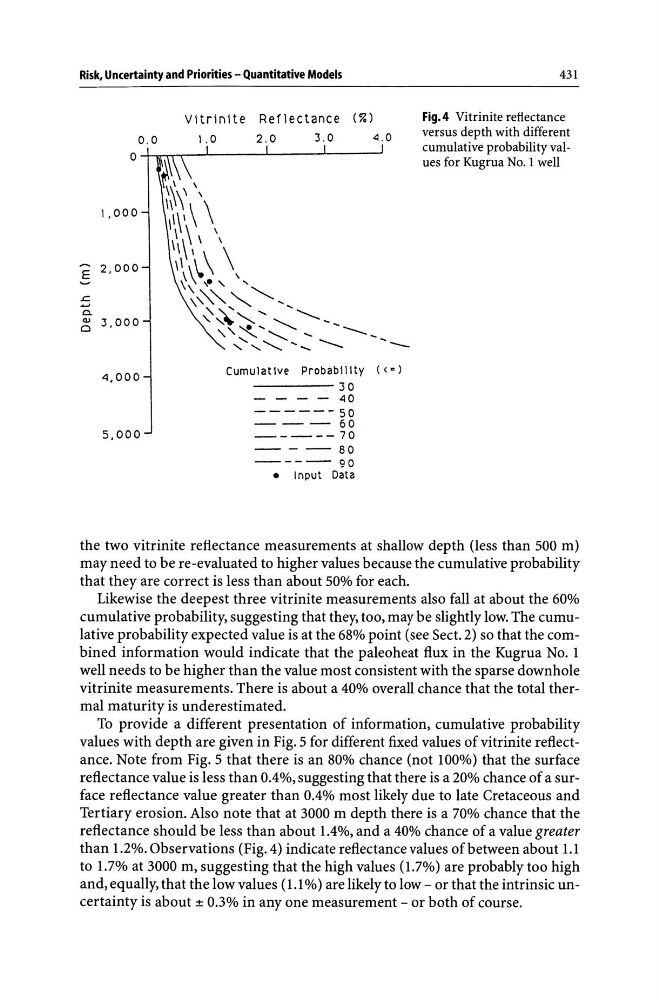
Fig.4 Vitrinite refiectance
versus depth with different
cumulative probability values for Kugrua No.1 well
the two vitrinite reflectance measurements at shallow depth (less than 500 m)
may need to be re-evaluated to higher values because the cumulative probability
that they are correct is less than about 50% for each.
Likewise the deepest three vitrinite measurements also fall at about the 60%
cumulative probability, suggesting that they, too, may be slightly low. The cumulative probability expected value is at the 68% point (see Sect. 2) so that the combined information would indicate that the paleoheat flux in the Kugrua No.1
well needs to be higher than the value most consistent with the sparse downhole
vitrinite measurements. There is about a 40% overall chance that the total thermal maturity is underestimated.
To provide a different presentation of information, cumulative probability
values with depth are given in Fig. 5 for different fixed values of vitrinite reflectance. Note from Fig. 5 that there is an 80% chance (not 100%) that the surface
reflectance value is less than 0.4%, suggesting that there is a 20% chance of a surface reflectance value greater than 0.4% most likely due to late Cretaceous and
Tertiary erosion. Also note that at 3000 m depth there is a 70% chance that the
reflectance should be less than about 1.4%, and a 40% chance of a value greater
than 1.2%. Observations (Fig. 4) indicate reflectance values of between about 1.1
to 1.7% at 3000 m, suggesting that the high values (1.7%) are probably too high
and, equally, that the low values (1.1 %) are likely to low - or that the intrinsic uncertainty is about ± 0.3% in anyone measurement - or both of course.
1,000
E
2,000
.c
.o..J
D..
QJ
3,000
0
4.000
5,000
Vitrinlte Reflectance (%)
1.0
2.0
3.0
4.0
CumulatIve ProbabIlity « =)
- - - - - 3 0
-
- - -
40
- - - - - - 50
- - - 60
- - - - - 7 0
- - - - - 60
- - - - - - 90
• I nput Data
431
Fig.4 Vitrinite refiectance
versus depth with different
cumulative probability values for Kugrua No.1 well
the two vitrinite reflectance measurements at shallow depth (less than 500 m)
may need to be re-evaluated to higher values because the cumulative probability
that they are correct is less than about 50% for each.
Likewise the deepest three vitrinite measurements also fall at about the 60%
cumulative probability, suggesting that they, too, may be slightly low. The cumulative probability expected value is at the 68% point (see Sect. 2) so that the combined information would indicate that the paleoheat flux in the Kugrua No.1
well needs to be higher than the value most consistent with the sparse downhole
vitrinite measurements. There is about a 40% overall chance that the total thermal maturity is underestimated.
To provide a different presentation of information, cumulative probability
values with depth are given in Fig. 5 for different fixed values of vitrinite reflectance. Note from Fig. 5 that there is an 80% chance (not 100%) that the surface
reflectance value is less than 0.4%, suggesting that there is a 20% chance of a surface reflectance value greater than 0.4% most likely due to late Cretaceous and
Tertiary erosion. Also note that at 3000 m depth there is a 70% chance that the
reflectance should be less than about 1.4%, and a 40% chance of a value greater
than 1.2%. Observations (Fig. 4) indicate reflectance values of between about 1.1
to 1.7% at 3000 m, suggesting that the high values (1.7%) are probably too high
and, equally, that the low values (1.1 %) are likely to low - or that the intrinsic uncertainty is about ± 0.3% in anyone measurement - or both of course.