

28
J. Lou· T. Wolf· W. Rosenthal
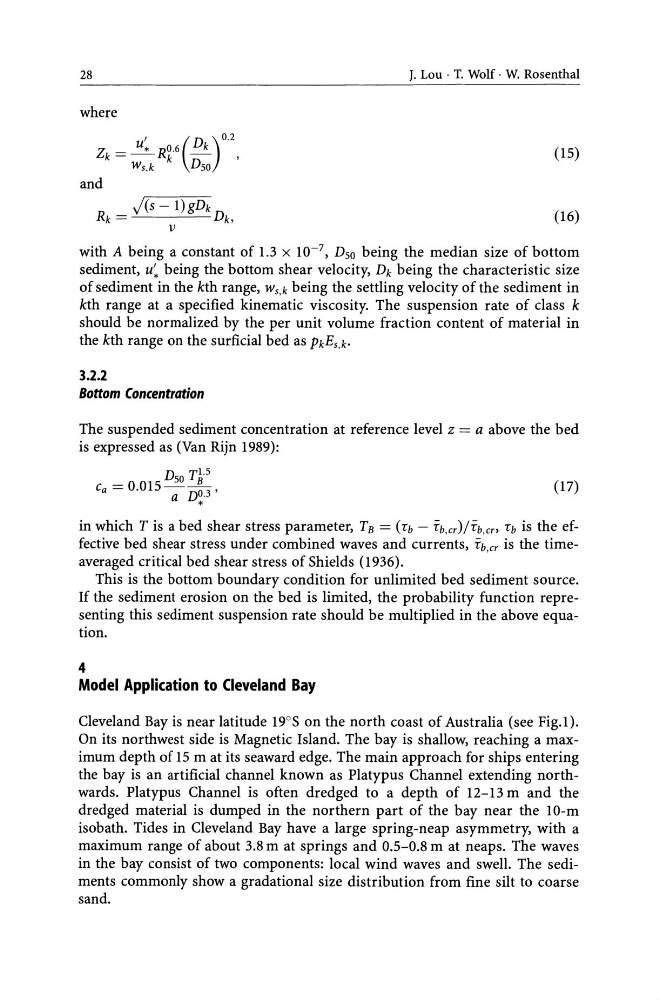
where
(15)
(16)
with A being a constant of 1.3 x 10- 7 , Dso being the median size of bottom
sediment, u: being the bottom shear velocity, Dk being the characteristic size
of sediment in the kth range, Ws,k being the settling velocity of the sediment in
kth range at a specified kinematic viscosity. The suspension rate of class k
should be normalized by the per unit volume fraction content of material in
the kth range on the surficial bed as PkEs,k.
3.2.2
Bottom Concentration
The suspended sediment concentration at reference level z = a above the bed
is expressed as (Van Rijn 1989):
Dso T1' s
Ca = 0.015-----03,
a D*·
(17)
in which T is a bed shear stress parameter, TB = (Tb - ib.cr)/ib,CT> Tb is the effective bed shear stress under combined waves and currents, ib,cr is the timeaveraged critical bed shear stress of Shields (1936).
This is the bottom boundary condition for unlimited bed sediment source.
If the sediment erosion on the bed is limited, the probability function representing this sediment suspension rate should be multiplied in the above equation.
4
Model Application to Cleveland Bay
Cleveland Bay is near latitude 19°5 on the north coast of Australia (see Fig.I).
On its northwest side is Magnetic Island. The bay is shallow, reaching a maximum depth of 15 m at its seaward edge. The main approach for ships entering
the bay is an artificial channel known as Platypus Channel extending northwards. Platypus Channel is often dredged to a depth of 12-13 m and the
dredged material is dumped in the northern part of the bay near the lO-m
isobath. Tides in Cleveland Bay have a large spring-neap asymmetry, with a
maximum range of about 3.8 m at springs and 0.5-0.8 m at neaps. The waves
in the bay consist of two components: local wind waves and swell. The sediments commonly show a gradational size distribution from fine silt to coarse
sand.
J. Lou· T. Wolf· W. Rosenthal
where
(15)
(16)
with A being a constant of 1.3 x 10- 7 , Dso being the median size of bottom
sediment, u: being the bottom shear velocity, Dk being the characteristic size
of sediment in the kth range, Ws,k being the settling velocity of the sediment in
kth range at a specified kinematic viscosity. The suspension rate of class k
should be normalized by the per unit volume fraction content of material in
the kth range on the surficial bed as PkEs,k.
3.2.2
Bottom Concentration
The suspended sediment concentration at reference level z = a above the bed
is expressed as (Van Rijn 1989):
Dso T1' s
Ca = 0.015-----03,
a D*·
(17)
in which T is a bed shear stress parameter, TB = (Tb - ib.cr)/ib,CT> Tb is the effective bed shear stress under combined waves and currents, ib,cr is the timeaveraged critical bed shear stress of Shields (1936).
This is the bottom boundary condition for unlimited bed sediment source.
If the sediment erosion on the bed is limited, the probability function representing this sediment suspension rate should be multiplied in the above equation.
4
Model Application to Cleveland Bay
Cleveland Bay is near latitude 19°5 on the north coast of Australia (see Fig.I).
On its northwest side is Magnetic Island. The bay is shallow, reaching a maximum depth of 15 m at its seaward edge. The main approach for ships entering
the bay is an artificial channel known as Platypus Channel extending northwards. Platypus Channel is often dredged to a depth of 12-13 m and the
dredged material is dumped in the northern part of the bay near the lO-m
isobath. Tides in Cleveland Bay have a large spring-neap asymmetry, with a
maximum range of about 3.8 m at springs and 0.5-0.8 m at neaps. The waves
in the bay consist of two components: local wind waves and swell. The sediments commonly show a gradational size distribution from fine silt to coarse
sand.