

Statistical Analysis of Dispersion and Geochemical Patterns of Sedimentary System...
407
Table 2. Average concentrations (5% trimming estimation, in percentage) of geochemical
constituents in sediments from the northern shelf of the South China Sea
Class
Size N
P
Mg
Fe
Mn
Ti
C org
a
CaC0 3 Al 2 0 3
Class 1 31
0.097 0.066 0.769 3.88
0.111 0.596 1.445
6.49
14.19
Class 2 64
0.083 0.050 0.724 2.89
0.063 0.450 1.147
9.18
11.77
Class 3 58
0.040 0.049 0.837 2.53
0.042 0.201 0.522 31.11
6.36
Class 4 95
0.030 0.029 0.415 1.45
0.031 0.201 0.417 13.55
5.35
a Organic carbon.
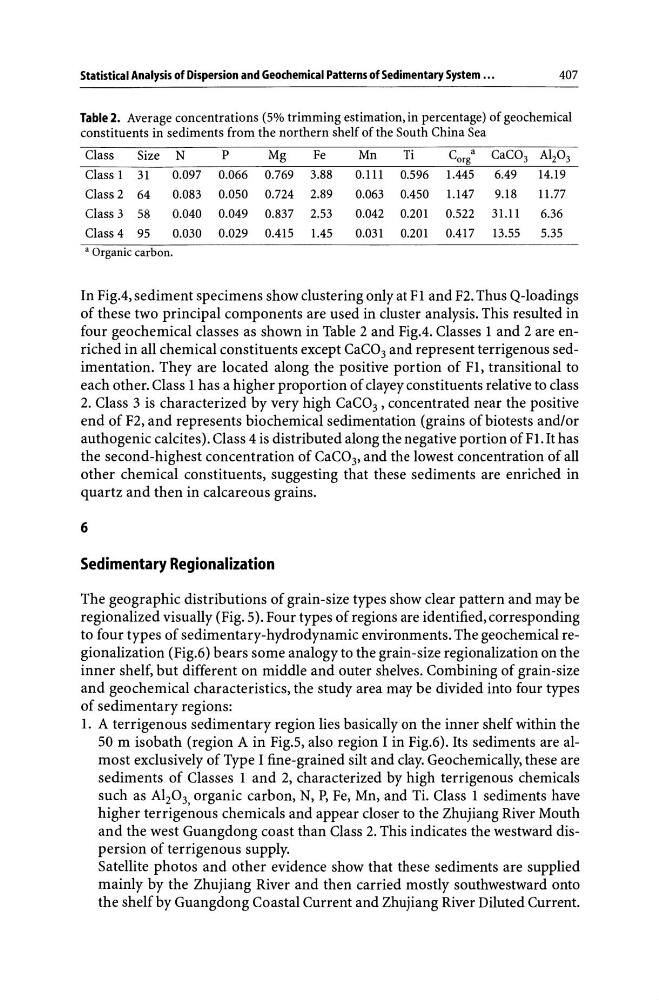
In FigA, sediment specimens show clustering only at F I and F2. Thus Q-Ioadings
of these two principal components are used in cluster analysis. This resulted in
four geochemical classes as shown in Table 2 and FigA. Classes I and 2 are enriched in all chemical constituents except CaC0 3 and represent terrigenous sedimentation. They are located along the positive portion of FI, transitional to
each other. Class I has a higher proportion of clayey constituents relative to class
2. Class 3 is characterized by very high CaC0 3 ' concentrated near the positive
end of F2, and represents biochemical sedimentation (grains of biotests and/or
authogenic calcites). Class 4 is distributed along the negative portion of F1. It has
the second-highest concentration of CaC0 3 , and the lowest concentration of all
other chemical constituents, suggesting that these sediments are enriched in
quartz and then in calcareous grains.
6
Sedimentary Regionalization
The geographic distributions of grain-size types show clear pattern and may be
regionalized visually (Fig. 5). Four types of regions are identified, corresponding
to four types of sedimentary-hydrodynamic environments. The geochemical regionalization (Fig.6) bears some analogy to the grain-size regionalization on the
inner shelf, but different on middle and outer shelves. Combining of grain-size
and geochemical characteristics, the study area may be divided into four types
of sedimentary regions:
1. A terrigenous sedimentary region lies basically on the inner shelf within the
50 m isobath (region A in Fig.S, also region I in Fig.6). Its sediments are almost exclusively of Type I fine-grained silt and clay. Geochemically, these are
sediments of Classes I and 2, characterized by high terrigenous chemicals
such as A1 2 0 3 , organic carbon, N, P, Fe, Mn, and Ti. Class I sediments have
higher terrigenous chemicals and appear closer to the Zhujiang River Mouth
and the west Guangdong coast than Class 2. This indicates the westward dispersion of terrigenous supply.
Satellite photos and other evidence show that these sediments are supplied
mainly by the Zhujiang River and then carried mostly southwestward onto
the shelf by Guangdong Coastal Current and Zhujiang River Diluted Current.
407
Table 2. Average concentrations (5% trimming estimation, in percentage) of geochemical
constituents in sediments from the northern shelf of the South China Sea
Class
Size N
P
Mg
Fe
Mn
Ti
C org
a
CaC0 3 Al 2 0 3
Class 1 31
0.097 0.066 0.769 3.88
0.111 0.596 1.445
6.49
14.19
Class 2 64
0.083 0.050 0.724 2.89
0.063 0.450 1.147
9.18
11.77
Class 3 58
0.040 0.049 0.837 2.53
0.042 0.201 0.522 31.11
6.36
Class 4 95
0.030 0.029 0.415 1.45
0.031 0.201 0.417 13.55
5.35
a Organic carbon.
In FigA, sediment specimens show clustering only at F I and F2. Thus Q-Ioadings
of these two principal components are used in cluster analysis. This resulted in
four geochemical classes as shown in Table 2 and FigA. Classes I and 2 are enriched in all chemical constituents except CaC0 3 and represent terrigenous sedimentation. They are located along the positive portion of FI, transitional to
each other. Class I has a higher proportion of clayey constituents relative to class
2. Class 3 is characterized by very high CaC0 3 ' concentrated near the positive
end of F2, and represents biochemical sedimentation (grains of biotests and/or
authogenic calcites). Class 4 is distributed along the negative portion of F1. It has
the second-highest concentration of CaC0 3 , and the lowest concentration of all
other chemical constituents, suggesting that these sediments are enriched in
quartz and then in calcareous grains.
6
Sedimentary Regionalization
The geographic distributions of grain-size types show clear pattern and may be
regionalized visually (Fig. 5). Four types of regions are identified, corresponding
to four types of sedimentary-hydrodynamic environments. The geochemical regionalization (Fig.6) bears some analogy to the grain-size regionalization on the
inner shelf, but different on middle and outer shelves. Combining of grain-size
and geochemical characteristics, the study area may be divided into four types
of sedimentary regions:
1. A terrigenous sedimentary region lies basically on the inner shelf within the
50 m isobath (region A in Fig.S, also region I in Fig.6). Its sediments are almost exclusively of Type I fine-grained silt and clay. Geochemically, these are
sediments of Classes I and 2, characterized by high terrigenous chemicals
such as A1 2 0 3 , organic carbon, N, P, Fe, Mn, and Ti. Class I sediments have
higher terrigenous chemicals and appear closer to the Zhujiang River Mouth
and the west Guangdong coast than Class 2. This indicates the westward dispersion of terrigenous supply.
Satellite photos and other evidence show that these sediments are supplied
mainly by the Zhujiang River and then carried mostly southwestward onto
the shelf by Guangdong Coastal Current and Zhujiang River Diluted Current.