

406
DiZhou
5
Geochemical Classification of Sediments
The statistical analysis of geochemical data follows the procedure stated in previous section only without logratio transformation, as these data do not contain
complete compositions.
As the first step, ROPCA were applied to the data. A five percent multivariate
trimming has improved the analysis, as evidenced by the trimming of three sampIes with unusually high phosphorus, three with unusually high Mn, and several
with very high Fe. The correlation coefficients of P, Mn, and Fe with other constituents, except of CaC0 3 , were improved compared with results given by ordinary least squares PCA (OLS); the percentage of variance for the first principal
component was increased from 50.3 to 60.9%; and the 3rd and 4th principal
components in OLS, which were generated mainly by outliers in P and Mn, were
removed (Zhou et. al.1990).
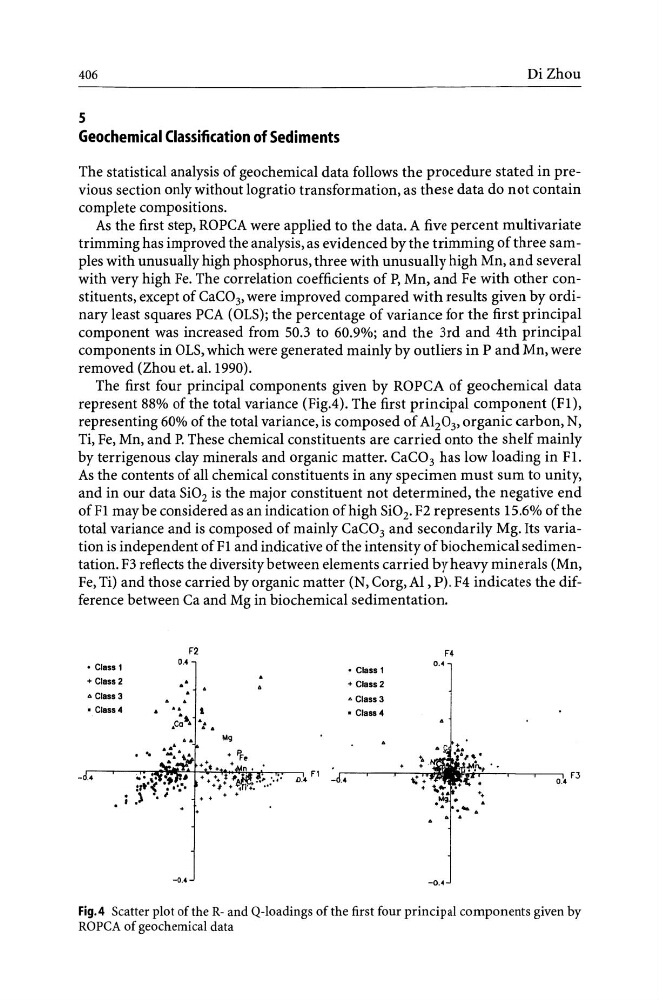
The first four principal components given by ROPCA of geochemical data
represent 88% of the total variance (FigA). The first principal component (Fl),
representing 60% of the total variance, is composed of A1 2 0 3 , organic carbon, N,
Ti, Fe, Mn, and P. These chemical constituents are carried onto the shelf mainly
by terrigenous clay minerals and organic matter. CaC0 3 has low loading in FI.
As the contents of all chemical constituents in any specimen must sum to unity,
and in our data Si0 2 is the major constituent not determined, the negative end
of Fl may be considered as an indication of high Si0 2 • F2 represents 15.6% of the
total variance and is composed of mainly CaC0 3 and secondarily Mg. Its variation is independent of Fl and indicative of the intensity of biochemical sedimentation. F3 reflects the diversity between elements carried by heavy minerals (Mn,
Fe, Ti) and those carried by organic matter (N, Corg, AI, P). F4 indicates the difference between Ca and Mg in biochemical sedimentation.
• cra •• 1
+ Cra •• 2
• Crass 3
• Class 4
F2
0.4
.'
•
+
-0.4
1019
• Cras.l
+ Class 2
• Cra •• 3
• Cra •• 4
F4
0 ••
Fig.4 Scatter plot of the R- and Q-loadings of the first four principal components given by
ROPCA of geochemical data
DiZhou
5
Geochemical Classification of Sediments
The statistical analysis of geochemical data follows the procedure stated in previous section only without logratio transformation, as these data do not contain
complete compositions.
As the first step, ROPCA were applied to the data. A five percent multivariate
trimming has improved the analysis, as evidenced by the trimming of three sampIes with unusually high phosphorus, three with unusually high Mn, and several
with very high Fe. The correlation coefficients of P, Mn, and Fe with other constituents, except of CaC0 3 , were improved compared with results given by ordinary least squares PCA (OLS); the percentage of variance for the first principal
component was increased from 50.3 to 60.9%; and the 3rd and 4th principal
components in OLS, which were generated mainly by outliers in P and Mn, were
removed (Zhou et. al.1990).
The first four principal components given by ROPCA of geochemical data
represent 88% of the total variance (FigA). The first principal component (Fl),
representing 60% of the total variance, is composed of A1 2 0 3 , organic carbon, N,
Ti, Fe, Mn, and P. These chemical constituents are carried onto the shelf mainly
by terrigenous clay minerals and organic matter. CaC0 3 has low loading in FI.
As the contents of all chemical constituents in any specimen must sum to unity,
and in our data Si0 2 is the major constituent not determined, the negative end
of Fl may be considered as an indication of high Si0 2 • F2 represents 15.6% of the
total variance and is composed of mainly CaC0 3 and secondarily Mg. Its variation is independent of Fl and indicative of the intensity of biochemical sedimentation. F3 reflects the diversity between elements carried by heavy minerals (Mn,
Fe, Ti) and those carried by organic matter (N, Corg, AI, P). F4 indicates the difference between Ca and Mg in biochemical sedimentation.
• cra •• 1
+ Cra •• 2
• Crass 3
• Class 4
F2
0.4
.'
•
+
-0.4
1019
• Cras.l
+ Class 2
• Cra •• 3
• Cra •• 4
F4
0 ••
Fig.4 Scatter plot of the R- and Q-loadings of the first four principal components given by
ROPCA of geochemical data