

394
C. Barcelo· V. Pawlowsky . G. Bohling
2.2
Mixture Clustering Model over the air-Transformed Data
Since granulometric data are compositional, attention should be paid more to
ratios of components than to their absolute values. For this reason, Aitchison
(1986) suggests applying the additive log-ratio transformation (air) to compositional data. This transformation breaks the constant sum constraint which distinguishes this kind of data.
Since one cannot compute the logarithm of zero, zero data values must be adjusted to some small positive value before the air transformation is performed
(Aitchison 1986, Chap. 11). This adjustment was done using a value of ()=O.05 as
the estimated maximum rounding error (Bohling et al. 1997). Bohling et al.
(1998) demonstrate that the computed results do not vary greatly when () is varied over a reasonable range, despite the large number of zeros in the data set.
Then, assuming that air-transformed data come frome a mixture of seven homoscedastic normal multivariate distributions, the EM-algorithm is applied as
a clustering technique. The sample is considered to be a completely unclassified,
although the initial estimations of the parameters of the mixture, needed to start
the EM algorithm, are calculated from the seven groups which are obtained
when Ward's method is applied to raw granulometric data (see Section 2.1). This
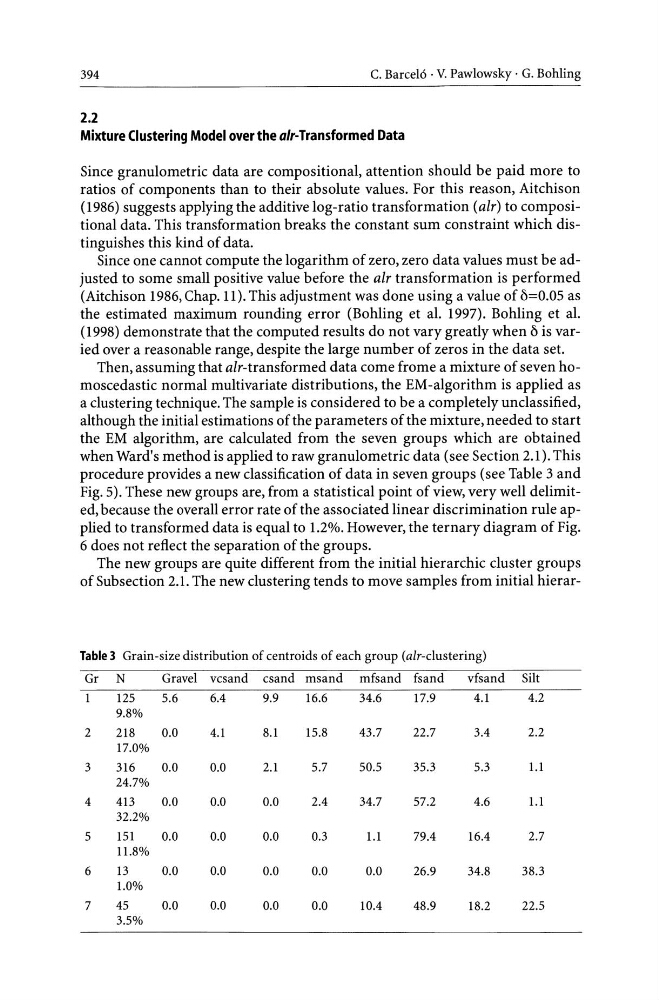
procedure provides a new classification of data in seven groups (see Table 3 and
Fig. 5). These new groups are, from a statistical point of view, very well delimited, because the overall error rate of the associated linear discrimination rule applied to transformed data is equal to 1.2%. However, the ternary diagram of Fig.
6 does not reflect the separation of the groups.
The new groups are quite different from the initial hierarchic cluster groups
of Subsection 2.1. The new clustering tends to move samples from initial hierarTable 3 Grain-size distribution of centroids of each group (aIr-clustering)
Gr N
Gravel vcsand csand msand mfsand fsand
vfsand Silt
125
5.6
6.4
9.9
16.6
34.6
17.9
4.1
4.2
9.8%
2
218
0.0
4.1
8.1
15.8
43.7
22.7
3.4
2.2
17.0%
3
316
0.0
0.0
2.1
5.7
50.5
35.3
5.3
1.1
24.7%
4
413
0.0
0.0
0.0
2.4
34.7
57.2
4.6
1.1
32.2%
5
151
0.0
0.0
0.0
0.3
1.1
79.4
16.4
2.7
11.8%
6
13
0.0
0.0
0.0
0.0
0.0
26.9
34.8
38.3
1.0%
7
45
0.0
0.0
0.0
0.0
10.4
48.9
18.2
22.5
3.5%
C. Barcelo· V. Pawlowsky . G. Bohling
2.2
Mixture Clustering Model over the air-Transformed Data
Since granulometric data are compositional, attention should be paid more to
ratios of components than to their absolute values. For this reason, Aitchison
(1986) suggests applying the additive log-ratio transformation (air) to compositional data. This transformation breaks the constant sum constraint which distinguishes this kind of data.
Since one cannot compute the logarithm of zero, zero data values must be adjusted to some small positive value before the air transformation is performed
(Aitchison 1986, Chap. 11). This adjustment was done using a value of ()=O.05 as
the estimated maximum rounding error (Bohling et al. 1997). Bohling et al.
(1998) demonstrate that the computed results do not vary greatly when () is varied over a reasonable range, despite the large number of zeros in the data set.
Then, assuming that air-transformed data come frome a mixture of seven homoscedastic normal multivariate distributions, the EM-algorithm is applied as
a clustering technique. The sample is considered to be a completely unclassified,
although the initial estimations of the parameters of the mixture, needed to start
the EM algorithm, are calculated from the seven groups which are obtained
when Ward's method is applied to raw granulometric data (see Section 2.1). This
procedure provides a new classification of data in seven groups (see Table 3 and
Fig. 5). These new groups are, from a statistical point of view, very well delimited, because the overall error rate of the associated linear discrimination rule applied to transformed data is equal to 1.2%. However, the ternary diagram of Fig.
6 does not reflect the separation of the groups.
The new groups are quite different from the initial hierarchic cluster groups
of Subsection 2.1. The new clustering tends to move samples from initial hierarTable 3 Grain-size distribution of centroids of each group (aIr-clustering)
Gr N
Gravel vcsand csand msand mfsand fsand
vfsand Silt
125
5.6
6.4
9.9
16.6
34.6
17.9
4.1
4.2
9.8%
2
218
0.0
4.1
8.1
15.8
43.7
22.7
3.4
2.2
17.0%
3
316
0.0
0.0
2.1
5.7
50.5
35.3
5.3
1.1
24.7%
4
413
0.0
0.0
0.0
2.4
34.7
57.2
4.6
1.1
32.2%
5
151
0.0
0.0
0.0
0.3
1.1
79.4
16.4
2.7
11.8%
6
13
0.0
0.0
0.0
0.0
0.0
26.9
34.8
38.3
1.0%
7
45
0.0
0.0
0.0
0.0
10.4
48.9
18.2
22.5
3.5%