

380
0.9~r--------------~
09
o
-
Regression
95% confid
•
• •
...
. , ...... .
o~~ ~~~~~~~-~~~~~~~~
065 0.7 0.75 0.8 0.85 0.9 0.95
Predicted porOSity
I. Gustavs
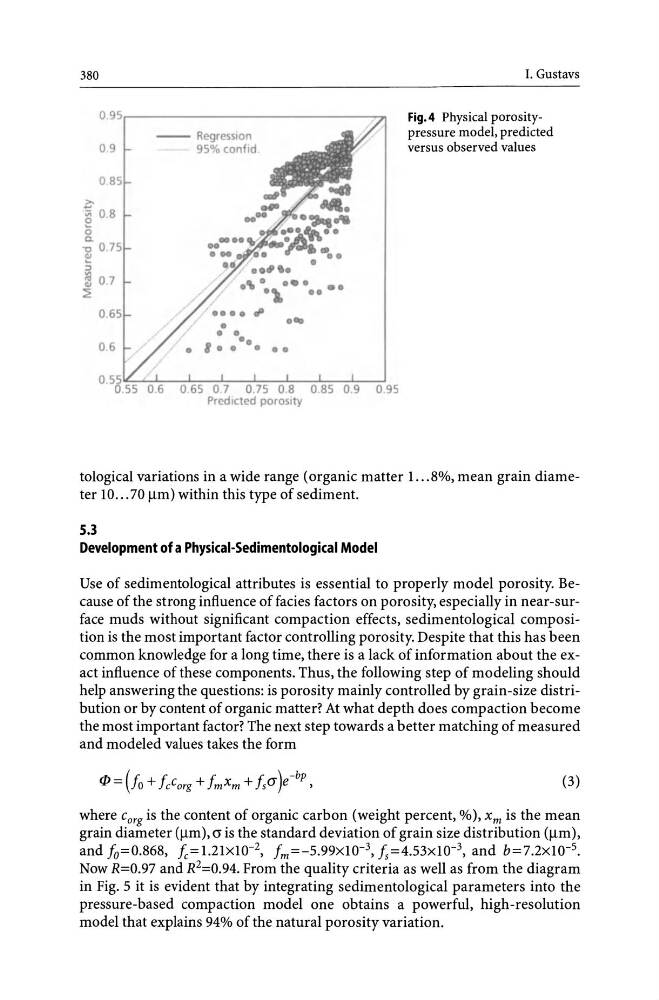
Fig.4 Physical porositypressure model, predicted
versus observed values
tological variations in a wide range (organic matter 1 ... 8%, mean grain diameter 10 ... 70 /lm) within this type of sediment.
5.3
Development of a Physical-Sedimentological Model
Use of sedimentological attributes is essential to properly model porosity. Because of the strong influence of facies factors on porosity, especially in near-surface muds without significant compaction effects, sedimentological composition is the most important factor controlling porosity. Despite that this has been
common knowledge for a long time, there is a lack of information about the exact influence of these components. Thus, the following step of modeling should
help answering the questions: is porosity mainly controlled by grain-size distribution or by content of organic matter? At what depth does compaction become
the most important factor? The next step towards a better matching of measured
and modeled values takes the form
(3)
where c org is the content of organic carbon (weight percent, %), xm is the mean
grain diameter (/lm), (J is the standard deviation of grain size distribution (/lm),
and 10=0.868, !c= 1.21xlO- 2 , Im=-S.99XlO-3, !s=4.S3xlO- 3 , and b=7.2xlO-s.
Now R=0.97 and R 2 =0.94. From the quality criteria as well as from the diagram
in Fig. 5 it is evident that by integrating sedimentological parameters into the
pressure-based compaction model one obtains a powerful, high-resolution
model that explains 94% of the natural porosity variation.
0.9~r--------------~
09
o
-
Regression
95% confid
•
• •
...
. , ...... .
o~~ ~~~~~~~-~~~~~~~~
065 0.7 0.75 0.8 0.85 0.9 0.95
Predicted porOSity
I. Gustavs
Fig.4 Physical porositypressure model, predicted
versus observed values
tological variations in a wide range (organic matter 1 ... 8%, mean grain diameter 10 ... 70 /lm) within this type of sediment.
5.3
Development of a Physical-Sedimentological Model
Use of sedimentological attributes is essential to properly model porosity. Because of the strong influence of facies factors on porosity, especially in near-surface muds without significant compaction effects, sedimentological composition is the most important factor controlling porosity. Despite that this has been
common knowledge for a long time, there is a lack of information about the exact influence of these components. Thus, the following step of modeling should
help answering the questions: is porosity mainly controlled by grain-size distribution or by content of organic matter? At what depth does compaction become
the most important factor? The next step towards a better matching of measured
and modeled values takes the form
(3)
where c org is the content of organic carbon (weight percent, %), xm is the mean
grain diameter (/lm), (J is the standard deviation of grain size distribution (/lm),
and 10=0.868, !c= 1.21xlO- 2 , Im=-S.99XlO-3, !s=4.S3xlO- 3 , and b=7.2xlO-s.
Now R=0.97 and R 2 =0.94. From the quality criteria as well as from the diagram
in Fig. 5 it is evident that by integrating sedimentological parameters into the
pressure-based compaction model one obtains a powerful, high-resolution
model that explains 94% of the natural porosity variation.