

Climate Cycles and Climate Transitions ...
239
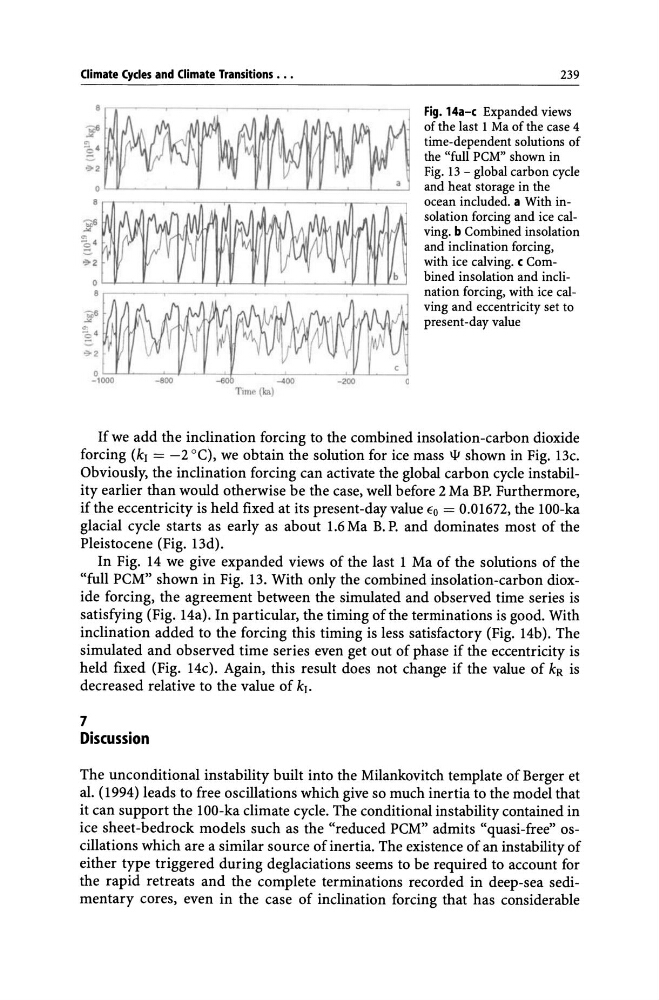
Fig. 14a-c Expanded views
of the last 1 Ma of the case 4
time-dependent solutions of
the "full PCM" shown in
Fig. l3 - global carbon cycle
and heat storage in the
ocean included. a With insolation forcing and ice calving. b Combined insolation
and inclination forcing,
with ice calving. c Combined insolation and inclination forcing, with ice calving and eccentricity set to
present-day value
If we add the inclination forcing to the combined insolation-carbon dioxide
forcing (kJ = -2°C), we obtain the solution for ice mass \11 shown in Fig. 13c.
Obviously, the inclination forcing can activate the global carbon cycle instability earlier than would otherwise be the case, well before 2 Ma BP. Furthermore,
if the eccentricity is held fixed at its present-day value Eo = 0.01672, the 100-ka
glacial cycle starts as early as about 1.6 Ma B. P. and dominates most of the
Pleistocene (Fig. 13d).
In Fig. 14 we give expanded views of the last 1 Ma of the solutions of the
"full PCM" shown in Fig. 13. With only the combined insolation-carbon dioxide forcing, the agreement between the simulated and observed time series is
satisfying (Fig. 14a). In particular, the timing of the terminations is good. With
inclination added to the forcing this timing is less satisfactory (Fig. 14b). The
simulated and observed time series even get out of phase if the eccentricity is
held fixed (Fig. 14c). Again, this result does not change if the value of kR is
decreased relative to the value of kJ•
7
Discussion
The unconditional instability built into the Milankovitch template of Berger et
al. (1994) leads to free oscillations which give so much inertia to the model that
it can support the 100-ka climate cycle. The conditional instability contained in
ice sheet-bedrock models such as the "reduced PCM" admits "quasi-free" oscillations which are a similar source of inertia. The existence of an instability of
either type triggered during deglaciations seems to be required to account for
the rapid retreats and the complete terminations recorded in deep-sea sedimentary cores, even in the case of inclination forcing that has considerable
239
Fig. 14a-c Expanded views
of the last 1 Ma of the case 4
time-dependent solutions of
the "full PCM" shown in
Fig. l3 - global carbon cycle
and heat storage in the
ocean included. a With insolation forcing and ice calving. b Combined insolation
and inclination forcing,
with ice calving. c Combined insolation and inclination forcing, with ice calving and eccentricity set to
present-day value
If we add the inclination forcing to the combined insolation-carbon dioxide
forcing (kJ = -2°C), we obtain the solution for ice mass \11 shown in Fig. 13c.
Obviously, the inclination forcing can activate the global carbon cycle instability earlier than would otherwise be the case, well before 2 Ma BP. Furthermore,
if the eccentricity is held fixed at its present-day value Eo = 0.01672, the 100-ka
glacial cycle starts as early as about 1.6 Ma B. P. and dominates most of the
Pleistocene (Fig. 13d).
In Fig. 14 we give expanded views of the last 1 Ma of the solutions of the
"full PCM" shown in Fig. 13. With only the combined insolation-carbon dioxide forcing, the agreement between the simulated and observed time series is
satisfying (Fig. 14a). In particular, the timing of the terminations is good. With
inclination added to the forcing this timing is less satisfactory (Fig. 14b). The
simulated and observed time series even get out of phase if the eccentricity is
held fixed (Fig. 14c). Again, this result does not change if the value of kR is
decreased relative to the value of kJ•
7
Discussion
The unconditional instability built into the Milankovitch template of Berger et
al. (1994) leads to free oscillations which give so much inertia to the model that
it can support the 100-ka climate cycle. The conditional instability contained in
ice sheet-bedrock models such as the "reduced PCM" admits "quasi-free" oscillations which are a similar source of inertia. The existence of an instability of
either type triggered during deglaciations seems to be required to account for
the rapid retreats and the complete terminations recorded in deep-sea sedimentary cores, even in the case of inclination forcing that has considerable