

228
A. Paul· W. H. Berger
kh = -6.5 K km- I , an increase in h should lead to a decrease in local surface
temperature and a further increase in h. This is the elevation-temperature
feedback. We must add that the non-local effects of an increase in h on surface
temperature can be more complex than captured by Eq. (2) - see, e.g., Barron
(1985); Paul (1996).
We test two simple paramterizations for the effect of changes in orbital inclination on temperature. In the first parameterization, we assume that increases in temperature are directly proportional to increases in orbital inclination, such that I = i, I* = i* and I' = i - i*. In the second parameterization, we
assume that decreases in temperature are proportional to the time the Earth
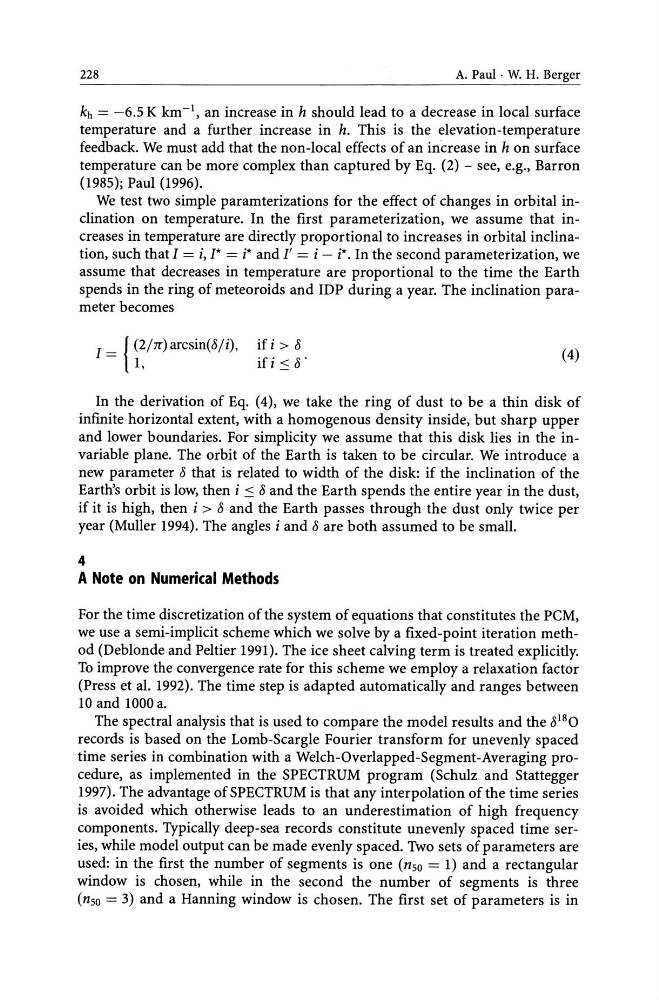
spends in the ring of meteoroids and IDP during a year. The inclination parameter becomes
1= {(2/n)arCSin(8/i),
1,
ifi> 8
if i .::s 8'
(4)
In the derivation of Eq. (4), we take the ring of dust to be a thin disk of
infinite horizontal extent, with a homogenous density inside, but sharp upper
and lower boundaries. For simplicity we assume that this disk lies in the invariable plane. The orbit of the Earth is taken to be circular. We introduce a
new parameter 8 that is related to width of the disk: if the inclination of the
Earth's orbit is low, then i .::s 8 and the Earth spends the entire year in the dust,
if it is high, then i > 8 and the Earth passes through the dust only twice per
year (Muller 1994). The angles i and 8 are both assumed to be small.
4
A Note on Numerical Methods
For the time discretization of the system of equations that constitutes the PCM,
we use a semi-implicit scheme which we solve by a fixed-point iteration method (Deblonde and Peltier 1991). The ice sheet calving term is treated explicitly.
To improve the convergence rate for this scheme we employ a relaxation factor
(Press et al. 1992). The time step is adapted automatically and ranges between
10 and 1000 a.
The spectral analysis that is used to compare the model results and the 8 18 0
records is based on the Lomb-Scargle Fourier transform for unevenly spaced
time series in combination with a Welch-Overlapped-Segment-Averaging procedure, as implemented in the SPECTRUM program (Schulz and Stattegger
1997). The advantage of SPECTRUM is that any interpolation of the time series
is avoided which otherwise leads to an underestimation of high frequency
components. Typically deep-sea records constitute unevenly spaced time series, while model output can be made evenly spaced. Two sets of parameters are
used: in the first the number of segments is one (nso = 1) and a rectangular
window is chosen, while in the second the number of segments is three
(nso = 3) and a Hanning window is chosen. The first set of parameters is in
A. Paul· W. H. Berger
kh = -6.5 K km- I , an increase in h should lead to a decrease in local surface
temperature and a further increase in h. This is the elevation-temperature
feedback. We must add that the non-local effects of an increase in h on surface
temperature can be more complex than captured by Eq. (2) - see, e.g., Barron
(1985); Paul (1996).
We test two simple paramterizations for the effect of changes in orbital inclination on temperature. In the first parameterization, we assume that increases in temperature are directly proportional to increases in orbital inclination, such that I = i, I* = i* and I' = i - i*. In the second parameterization, we
assume that decreases in temperature are proportional to the time the Earth
spends in the ring of meteoroids and IDP during a year. The inclination parameter becomes
1= {(2/n)arCSin(8/i),
1,
ifi> 8
if i .::s 8'
(4)
In the derivation of Eq. (4), we take the ring of dust to be a thin disk of
infinite horizontal extent, with a homogenous density inside, but sharp upper
and lower boundaries. For simplicity we assume that this disk lies in the invariable plane. The orbit of the Earth is taken to be circular. We introduce a
new parameter 8 that is related to width of the disk: if the inclination of the
Earth's orbit is low, then i .::s 8 and the Earth spends the entire year in the dust,
if it is high, then i > 8 and the Earth passes through the dust only twice per
year (Muller 1994). The angles i and 8 are both assumed to be small.
4
A Note on Numerical Methods
For the time discretization of the system of equations that constitutes the PCM,
we use a semi-implicit scheme which we solve by a fixed-point iteration method (Deblonde and Peltier 1991). The ice sheet calving term is treated explicitly.
To improve the convergence rate for this scheme we employ a relaxation factor
(Press et al. 1992). The time step is adapted automatically and ranges between
10 and 1000 a.
The spectral analysis that is used to compare the model results and the 8 18 0
records is based on the Lomb-Scargle Fourier transform for unevenly spaced
time series in combination with a Welch-Overlapped-Segment-Averaging procedure, as implemented in the SPECTRUM program (Schulz and Stattegger
1997). The advantage of SPECTRUM is that any interpolation of the time series
is avoided which otherwise leads to an underestimation of high frequency
components. Typically deep-sea records constitute unevenly spaced time series, while model output can be made evenly spaced. Two sets of parameters are
used: in the first the number of segments is one (nso = 1) and a rectangular
window is chosen, while in the second the number of segments is three
(nso = 3) and a Hanning window is chosen. The first set of parameters is in