

Climate Cycles and Climate Transitions . ..
227
by Saltzman and Verbitsky (l992) for their zero-dimensional model from the
one-dimensional model of Pollard (l982, 1983). A «reduced PCM" is obtained
if the influence of atmospheric CO2 and mean ocean temperature on ice mass
is neglected. It is composed of only two time-dependent equations.
Here we merely give the equation governing total ice mass W,
(1)
and the equation for summer mean temperature T,
T = i + ~(/L - ji) + ke(e - e*) + kljJ(W- ~*) + khh' + kRR' + kIl'o
(2)
/L
We adopt the convention of Saltzman and Verbitsky (l993) and denote the
climatic ground state solely determined by longer-term tectonic processes by a
wavy bar, and a constant representative of the late Pleistocene by a star. The
variables h', R' and l' denote ice sheet height above present sea level, highlatitude summer insolation at ¢o = 65° N and accretion of meteoroids and
IDP, all expressed as departures from the climatic ground state. The coefficients ¢!, ¢2 and ¢3 are rate constants and the coefficients B, ke, kljJ, kh, kR,
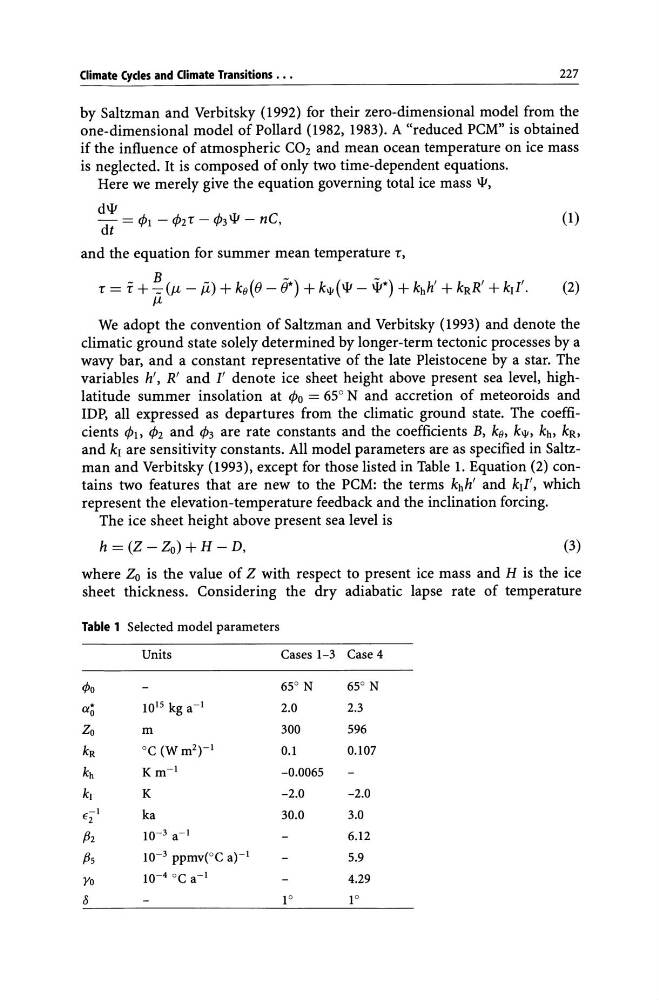
and kI are sensitivity constants. All model parameters are as specified in Saltzman and Verbitsky (l993), except for those listed in Table 1. Equation (2) contains two features that are new to the PCM: the terms khh' and kIl', which
represent the elevation-temperature feedback and the inclination forcing.
The ice sheet height above present sea level is
h = (Z - Zo) + H - D,
(3)
where Zo is the value of Z with respect to present ice mass and H is the ice
sheet thickness. Considering the dry adiabatic lapse rate of temperature
Table 1 Selected model parameters
Units
Cases 1-3 Case 4
1>0
65° N
65° N
a* 0
lOIS kg a-I
2.0
2.3
Zo
m
300
596
kR
°C (Wm2)-1
0.1
0.107
kh
K m-I
-0.0065
kJ
K
-2.0
-2.0
10 2 1
ka
30.0
3.0
fh
10-3 a-I
6.12
f3s
10- 3 ppmv(OC a)-I
5.9
Yo
10-4 °C a-I
4.29
8
1°
1°
227
by Saltzman and Verbitsky (l992) for their zero-dimensional model from the
one-dimensional model of Pollard (l982, 1983). A «reduced PCM" is obtained
if the influence of atmospheric CO2 and mean ocean temperature on ice mass
is neglected. It is composed of only two time-dependent equations.
Here we merely give the equation governing total ice mass W,
(1)
and the equation for summer mean temperature T,
T = i + ~(/L - ji) + ke(e - e*) + kljJ(W- ~*) + khh' + kRR' + kIl'o
(2)
/L
We adopt the convention of Saltzman and Verbitsky (l993) and denote the
climatic ground state solely determined by longer-term tectonic processes by a
wavy bar, and a constant representative of the late Pleistocene by a star. The
variables h', R' and l' denote ice sheet height above present sea level, highlatitude summer insolation at ¢o = 65° N and accretion of meteoroids and
IDP, all expressed as departures from the climatic ground state. The coefficients ¢!, ¢2 and ¢3 are rate constants and the coefficients B, ke, kljJ, kh, kR,
and kI are sensitivity constants. All model parameters are as specified in Saltzman and Verbitsky (l993), except for those listed in Table 1. Equation (2) contains two features that are new to the PCM: the terms khh' and kIl', which
represent the elevation-temperature feedback and the inclination forcing.
The ice sheet height above present sea level is
h = (Z - Zo) + H - D,
(3)
where Zo is the value of Z with respect to present ice mass and H is the ice
sheet thickness. Considering the dry adiabatic lapse rate of temperature
Table 1 Selected model parameters
Units
Cases 1-3 Case 4
1>0
65° N
65° N
a* 0
lOIS kg a-I
2.0
2.3
Zo
m
300
596
kR
°C (Wm2)-1
0.1
0.107
kh
K m-I
-0.0065
kJ
K
-2.0
-2.0
10 2 1
ka
30.0
3.0
fh
10-3 a-I
6.12
f3s
10- 3 ppmv(OC a)-I
5.9
Yo
10-4 °C a-I
4.29
8
1°
1°